Sex, Death and Darwin (I)
Evolving evolution, part VIII—Finding Marlina

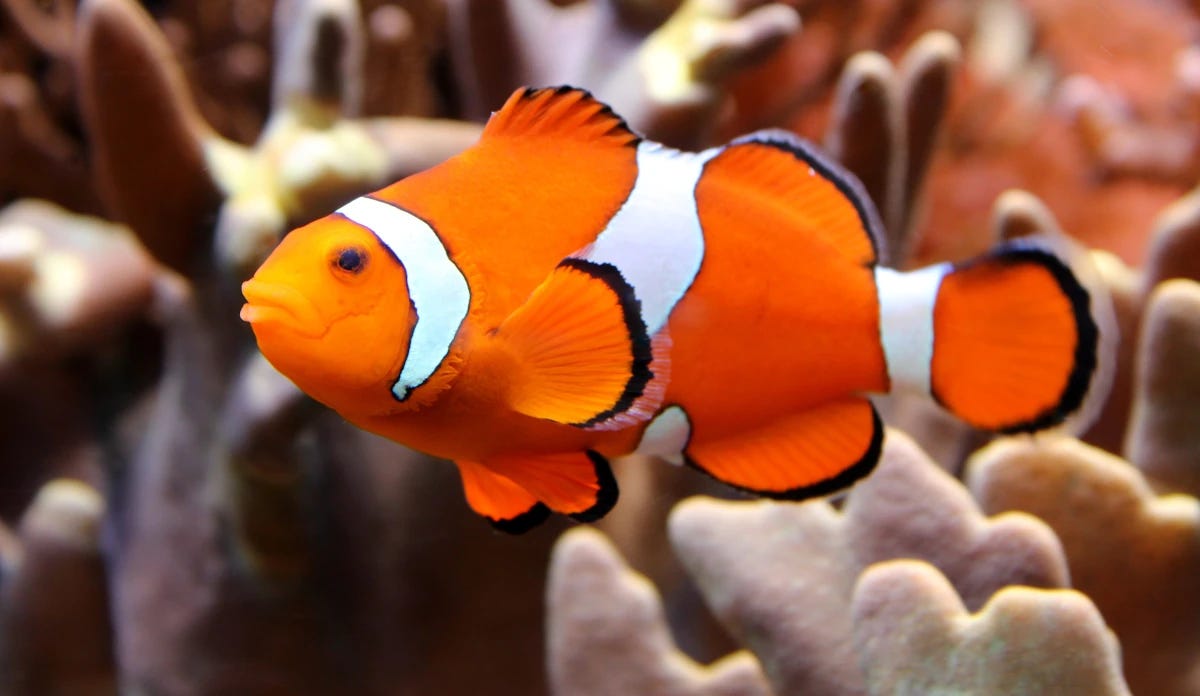

Have you noticed how makers of seriously expensive movies often employ seriously expensive consultants to inform them about the most minute details—and then completely ignore their advice? With my doctor hat on, medical dramas in particular used to pain me, but now I just flinch, look away, and grant them unreasonable artistic licence.1
In 2003, Pixar employed biomechanist and fish expert Adam Summers when developing Finding Nemo. They wanted eyebrows on Marlin and Nemo—to get facial expressions—and he protested, at which point there was some tension along the lines of “You do realise we’re dealing with talking fish here, don’t you?”
He actually did a pretty decent job, and they did listen a lot, removing the kelp from the tropical reef. Subsequently, he’s had more than 100 smallish inaccuracies pointed out to him, including the snipping of the claspers off Bruce the great white shark (voiced by Barry Humphries, aka Dame Edna Everage), but you’ve likely heard the one that sticks. Yep, that one. Had the dominant female clownfish Coral been taken away in real life, Marlin would have transformed into ‘Marlina’, and mated with Nemo once he’d matured.2 Pixar was a little shy of normality here. Following the biology would surely have cost them a lot of money, especially in America.
“To make sure that I played Dory as a believable character, I wanted to remain faithful to the realism of aquatic life. Since I found it difficult to breathe underwater, it was a tough research challenge. But after living with a school of fish for a few months, I discovered that they apparently learned nothing at all in school and had nothing intelligent to say. So we had a lot in common.” —Ellen DeGeneres, who played Dory.
If you hold your breath for the duration of this post, you’ll also find it tough. It’s a long post. Here’s the layout: first we’ll discuss, well, clown sex; then, after a brief digression on the palolo worm, we’ll get down to basics: what even is sex? We’ll wind this right back to the start—several billion years ago; meet organisms with thousands of different sexes; dial it back to just two; clean up (as far as is reasonable) our knowledge of sex determination; and end off with edible frogs. Are you ready?
A threesome!
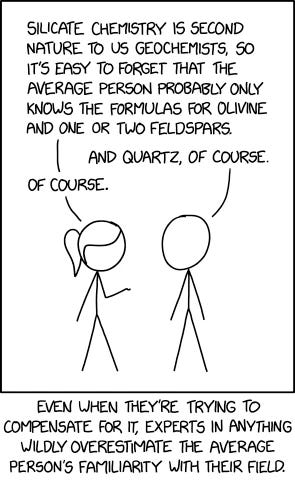
So here’s the thing. I carefully composed what I thought was a moderately long but still readable post, and did a bit of internal peer review. My older daughter quite correctly referred me to the above XKCD comic. She only got one thing wrong—I’m far from expert. I just read too much, and think too hard.
So this is the revised version.3 You now get three posts for the price of one (still entirely free :) If at any point this lot becomes boring, skip to the link at the bottom, where we’ll soon begin in earnest. As earnestly as we can, that is, where sex is the topic of discussion.
Basic positions
Most of us explored topics like mitosis and meiosis when we did biology in school. And let’s face it, most of us were distracted adolescents, more interested in exploring the more practical aspects of the latter—while, of course carefully avoiding actual syngamy and its consequences. If we were sensible.
If any of that was Greek to you, let’s have a quick review of the basics. As an aside we’ll also bone up on the major groups of living organisms.
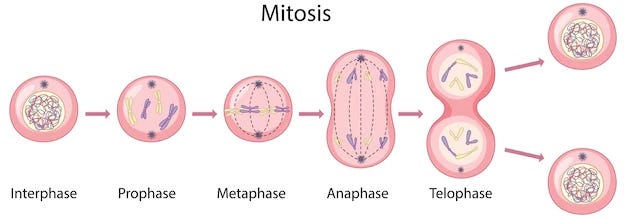
Let’s start with mitosis, because we’ve already done this in my last post.⌘ It usually has nothing to do with sex. When cells divide, mitosis is carefully orchestrated, because getting a single chromosome out of place can be catastrophic.
Mitosis involves turning one cell into two, with each ‘daughter cell’ containing an identical copy of the genetic information in the parent cell. Before mitosis actually kicks off, DNA copies are made,4 in the form of two sister chromatids linked together at a point that is usually a bit off-centre: the centromere. We’ve all seen pictures of that X-shape. Here are the details for you to skim:
In plants, there’s a preprophase that establishes precisely where a cell will divide (and form a dividing cell wall)
Things really kick off with prophase: discrete chromosomes become visible, each made up of sister chromatids still tightly linked at the centromere. A complex structure called the kinetochore attaches to each centromere. A spindle apparatus is setup at opposite ends of the cell, later used to draw the sister chromatids apart. The spindle is made up of microtubules.
During prometaphase, the membrane (‘envelope’) around the cell nucleus breaks up, and microtubules attach to the centromeres of the chromosomes, linking to the kinetochore.
Tension builds now that everything is attached. In metaphase, the chromosomes align in a flat metaphase plate, half way between the opposite poles of the spindles.
During anaphase, links between sister chromatids are severed, and the resulting daughter chromosomes are drawn apart.
Telophase (τελος is Greek for ‘the end’) marks the formation of a new nuclear envelope, and the cells separate.
GeeksForGeeks has a neat summary diagram …
Meiosis
Now, meiosis. It’s all rather complex, so let’s strip down to basics.5 A few terms will become useful …
diploid : a cell with a full complement of paired chromosomes is diploid
haploid : one with half the ‘normal’ complement of chromosomes (half of each pair) is haploid
gametes : these are haploid sex cells that unite (pair up)
zygote : this results from the fusion of two gametes (syngamy is that fusion)
homologous chromosomes : Those pairs of chromosomes that resemble one another and match up are ‘homologues’—the adjective is ‘homologous’.
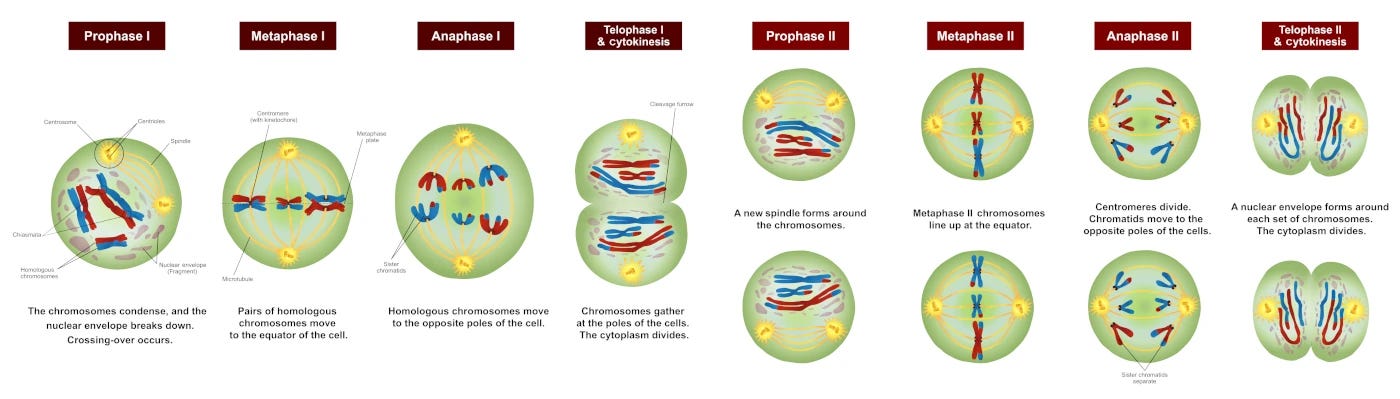
Meiosis then is the way we turn one diploid cell into four haploid ones. From the 1-to-4 plan, you can work out that two divisions are needed, and these are called Meiosis I and Meiosis II. There are two main tricks here:
In metaphase I, rather than just sister chromatids aligning on that flat metaphase plate, homologous chromosomes do the aligning, and are drawn apart during anaphase I. The sister chromatids making up each individual chromosome are still tightly bound, thank you very much.
Prophase II … telophase II works very much like mitosis, but at the end we have haploid cells.
Okay, there’s a third trick, perhaps the most important of all. When those homologous chromosomes pair up, they swap sections of DNA.6 This is the opportunity for homologous chromosomes to get together over a nice cup of tea, one to one, and exchange information. This recombination during ‘prophase I’ is slow, extensive and the gene mixing seems to have huge evolutionary value.
When all is done, sometimes all four cells persist, going on to form sperm, spores or pollen; but with ovum (‘egg’) formation, typically, three of the four will be tossed out. Here’s another neat summary, this time from Wikimedia Commons:

I’ll now digress. But before I do, a little poll. It concerns something very basic: the fundamental types of living organisms. Soo …
As with all such classifications there’s an arbitrary component, so it may be unwise to seek a ‘true’ answer, and even less wise to get angry if others disagree. With this in mind …
Roots
Let’s talk about the much misunderstood and heavily neglected archaea. Like the drunkard looking for his keys under the lamplight (“Because otherwise I wouldn’t be able to see them, D’Oh!”) we tend to see (a) things that are easy to see and, even more, (b) things that we want to see.
In past posts, I’ve mentioned archaea in passing. Let’s learn a bit more about them. The traditional view of archaea is that they are amazing, ‘extremophile’ organisms that thrive in hostile environments that would kill other organisms in the blink of an eye. Some can survive at a pH below zero; others thrive above 100°C; some breed in ice, others in brines that would pickle another organism even before the heavy metals killed it; a substantial part of the biomass of Earth may come from Archaea living in subsurface rock, slowly dividing, and feeding off the products of radioactive decay. Unfairly, Archaea were even lumped together with the Bacteria as ‘prokaryotes’—until we realised that they are as different from them as we are.
In fact, archaea are everywhere. To move on, we need another definition …
outgroup : A clade that is outside the ingroup, but more closely related to the ingroup than any other taxa not included in your analysis.
Oh Dear! We need to start talking cladistics.
Cladistics groups organisms based on theories about their most recent common ancestor. For decades, it has head-butted the study of organisms based on how they look—otherwise known as ‘phenetics’. It didn’t have an auspicious start, as its main originator, fly biologist Willi Hennig came up with it while a prisoner-of-war of the Allies—working for the British anti-malaria services. Some translation from the original German was required.
A clade is a grouping of organisms with a common ancestor. A taxon (plural: taxa) is a more traditional grouping that may also be a clade—but then we have paraphyletic taxa like the Reptiles, which peculiarly excludes mammals and birds, all of which have a shared common ancestor.
With phenetics mostly in retreat, you will now more frequently encounter terms like LUCA—the last universal common ancestor of all living organisms. Similarly LECA is the last eukaryotic common ancestor—that original organism that gave rise to all organisms with a membrane-bound nucleus, the ‘eukaryotes’.
It’s likely that the LECA arose from the symbiosis of an archaeon and intracellular bacteria. This observation has caused rather a lot of controversy about whether eukaryotes are an outgroup of modern archaea, or whether there are just two domains of life: bacteria and archaea.7
_-_02.jpg)
Finally, sex
Traditional biologists are big on classification. They use very precise definitions and distinctions. They define ‘sex’ quite simply: gametes are produced, and two then meet up to form a zygote. That’s it. Which brings us to …
isogamy | anisogamy | oogamy : simply refers to the relative size of the two gametes—if they differ substantially in size, this is anisogamy; if anisogamy involves one gamete being an ovum, this is oogamy. By definition, ‘male’ gametes are smaller, ‘female’ are larger. Practically, most of the time when people are saying the word ‘anisogamy’, they’re referring to oogamy—unless they study algae.
triploid : three sets of homologous chromosomes; four sets gives us tetraploidy.
We now have most of the words we need—and what they mean. English terms like “self-fertilisation” should generally be obvious. Words that come from Latin like ovary, ovum and testis are likely also familiar. We can however thank the Greeks for a lot of irritating science words and horny deities. Certain words like spermatozoon are peculiar hybrids, here from the Latin spermato- (seed) and Greek ζῷον (animal). We’re already familiar with several other strange terms, thanks to our discovery of gynogenesis with the Amazon molly⌘; and haplodiploidy, which we learnt from bees.⌘ We’re nearly done. We just have …
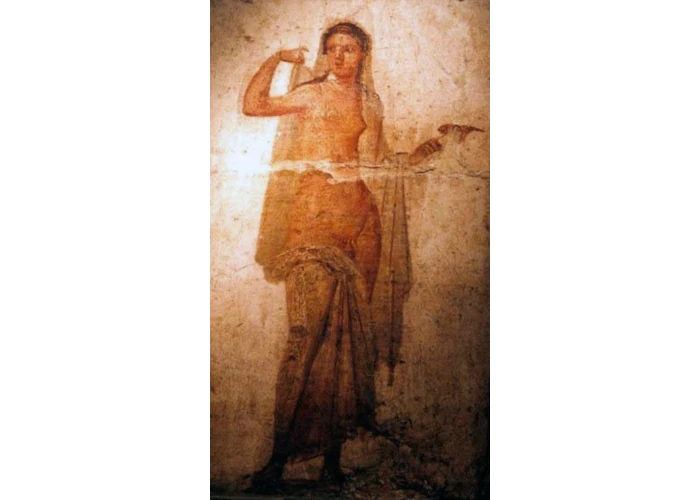
hermaphrodite : capable of producing both male and female gametes. The name comes from Hermaphroditus in Greek mythology, pictured above. Then there’s …
protogynous | protandrous : “Ladies first”, or indeed “Gentlemen first”. The catch is, this is the same individual. We’ll get there.
frogs : frogs are stranger than you think.
But let’s not get ahead of ourselves. We do have to keep some secrets for later: atoke, epitoke, epigamy, kleptons, tetrapolar mating systems, selfing, endopod, Zenker’s organ, hemiclonal hybridogenesis, the gynaecophoric canal, and lifelong copula.
The next section of this post will publish on Monday 1 June, 2026.
The pleasure still awaits us!
My 2c, Dr Jo.
⌘ This symbol is used to indicate posts where I’ve discussed the flagged topic in more detail
Today, The Pitt comes pretty damn close to real Medicine, by the way. Almost as authentic as Quincy, which had a fully-functioning, on-set mass spectrometer. For non-medical films, my favourite meta-cockup comes from The Full Monty, where the purported welder is watching a dance video involving welding, and rants “Too much acetylene is that. Them joints won’t hold f—all.” Spoiler: the video is Flashdance, and the woman is arc welding.
With Marlina perhaps played by Dame Edna?
Okay, it may have grown a bit more. Just a teensy bit :)
During the S phase of interphase.
The significance of meiosis was only picked up by August Weismann in 1890, and it took until 1911 before Thomas Hunt Morgan worked out that crossovers during meiosis explain the way genetic traits are transmitted. The name ‘meiosis’ comes from a Greek word for ‘lessening’, μείωσις.
We’ve already touched on this gene mixing in bees.⌘ The mixing phase is called the ‘leptotene’, followed by closer pairing of homologous chromosomes (the ‘zygotene’) and then the pachytene, where any residual DNA breaks are repaired.
There’s a strong movement towards 2 domains. Many will protest “But Archaea lack a nucleus, of course!” The catch is that archaeal ribosomal proteins unexpectedly have ‘nuclear localisation signals’. In fact, many core nuclear functions seem to be archaeal in origin. There’s still a lot of to-and-fro. In a later post, we’ll visit Asgard.
Oh my! The lies I was told by my biology teachers 60 years ago!
It seems Nick Lane had this largely correct in The Vital Question (2015)