Duck, duck, goose?
Evolving evolution Part VII—Hybrids

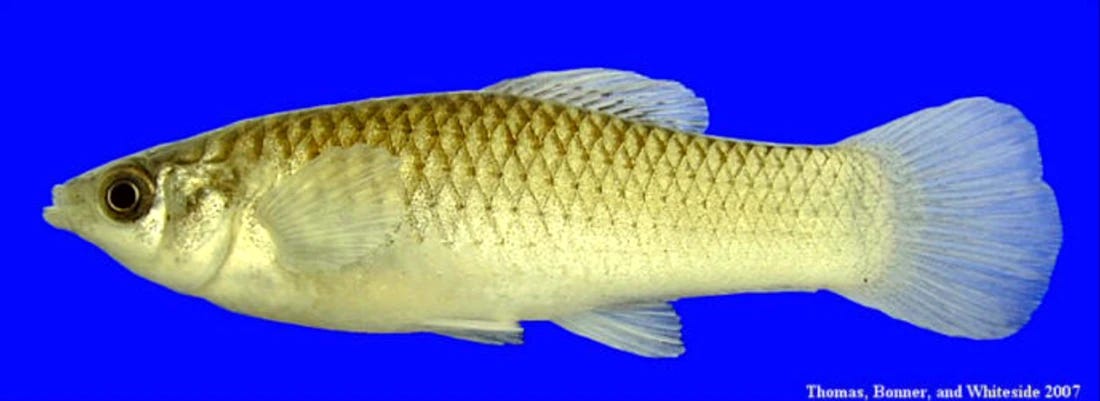

Why the fish? Why this fish? We’ll get there. But first, Darwin again. We already know⌘ that species can gradually or, contra Darwin, occasionally even rapidly⌘ evolve into other species. Rather than being fixed, ‘species’ is more like a marker placed loosely somewhere in the tree of life. But is it even a ‘tree’? Let’s see.
Darwin on Hybrids
The view generally entertained by naturalists is that species, when intercrossed, have been specially endowed with the quality of sterility, in order to prevent the confusion of all organic forms.
Chapter VIII of On the Origin of Species is fairly long, but its objectives are simple. Darwin devotes a fair amount of effort to showing that naturalists’ conclusions about endowment of the ‘quality of sterility’ are an artefact of the authors preconceptions.
We’ll encounter similar phenomena again and again, not confined to the 19th century, nor indeed absent from the 21st. It is a sad truth that there is nobody more dogmatic than someone who pre-decides how the world must work, and then bends everything to fit.
If, for example, only ‘varieties’ can intermingle successfully, then everything that intermingles and produces fertile offspring can safely be categorised as a ‘variety’, right? Darwin describes how Joseph Gottlieb Kölreuter and Karl Friedrich von Gärtner explored hybridisation, with both laying down a universal rule that defines species as being unable to interbreed. Unsurprisingly, they then don’t find species interbreeding.
Darwin first raises methodological concerns (We’d talk about lack of controls, and confounders like inbreeding); he also points out that for some species, these two authors’ conclusions are diametrically opposed. He then cites the example of another researcher, Rev. William Herbert, who shows that some hybrids are perfectly fertile. In fact Crinum capense (C. bulbispermum) x C. revolutum is super fecund! He produces many other examples of very fecund hybrids, even across genera.
And that should more or less be the end of the chapter. But he does go on a bit. He tries to explore in more depth and on page 257 notes:
“No one has been able to point out what kind, or what amount, of difference in any recognisable character is sufficient to prevent two species crossing.”
This was before we understood chromosomes and DNA. So, with the benefit of hindsight, let’s look at these. Darwin is mostly sound, but now we know so much more.
Now, DNA
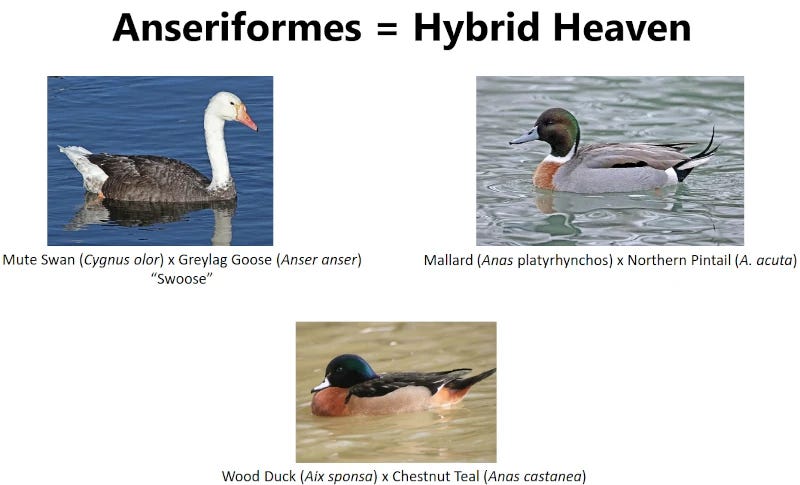
In 1963, Ernst Mayr stated firmly that “the available evidence contradicts the assumption that hybridization plays a major evolutionary role”. At the time, this was wrong about plants, but plausible concerning animals. It now seems that he was pretty darn wrong about animals too. Especially when it comes to waterfowl.
The mallard Anas platyrhynchos is something of a swinger here. It has crossbred with over 30 species; the offspring are often fertile. ‘Brewer’s duck’ is a mallard x gadwall hybrid, once considered a separate species. There can even be 3-species crosses.
The above examples are from a presentation by Jente Ottenburghs, whose area of expertise is hybrids. He makes a compelling argument (based on DNA) that this ‘introgression’ between species is common enough to influence a substantial part of the evolution of ducks and geese.1 So much so, that there is no ‘evolutionary tree’ here; it’s more like a network.
I suppose the inevitable question invited by my title is “Can ducks and geese form hybrids?” If this does occur, it must be incredibly rare. The two lineages diverged over 30 million years ago, and although current evidence suggests that avian introgression makes species boundaries permeable for well over 2 million years ago, this might really be pushing the boat out a bit. We’re fairly comfortable in saying ‘No’.
Dividing cells
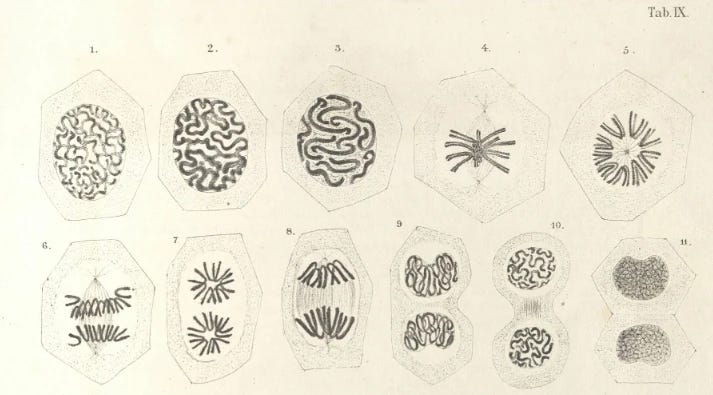
We must remember that Darwin didn’t even know how chromosomes fit in. The normal process cells use to divide only started to be properly understood in about 1875, with the work of three people: Otto Bütschli (animals), Eduard Strasburger (plants) and the little-known Polish scientist Wacław Mayzel, who pre-empted the others by a few months when he looked at how frog skin heals. His elegant drawings are shown above—clearly demonstrating how one cell becomes two.
A few years later, Walther Flemming came up with the glorious word mitosis, apparently from a Greek word (μίτος) that refers to the warp thread of a tapestry. The warp is the vertical yarns that are held stationary as the weft is drawn through them to make the fabric.
There’s some quite careful orchestration here. Or weaving. Actually, mitosis is wildly, baroquely complex. Nobody will think less of you if you now wish to skip to the next section.
Still here? We can mark out several phases. When I did biology, we learnt the catechism “prophase, metaphase, anaphase and telophase”, but current descriptions are more involved, with a preprophase in plants, and a ‘prometaphase’ for the splitters among us.⌘
Multicellular organisms have a multiplicity of chromosomes, which become clearly visible (helped by a suitable stain—the word ‘chromosome’ means ‘coloured body’) as mitosis starts with the prophase. You can pretty much step through this process of arranging and drawing out matching pairs of chromosomes into two new cells, simply by working through Mayzel’s drawings, starting at the top left.
Leading up to prophase, the cell makes a complete copy of each chromosome. When we discussed billionaires seeking immortality,⌘ we already saw the beautiful work of Joe Hin Tjio from 1956, the first person to correctly count the human chromosomes. We learnt that this copying process is a little fraught. Later, when we looked at a glorious animation of DNA reproduction,⌘ where helicase unwinds the DNA, we saw how finicky2 DNA copying is. This is just the start.
In the prophase, shown in Mayzel’s first 3 pictures, the dance of the spindles begins. The cell has also already made a copy of its control structure, the centrosome.3 As we’ve noted, where once there was a chromosome, now there are two, closely associated. Technically, each of the chromosome copies is called a ‘sister chromatid’. We need to draw them apart, to form two nuclei, and two cells.
First, the centrosomes separate, moving to opposite ends of the cell. From these poles, microtubules radiate, and form a massive, temporary scaffold called the mitotic spindle, made up of hundreds of different proteins.
In the next step, metaphase, the nuclear envelope that normally separates the cell nucleus from the cytoplasm breaks up.4 Microtubules from the mitotic spindle then seek out and attach to individual chromatids. And we’re into metaphase!
The chromatids now line up with the equator that separates the two poles of the cell. This imaginary flat plate is the ‘metaphase plate’. Because this is so important, there’s a built in ‘metaphase checkpoint’ where the cell ensures every chromatid is well aligned with its partner on the metaphase plate, so that when they’re pulled apart, each new cell gets its own, correct complement.5 Look back at Mayzel’s drawings. Can you see metaphase?
Anaphase is a drawing apart. First, ties that link daughter chromatids are broken.6 Now, something remarkable happens: tiny protein motors pull the daughter chromatids apart.7 Then the centrosomes are separated even more emphatically by the actions of specific microtubules (interpolar and astral microtubules) and the activity of more motor proteins. Can you spot the anaphase in Mayzel’s pictures?
Finally, we have telophase, a cleanup where things go back to normal in each of the two new cells. Provided, that is, everything went according to the rules. A new nuclear envelope forms, and the normal business of protein transcription resumes. Whew!
I’m sure Darwin would have been fascinated by the above details. Meiosis on the other hand would have blown his mind. I think we’ll keep meiosis for my next post :)
If we’re looking for a principle …
Then it might be something along these lines:
Nanny Ogg would try anything once. Some things she’d try several thousand times. — Terry Pratchett, Witches Abroad.
Nature resembles Nanny Ogg. If natural selection can find a shoe that fits, it will wear it. We can even broaden this to determine that if you can reasonably come up with a plausible scenario, it may well be out there in Nature. And some of the scenarios we encounter at first seem quite outrageously implausible. Glass slippers may not be totally out of bounds!
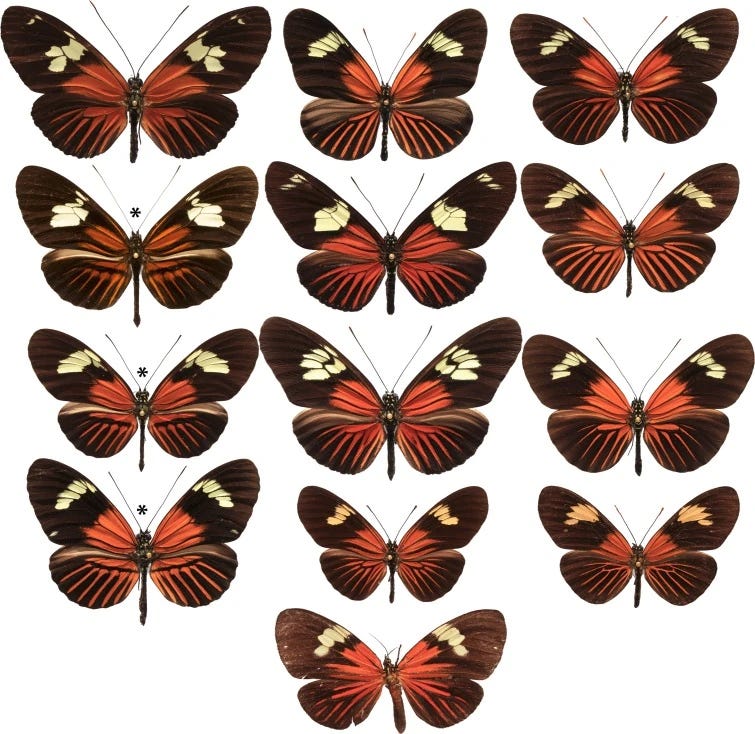
Our exploration above has cast extra doubt on the concept of species as much more than a bookmark. Introgression may be uncommon, but that belies its importance. For example, in Heliconiid butterflies, genetic sequencing by the Heliconius Genome Consortium shows that three species (Heliconius melpomene, H. timareta and H. elevatus) have promiscuously shared genes, especially the genes that control their protective colour patterns. In the picture of multiple species above, H. timareta is in the second row on the left, and H. melpomene is below it.8 Things can get very weird.
Take that molly
The Amazon molly pictured at the start of my post doesn’t come from the Amazon river, as you might expect. Instead, she is found in northeastern Mexico and parts of Texas. The ‘Amazon’ reference is a tribute to its unusual female-dominant mode of reproduction. We call it gynogenesis.
Poecilia formosa is, you see, a hybrid.9 About half a million generations ago, a male sailfin molly (P. latipinna) and a female Atlantic molly (P. mexicana) got together, and had a very special daughter. Her remarkable reproductive method has been passed on through the generations.
In order to breed, the Amazon molly needs to mate with a male from one of four different species: P. latipinna, P. mexicana, P. latipunctata, or even P. sphenops. Once a sperm from the male has primed the ovum, the male genetic material is all discarded, and the cells that go on to make the female of the next generation contain only their mother’s chromosomes and DNA.
The very existence of the Amazon molly challenges a lot of preconceived dogma about sex. Those fixated on the importance of sexual reproduction tell us that asexual species should accumulate mutations, and go extinct.10 A recent paper in Nature confirms that P. formosa has accumulated mutations faster than its parent species, but this doesn’t seem to have harmed the fish.
Again and again, we’ll discover that our assumptions—preconceptions—are wrong. This particularly applies to sex, so let’s transiently diverge from Darwin for my next post. ⇶ We’ll look at sex across the board, and how remarkably inventive natural selection has been over the billions of years that sex has been around.
My 2c, Dr Jo.
⌘ This symbol is used to indicate posts where I’ve discussed the flagged topic in more detail.
Where we pick up DNA evidence of hybridisation with an extinct species, this is termed “ghost introgression”.
In keeping with our Darwinian theme, the Oxford English Dictionary informs us that ‘finicky’ refers to a variety of pigeon :)
Although this is a Lie to Children,⌘ it’s really all about microtubules, and plants don’t actually have centrosomes.
Except in some organisms, like fungi and algae.
Microtubules attach to the kinetochore of each chromatid. Improper separation will lead to aneuploidy. We’ve extensively studied the ‘spindle assembly checkpoint’ that regulates the checking for tardy chromosomes that are late in getting into position.
This too is rather complex. After sister chromatids have been made, they are linked by a protein called cohesin, discovered in 1997. When the cell is ready, another protein, securin is tagged for destruction (ubiquitination happens, courtesy of the anaphase promoting complex). With securin gone, the enzyme separase is released, and it breaks the link.
Kinetochores exert pulling forces. The kinetochore assembles at the centromere that links two sister chromatids. Even this is a Lie to Children, as in nematodes, the kinetochore extends for the length of the chromosome. The motor proteins that generate the pulling force include dynein and kinesin.
These butterflies taste foul, and use Müllerian mimicry to share the cost of warning predators. Chetone phyleis, the moth at the bottom of the picture, is also unpalatable, part of the Müllerian ring.
The specific name ‘formosa’ means beautiful. And indeed, this Amazon is sought after by the males of similar species.
But why then should mitochondria survive? They reproduce clonally too.
Back in 1971, on our college smallholding, we had a brown bantam hen that had her wicked way (or perhaps the other way round) with a wild pheasant - two different bird species. We let her hatch the chicks, which turned out to be little bantams with glorious plumage (nicknamed phantoms) - 2 male, 2 female. We separated them from the rest of the flock and let nature take its course (nature doesn't care about incest). Only one hen produced fertile eggs and her clutch of eggs produced a huge white female, a tiny black male and two female phantoms. DNA be weird.