Nipah
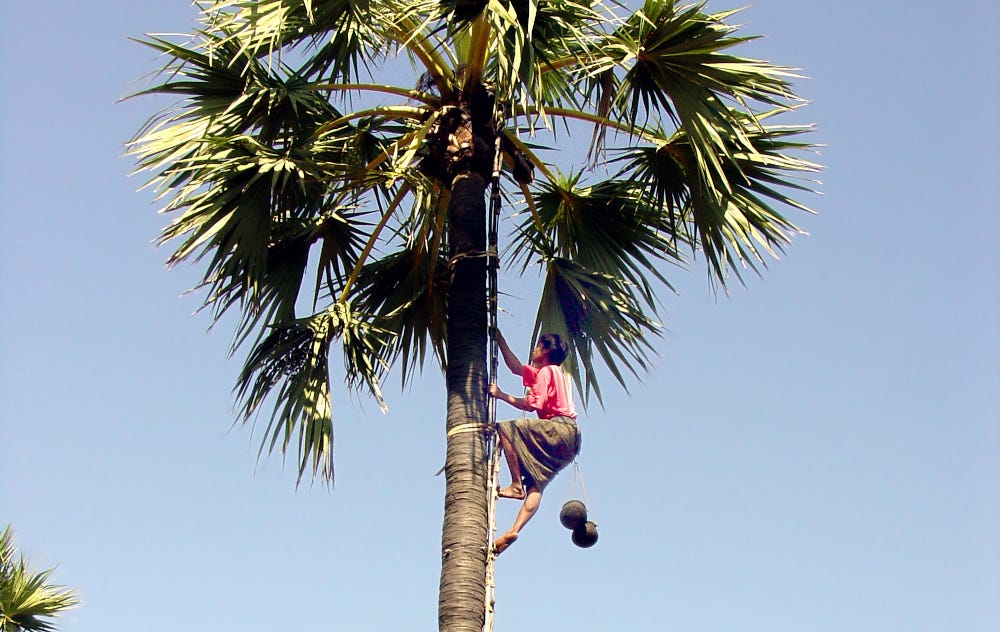
(Palm toddy, anybody?)


There’s likely little reason to worry about Nipah virus infection, based on one simple fact. The R0 of Nipah virus is currently under 1.0.
Which is just as well. If we take all of the cases ever identified, well over half of them died. Death is usually due to brain inflammation (encephalitis).1 One quarter of the survivors have severe, irreversible brain damage. Human-to-human spread is well documented.
There’s now been an outbreak in India’s West Bengal state. Health care professionals are infected. Currently we believe the virus is spread by close contact, but we’re not sure.2
What exactly is Nipah?
With viruses, some long names and fine details are unavoidable if you want to understand them properly. Along with measles, mumps and human parainfluenza virus, Nipah virus is one of the Paramyxoviruses, named because they bind to mucins (Greek ‘muxa’, slime).
These are negative stranded RNA viruses—messenger RNA made directly from the viral strand enters the host’s protein factories which form viral proteins.
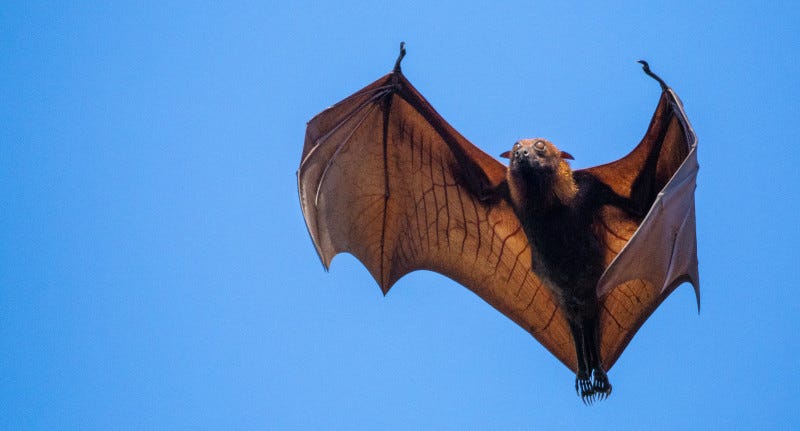
And of course it’s the bloody bats again. Specifically flying foxes like the Malayan flying fox (Pteropus vampyrus) pictured above,3 which simply love to drink palm sap, as do humans. We harvest the stuff in large amounts, and if a flying fox has left some of its viruses in the raw sap, well then.

Let’s be frank here. The virus gets into the palm sap from bat spit, bat urine, or poo. Ugh. Soon after collection, the palm sap starts fermenting, to form ‘palm toddy’, tari or palm wine. Transmission from palm toddy is well documented.4 Bats can also transmit the virus to pigs. Don’t hug your sick pig.
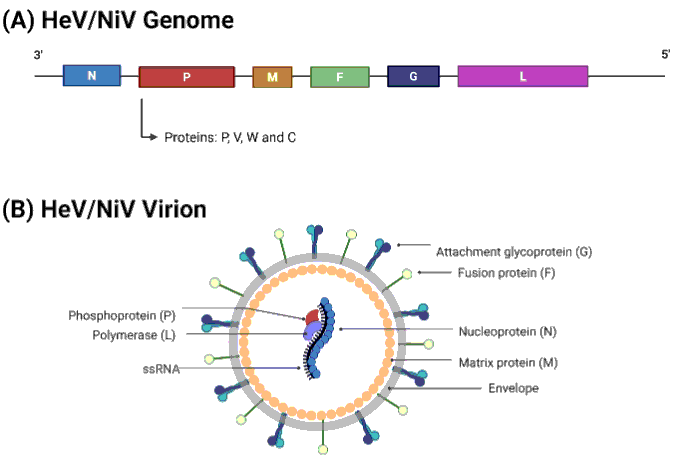
Like most other RNA viruses, Nipah is small (although a bit bigger than ‘flu). It has just six genes, but as with many viruses, some trickery is involved. Those six genes (N, P, M, F, G and L) produce six proteins, but through various mechanisms, three additional proteins are made: V, W and C. Together with P, these mess with your immune response, giving the virus more of a foothold.5
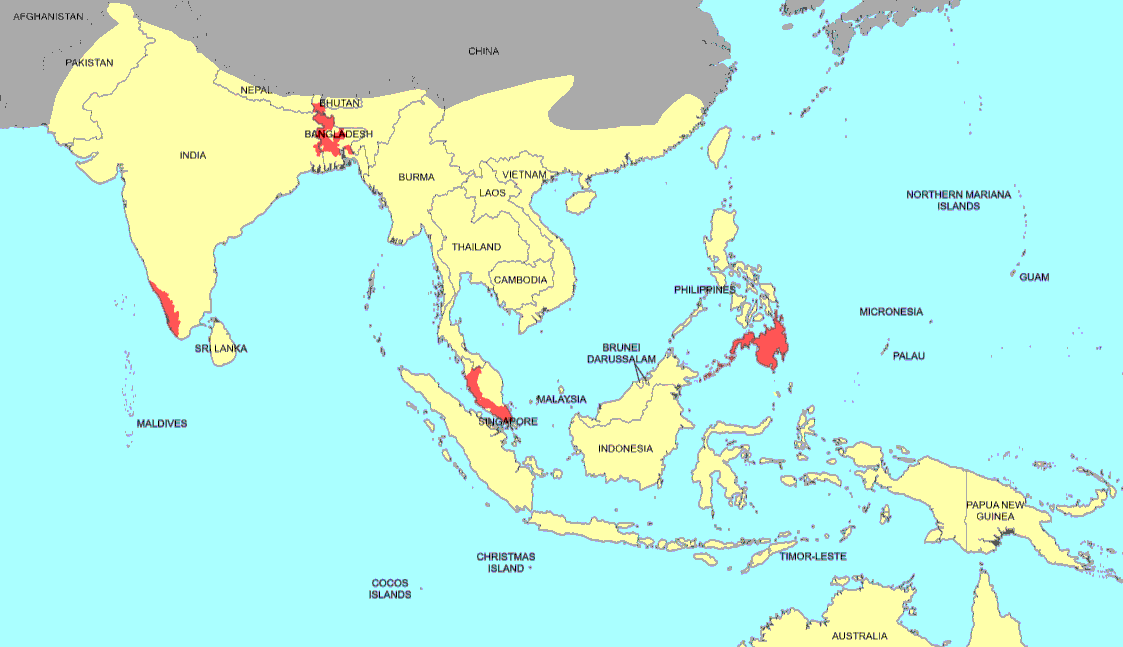
Fruitbats are found in the yellow area in the map below; red indicates Nipah outbreaks.
Why we shouldn’t worry ...
I’ve talked about the basic reproduction number (R0) before.⌘ It’s on average how many others you will infect if you acquire a specific virus.
If the R0 is under 1, then the virus will infect fewer and fewer people as it moves on. Eventually, it will die out. And our estimates of the R0 of Nipah are about 0.5. If ten people are infected, they will infect 5, on average. and those five will go on to infect just 2 or 3. And so on. Not a problem, overall.
… yet!
SARS-CoV-2, the cause of COVID-19, likely killed well over 20 million people worldwide, but these were only about 0.5% of those infected. Can you imagine what Nipah would do if it had an R0 similar to that of SARS-CoV-2?
The interesting thing with SARS-CoV-2 is that it progressively increased its R0 as it spread. Initially, it’s likely that the value was about 2–3; With delta, this likely rose to about 5; and when omicron popped up, it almost certainly had an R0 of over 10.
The R0 is a bit of a fiction, actually, because so much depends on circumstances. We often prefer to talk of the Reff, which refers to effective transmission. For example, if measures are in place to prevent spread, such as isolation and using effective masks properly, then we can cut the Reff right down. If there’s an effective vaccine, this can have a dramatic effect.
But we simply don’t know whether at some point Nipah virus will mutate and change its behaviour. Nipah binds to the ephrin-B2/B3 receptors6 using its G protein. It’s reasonable to speculate that one or a few point mutations might change the binding affinity and turn the virus into a monster that rampages across the globe. Or this could happen in its Henipavirus relatives.7
But I’d guess not. It is however pretty certain that at some point our burgeoning human population will bump into a virus that will kill a lot of us; we just don’t know whether this will happen next year, or in a thousand years’ time.
What we do know is that cutting back on surveillance, and slashing public health spending will set us up for just such a scenario. The big worry is the virus that we don’t get onto promptly. The first Nipah outbreak was pretty fraught.
Sadly, in our current environment
… it seems likely that even if we have a massive pandemic involving a virus with a high R0 and a massive infection fatality rate, enough people will go into conspiracy theorist denial mode for the damn thing to run rampant. We’re starting to develop vaccines to Nipah, but can you imagine how some people8 would receive them?
We’ve talked about this lot before.⌘
My 2c, Dr Jo.
⌘ This symbol is used to indicate posts where I’ve discussed the flagged topic in more detail.
Although quite a number get severe lung damage too.
As scientists we were far too conservative and made unreasonable assumptions about how SARS-CoV-2 spread. We were wrong about aerosols.
In predominantly Muslim Bangladesh, producing or using tari is technically illegal.
G attaches, F is for fusion, N is the nucleocapsid that gives the virus its helical structure, L is the ‘large’ RNA-dependent RNA polymerase that the virus uses to make copies of itself, and P is a phosphoprotein that helps anchor the P to N. M is the vital matrix protein that coordinates budding of the virus from specific sites on the plasma membrane of the host cell.
Transmembrane receptors that are also tyrosine kinases; they are important in development of the nervous system, blood vessels and also blood itself.
There is a bunch of related Parahenipaviruses: Hendra virus has killed a few; Cedar, Ghana and Angavokely viruses seem non-pathogenic; Langya virus causes human infections but hasn’t killed anyone that we know of; Mojiang virus may have killed 3 people so far. Some people swab bat anuses for fun.
Just wait for the outcry when they discover that yes, we’ve been researching Nipah virus mutations, and mutations of the ephrin-B2 receptor.
I am minded of Laurie Garrett's "The Coming Plague: Newly Emerging Diseases in a World Out of Balance." and 'Betrayal of Trust: The Collapse of Global Public Health ," published 31 and 26 years ago, respectively. I bet even she did not see what has happened in the US coming, though.