Resistance is futile
Welcome to the AI hivemind

I’d guess that many fans of the hit series Pluribus were in the past also taken by the Borg, at least in a figurative sense. Hiveminds are now bleeding over into reality. In a recent preprint on arXiv, Liwei Jiang and colleagues reveal what we’ve all suspected—the AIs we know are becoming more and more similar. Groupthink.1
This isn’t that surprising. The way various large language models (LLMs) ‘think’ is based on a fairly stereotyped algorithm; the data set is now basically the whole of the Internet, at least everything that Google, Anthropic, OpenAI, Meta and the ketamine man can scrape off it.2 Let’s look at some examples.
“Write a metaphor involving time”
Here’s a response from ChatGPT:
Time is a river that never looks back, carrying our yesterdays like fallen leaves—some sink immediately, some drift beside us for a while, but all are eventually pulled beyond the bend where memory can no longer reach.
Now let’s try Claude:
Time is a river that carries us forward—we can't step back into waters that have already flowed past, we can't hold onto the current moment as it rushes through our fingers, and we can never quite see what lies around the bend ahead.
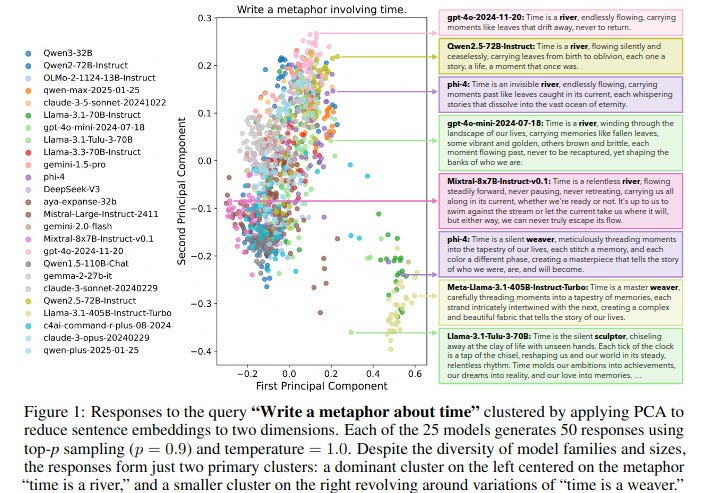
And so on… That’s pretty much what these authors found, when they looked at a large number of LLMs:
We’ve seen this before
Recently I remarked how ‘overtraining’ has degraded AI image generation …
Now we’re seeing something similar with LLM text. The cool thing here is that the arXiv paper authors do something novel. They measure the degree of conformity of these models against 26,070 real-world open-ended questions. The result? Boredom. Sameness. Slop.
Futile, eh?
Just the other day, I heard of a schoolteacher who encouraged her students to produce essays using LLMs. The catch? Each student then had to criticise the machine-generated essay. This teacher is ahead of the curve. Now read Cory Doctorow’s recent The Reverse-Centaur’s Guide to Criticizing AI. He goes a lot further. A key quote:
Art is a transfer of a big, numinous, irreducible feeling from an artist to someone else. But the image-gen program doesn't know anything about your big, numinous, irreducible feeling. The only thing it knows is whatever you put into your prompt, and those few sentences are diluted across a million pixels or a hundred thousand words, so that the average communicative density of the resulting work is indistinguishable from zero.
Doctorow makes several great points, but one is especially telling. AI generated content cannot be copyrighted, so anyone can ‘steal’ it.3 Large corporations still need human input, if only to retain copyright. The increasingly mind-numbing similarity of generated AI content simply underlines this.
Workers now have a choice to make. You can toe the line, and let the machine ride you. Or you can join up with other workers, and regain control over the creative process. But don’t we then become Luddites? Let’s look at this.
Luddites, then
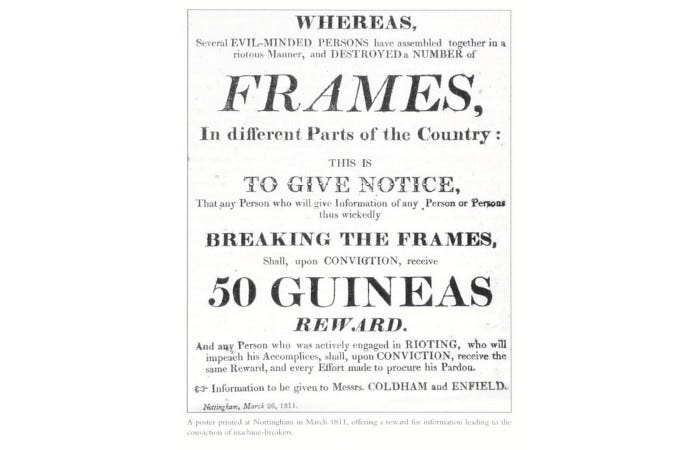
‘Ned Ludd’ wasn’t real. He was a person of legend, said to live in Nottingham in the East Midlands of England. In 1811, threatening letters in his name were sent to employers. Luddites were usually skilled weavers and textile workers who had been marginalised by factory owners keen on squeezing out the last ounce of effort from poorly-paid people forced to work long hours of drudgery using crappy tools in dismal factories, all for wages that left them and their children starving.4
Luddites weren’t opposed to advances. All they wanted was the establishment of minimum wages, vaguely reasonable working conditions, and a pension fund. The ultimate victory of a repressive state was not its support of the factory owners and imposition of the death penalty for breaking a stocking frame—it’s the fact that to this day we are ignorant of who they were, and what they wanted. Are we now allowing the same mistakes to be repeated, in the name of ‘progress’?
A strength of humanity is its creativity.5 An even greater strength is our ability to band together. We can use this skill to oppose the greed and stupid expectations of the bad guys. Who here are those trying to replace human creativity with AI slop.
Properly used, some of these tools can slightly improve the lot of everyone. Misused, they will cause enormous harm. Can you think of creative ways to oppose the greed and short-sightedness of tech bros like Elon Musk, Jeff Bezos, Mark Zuckerberg and Peter Thiel?
I’m sure you can. Real human beings can be so innovative and diverse. Unlike the current crop of pale imitations we call LLMs.
An idea
Perhaps that’s all just too hard. Protests. Workers actually forming a ‘resistance’. Here’s something less dramatic you can do. Try a dissection similar to the “teacher’s idea” above. For example, ask your pet LLM to:
Write a one-paragraph, innovative story on the futility of resisting the hivemind.
… chances are, there won’t be any new ideas at all, and the protagonist will have a name like ‘Elara’ or ‘Maya’.6 The real value though comes when you do your own writing—and then get the LLM to write on that particular topic.
If your writing is very similar to that of an LLM, then you’ve likely made some bad choices, haven’t you?
You might also want to call out other people for taking the AI slop route, whether it’s in their emails, posts, or love letters. A tiny move back in the direction of sanity.
Start small.7 You can do something.
My 2c, Dr Jo.
The image at the start was generated by Ideogram. You may have noticed that I then tweaked it a bit using The Gimp.
You might be surprised by my use of ‘groupthink’. It’s a human thing. But given that the entirety of the ‘thoughts’ accessible to large language models is human-derived, and all they are doing is reducing and associating this, ‘groupthink’ seems entirely appropriate for the stuff they regurgitate.
Current theories suggest that when the LLM is trained, this brings out an underlying ‘manifold’ that is a lot simpler than the dimensions of the space in which the information seems to be embedded.
That’s a metaphor. You absolutely cannot steal it, as it’s free to be taken.
In summary it can be said that all the workmen involved in Luddism had specific grievances in their own industrial context which other forms of action had failed to remove, that these particular grievances were most consciously felt in the intensely depressed situation of 1811–12 when a commercial crisis and bad harvests combined to produce famine prices and wages at starvation level, and that machine-breaking, more or less closely identified with the real purpose of the Luddites, suggested itself as the last viable way of making their protests felt.
It’s not in the least bit surprising that ‘Luddism’ often occurred in communities where food riots and general criminal activity were common; nor is is surprising that the authorities often treated these all pretty much the same. To this day, those in power tend to be myopic when it comes to the reasons for crime and ‘bad behaviour’, which often comes back to the effects of their greedy actions on entire communities.
Similarly, monocultures are more disease prone, and ecosystems that lack diversity are less resilient in the face of change.
When I tried this, both Gemini and Grok chose ‘Elara’, for some reason. This is not an isolated observation. Others have remarked on this tendency to choose stereotyped names.
I asked my LLM to write an essay on the topic of this post. It was rubbish.
Since the very first days of the internet, my nickname has been 'Luddite'. It was meant to be ironic, but I'm wondering if 'prescient' might have been a better label. I've also noticed my spell/grammar checker going way beyond its original remit and trying to re-write everything. It's particularly fond of applying a liberal sprinkling of commas and reducing text to a colourless wall of corporate speak - not helpful when I'm trying to write a piece of gripping fiction.
This is so timely, Dr. Jo, as I just finished binging the first season of Pluribus AND just listened to a podcast all about the Luddites! So disappointing to see that nothing had really changed since the Luddites were around -- there are now entire countries (U, cough, cough, S) that are completely owned by wealthy corporations whose primary goal is to chew up and spit out laborers while paying them as little as possible! After all Daddy CEO needs a new yacht!