Sex, Death and Darwin (II)
Evolving evolution, part VIIIb—Clown Sex

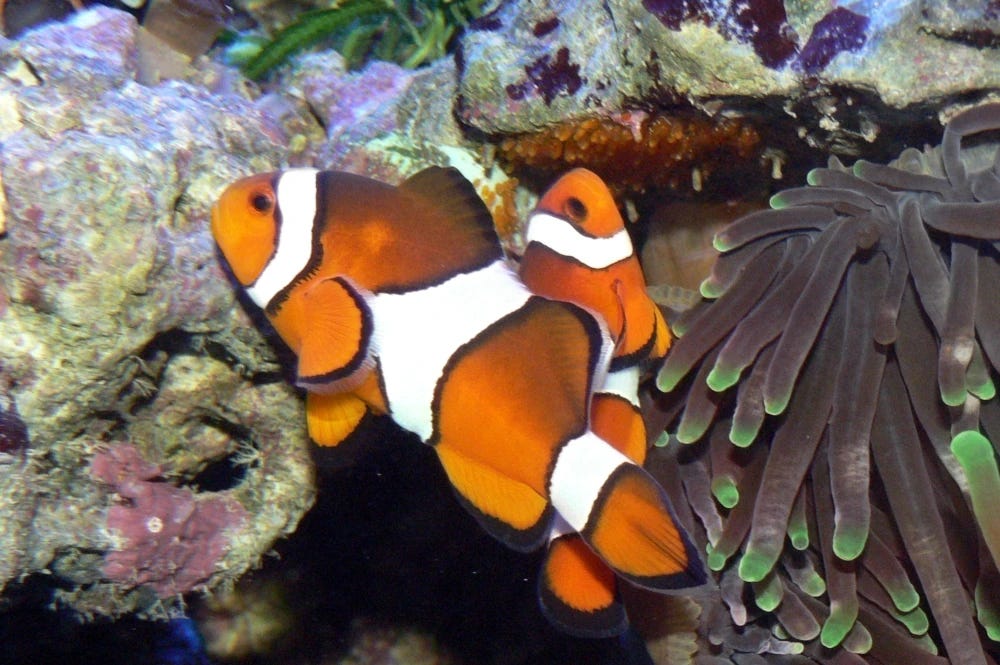
If you’ve stumbled on this post and at any point start feeling a bit lost, You may first wish to read the previous one, which revises the basics. We also found Marlina there. Sort of.
Protandrous sequential hermaphroditism
Our Nemo excursion invites exploration of clownfish sex. Clownfish are hermaphrodites, with both ovarian and testicular tissue in their gonads—they change sex (and behaviour) in response to their dominance in the hierarchy, with a female at the top, a male below her, and others forced to simply spectate (non-breeding status) until they attain the right size and status. The smaller male looks after the clutch of eggs.
As we discovered with bees,⌘ there are evolutionary challenges and solutions to having non-breeders. Here, we have the added feature of a queue, which is neither broken nor contested!
Sequential hermaphroditism is common in fish,1 gastropods and plants: it’s built in. This may be protandrous (start as male, transition to female), protogynous (the reverse), or bidirectional. It is also found in crustaceans like the ecologically important ‘northern prawn’ Pandalus borealis as well as some isopods and tanaids; starfish like the starlet cushion star Asterina gibbosa, and certain marine annelids. Which brings us to all of the fun sex experienced by polychaete worms. Sex, and death.
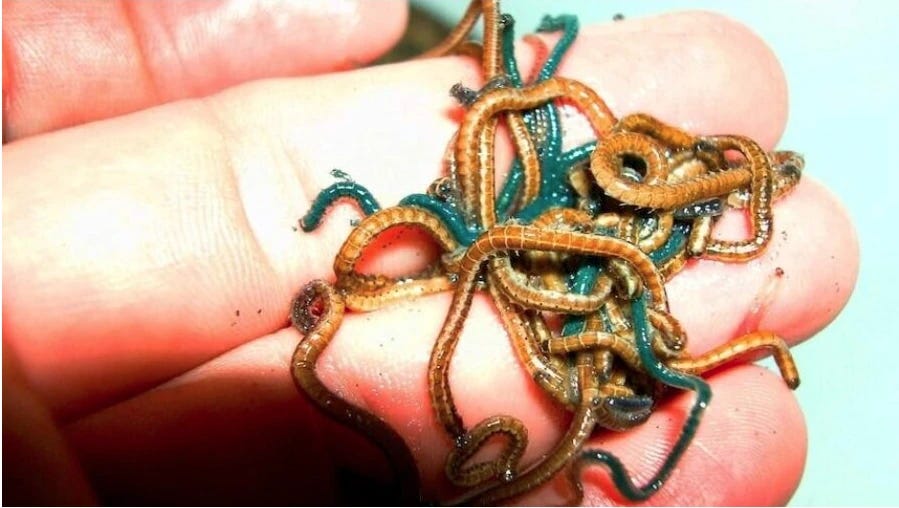
Polychaete sex
Bristle worms are marine organisms related to earthworms (annelids) with a pair of fleshy parapodia protruding from each segment. Most have separate sexes, shedding their immature sex cells (gametes) directly into their body cavity, and releasing mature gametes either through openings or by rupturing and dying. Gametes meet, larvae form, and turn into adults. Seems boring, right?
Not so fast! Ophryotrocha species display all major approaches to sex: sequential or simultaneous hermaphroditism, or gonochorism (distinct, fixed male and female sexes). Simultaneous hermaphroditism is likely their ancestral way2 so, to prevent self-fertilisation, polychaete worms like O. diadema form up in pairs, with a long courtship that culminates in pseudocopulation. Larger females favour smaller males, but because they invest more energy in female functions, after repeated simultaneous discharge of eggs and sperm, the females tire and then switch to the less costly male role; males that can’t find a mate tend to become hermaphrodite and function as females. Their sexuality is perhaps best described as ‘plastic’.
Some polychaetes are even more exotic. Take epitoky, epitomised by the palolo worms pictured above. As the breeding season approaches, the worm divides into two—an asexual atoke, and a sexy-as-hell epitoke, full of eggs or sperm. With the coming of a waning moon in early summer, millions of worms indulge in a death orgy.3 The epitokes split off, float to the surface and burst.
There are variants. With epigamy, the entire worm transforms and swims to the surface. Some species can fragment, with each fragment forming a new worm. In another mating ritual, Platynereis dumerilii rises to the surface a few days after the full moon; the female swims in small circles and the male swims around her, culminating in release of gametes. Polychaetes have likely been doing this for hundreds of millions of years, but let’s wind back the clock even further.
What is sex?
You’ll recall the simple definition of sex I introduced in the preceding post: gametes are made, meet, and form a zygote. I’d suggest that this fundamentally misses the mark in two ways: both at the ‘lower level’ of exchange of genetic information, and at the top end, where all sorts of secondary consequences result from the evolutionary benefits of this exchange. As we’ve noted repeatedly in the past,⌘ all of our theories are provisional; rather than confirmation, we should therefore seek refutation.
Clearly we can’t go back to observe the original archaea and bacteria several billion years ago. But we can watch what they do now. We can, for example, see archaea mating.
Biologists will hasten to inform you, like Bill Clinton, that this isn’t sex. But archaea do mate—they transfer segments of DNA. It’s likely that the LECA—the last eukaryotic common ancestor—had many features we would recognise today: a centriole, cilia, mitochondria, dormant cysts, and peroxisomes.
It also seems increasingly likely that meiosis arose before the LECA. A 2022 paper in Nature Communications shows that archaea have fusexin analogues that closely resemble the fusion proteins used by eukaryotic gametes. It may seem a mite pedantic to say “Archaea mate and have fusexins” and then in the next breath to assert categorically that “Sex is absent from archaea”.
The preceding paragraph will make some biologists grumpy. Several of them even question using the term ‘species’ for something as ‘asexual’ as the archaea. But since we established that ‘species’ are best seen as convenient bookmarks,⌘ and that even the ‘tree of life’ is sometimes better characterised as a network (as with ducks⌘), we should be more comfortable with ‘archaeal species’ and with a more liberal characterisation of archaeal mating.4
Now let’s talk about the fusion of gametes.
Isogamy
It’s likely that originally, all gametes looked the same: ‘isogamy’. It’s the rule among unicellular organisms. This similarity however hides something very important: there can be different ‘mating types’.
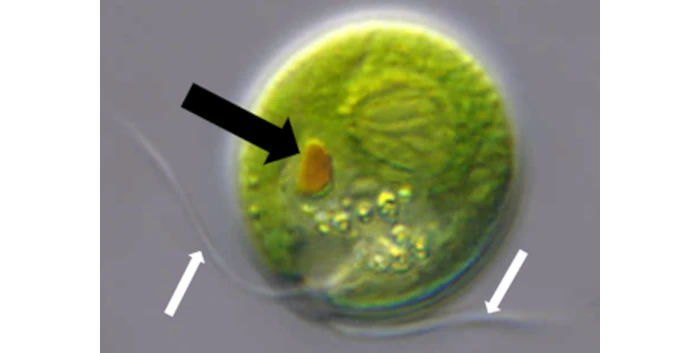
For example, Chlamydomonas, the single-celled green alga shown above, the darling of wonder-struck biologists, is normally haploid. When you starve it, sex happens: the ‘vegetative’ cells, usually content to swim around waving their flagella, photosynthesising and guzzling a few organic compounds, differentiate into gametes that are the same size, but have two distinct ‘mating types’.
Because biologists by definition reserve ‘male’ and ‘female’ for the case where gametes are different-sized, these are referred to as ‘mt+’ and ‘mt–’ instead. Two complementary types fuse to form an immotile zygote, which lies dormant. When things improve, the zygote undergoes meiosis, releasing four haploid cells that go about their business.
Chlamydomonas already seems to give us a few clues about where sex came from, doesn’t it? But it also tells us something about biologists: they they may be just a little fixated on appearances. Surely the key thing about + and – forms is that they have functional implications. As we shall soon discover.5

_(33389628036).jpg)
Sexes by the thousands
There’s a peculiar problem here. If you’re isogamous and adopt + and – mating types, you have halved your chances meeting someone to mate with. For this reason, we’re still a bit puzzled why sex has been so successful. Two of the many possible reasons are elimination of major genetic issues like bad genes, as we saw with haplodiploidy in honeybees⌘; and the ability to combine useful, synergistic genes during recombination. There are other explanations that we’ll get to when we examine parasites in a subsequent post.
There is however a way around the + / - dichotomy! If there’s an extra mating type that can mate with either, you’ve partly solved the problem. And organisms with hundreds or even thousands of possible mating types would be even better—but paradoxically, they are rare. Rare, but interesting.
A 1996 paper by Erika Kothe is titled Tetrapolar fungal mating types: sexes by the thousands. Apparently, JR Raper tried to use this for a book title in 1966, and was straitjacketed into “Genetics of sexuality in higher fungi” instead; this is her tribute.
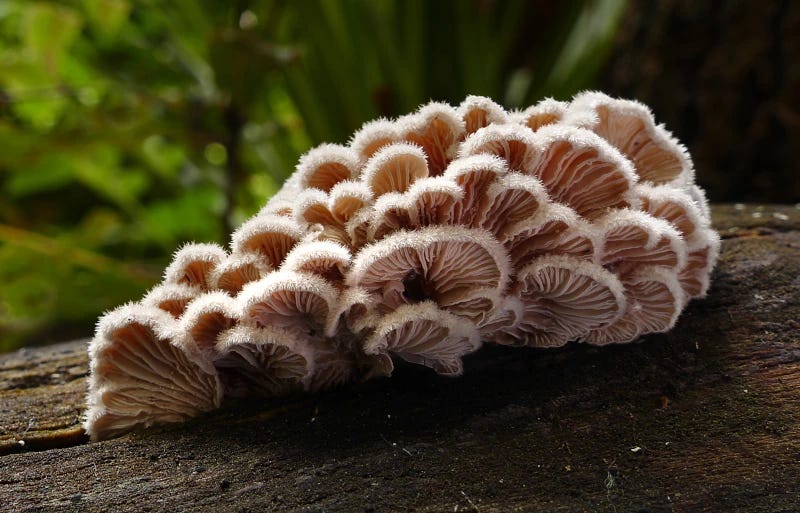
The split-gill fungus Schizophyllum commune pictured above has a tetrapolar mating system that results in perhaps 23,328 mating types.6 This is really weird for several reasons. These fungi have two systems, one (‘A’) involving transcription factors, and a distinct ‘B’ system of pheromones and 7TM receptors⌘—but compatibility of both is only checked after their ‘marriage at first sight’. Most strains will be able to mate—and ‘selfing’ (inbreeding) is limited.7
In the concluding post in this triad, we’ll look at organisms that don’t have the luxury of thousands or even hundreds of sexes. Just the two. More conventional sex. Or is it?
The final part of this post publishes on Tuesday 2 June 2026.
My 2c, Dr Jo.
⌘ This symbol is used to indicate posts where I’ve discussed the flagged topic in more detail
Remembering that there is no such thing as a fish. The salmon is more closely related to the camel than, say, the hagfish.
To confuse you, biologists will say it’s ‘plesiomorphic’!
Watchers of Futurama may recall Zoidberg’s visit to his home planet.
The same may well apply to other microbes too.
As an aside we might at this point note that some organisms (e.g. basidiomycete fungi) can conjugate without forming gametes; there are even organisms that have + and – forms containing different enzymes. For example neither + nor – ‘Zygomycetes’ can make trisporic acid on their own, but when they grow together, they can share intermediate products to do the job. The trisporic acid then acts as a sex hormone, allowing them both to develop sexually, and form a zygospore together.
This number is widely quoted as a ‘fact’, but is actually based on estimates of the different number of variants at the four loci that must differ ( 9 Aα, ~32 Aβ, 9 Bα, 9 Bβ).
There are multiple other organisms with ‘distinct mating types’ i.e. sexes: over 100 for the fairy bonnet Coprinellus disseminatus; and numerous sexes in Euplotes and Tetrahymena. It seems that even yeasts have exciting sex lives; “Go f— yourself!” is not an idle threat for a fungus.
Checked the link for fairy bonnet but nothing there!! Try this instead:
https://www.first-nature.com/fungi/coprinellus-disseminatus.php
A plus for mentioning Futurama.