The Perfection of Bees
Evolving evolution, Part VI

“I have no father, and won’t have sons; but I have a grandfather and will have grandsons.
Who am I?”
The answer to that riddle should be obvious from its context. But Ah! the mechanism! We’ll get there as we continue our exploration of Darwin and his insights into natural selection. Also please don’t forget to vote at the end.
Exploring Darwin is a fractal experience: you think “I’ll just follow the coastline as I whip around to the next headland,” and then you realise that if you do this faithfully, you may never get there. Preparing for this post, I started to “whip through” Chapter VII on Instinct; but Darwin chose his examples so well that I’ll need several posts to do this single chapter justice. Here, we’ll pretty much stick to the bees—and I’ll try not to drone on too much. We’ll focus on the western honeybee, Apis mellifera.
Ridiculous precision
If you look at how precisely our bees make hexagons—geometrically within 2%—then you’d be forgiven for thinking that if US Teslas were built by bees, their doors might fit better.1
Darwin doesn’t just praise their abilities2; he presents them as a serious threat to his theory. And indeed, if you consult a host of ‘Intelligent Design’ (ID) websites and YouTube talks, they will to this day rhapsodise about how the precision of the honeycomb is ‘evidence’ of divine design. Darwin is pretty frank (p 224):
“He must be a dull man who can examine the exquisite structure of a comb, so beautifully adapted to its end, without enthusiastic admiration. We hear from mathematicians that bees have practically solved a recondite problem, and have made their cells of the proper shape to hold the greatest possible amount of honey, with the least possible consumption of precious wax in their construction. It has been remarked that a skilful workman, with fitting tools and measures, would find it very difficult to make cells of wax of the true form, though this is perfectly effected by a crowd of bees working in a dark hive.”
What the ID chaps will not present—at least, not that I can find—is Darwin’s argument from 1859, let alone subsequent progress.
Explained
Darwin provides a lucid explanation. Let’s start at the beginning of the chapter:
“It will be universally admitted that instincts are as important as corporeal structure for the welfare of each species, under its present conditions of life. Under changed conditions of life, it is at least possible that slight modifications of instinct might be profitable to a species; and if it can be shown that instincts do vary ever so little, then I can see no difficulty in natural selection preserving and continually accumulating variations of instinct to any extent that may be profitable.”
The firmware can change over time, using our well-established process of natural selection.⌘ We have all the necessary requirements, so why not? He then goes on to explore how such variation does occur, both in situations where we’ve domesticated animals and selected for certain behaviours, and in the wild, where the Grim Reaper does the selection.
Darwin does his usual thorough job, working through ‘domestic instincts’ before he settles on three examples: cuckoos, slave-making ants, and of course, bees. As promised, bees are our focus.
The driver for perfect hexagons with thin, shared walls is simple: to produce a kilo of wax is energy expensive, requiring several kilos of honey.3 If the hive doesn’t optimise its storage, it will either die during the lean times because it runs out of honey due to insufficient storage, or it will die because it’s already wasted too much energy on wax.
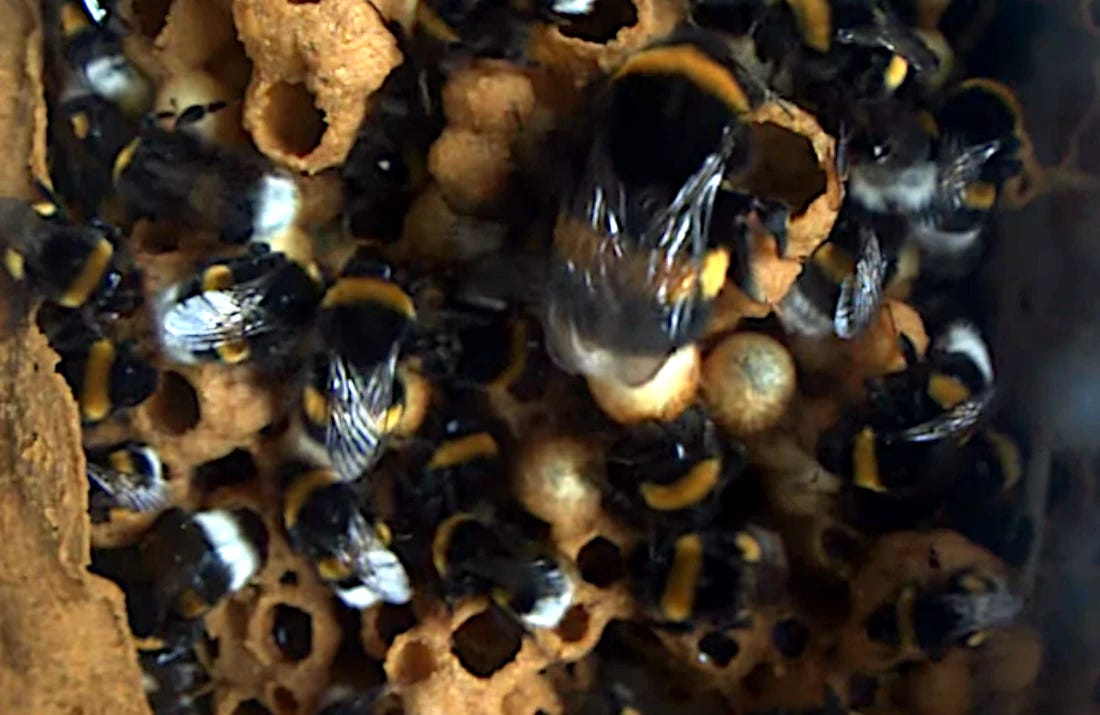
And Darwin nails the mechanism. He points out that the “humble-bees” (bumblebees) pictured at the top of my post4 can make wax pots for storage, but they’re pretty haphazard.
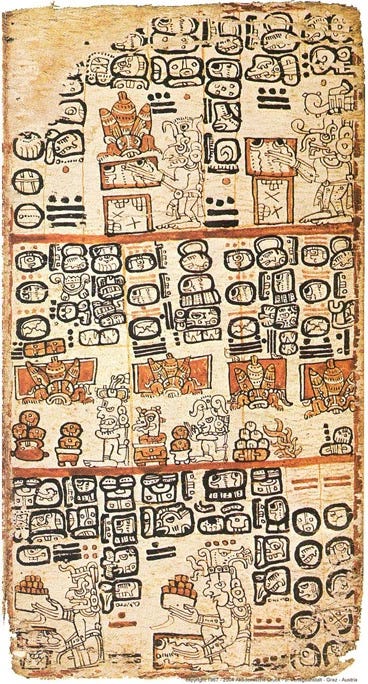
The “next step up” is a stingless bee that was loved and cared for at least 2300 years ago in the Mayan civilisation: Melipona.5 It’s the honey, of course, which is rich in low-GI trehalose. They are found mainly in neotropical forests. Females of these fascinating bees are all pretty much the same size, and any worker can become a queen. There is a catch though—when the queen dies, all but one queen-elect will be designated as ‘extras’ and promptly dismembered by the workers. Self-determination comes at a cost.
Darwin pointed out that Melipona also forms a wax comb made up of spheres. Where these touch, perfectly flat surfaces form, and a cell in contact with three others forms a pyramid that is very similar to the basis of comb formation in honeybees. It’s reasonable to deduce that a slight tweak to the genes that govern the instincts of Melipona will produce the wonderful combs of A. mellifera. Or, as Darwin puts it:
“By such modifications of instincts in themselves not very wonderful,—hardly more wonderful than those which guide a bird to make its nest,—I believe that the hive-bee has acquired, through natural selection, her inimitable architectural powers.

Intellectual timidity
As I’ve already noted, people who tell us that their God (or rarely, gods) tweaks or drives the ‘design’ of organisms pretty much never address the potency of Darwin’s argument about honeycomb.6 I suspect they are simply too afraid, because such an examination would involve one of two things: either viewing all of the evidence and then feeling compelled to produce preposterous special pleading; or doing real science, which as we’ve often said, makes us do what Darwin does here: confront the apparently most severe weaknesses in our own arguments! They prefer to remain stuck pre-1859.
The more we look
In contrast, actual scientists have been fascinated by Darwin’s explanation, and his experiments. For example, he put a long, thick strip of wax between two separated combs, and watched how the bees started by excavating minute part-spherical pits at a precise separation from one another. When the pits met, they started building flat walls at the intersections. He also observed how they manipulated thin layers of dyed wax. He writes:
“The work of construction seems to be a sort of balance struck between many bees, all instinctively standing at the same relative distance from each other, all trying to sweep equal spheres, and then building up, or leaving ungnawed, the planes of intersection between these spheres.”
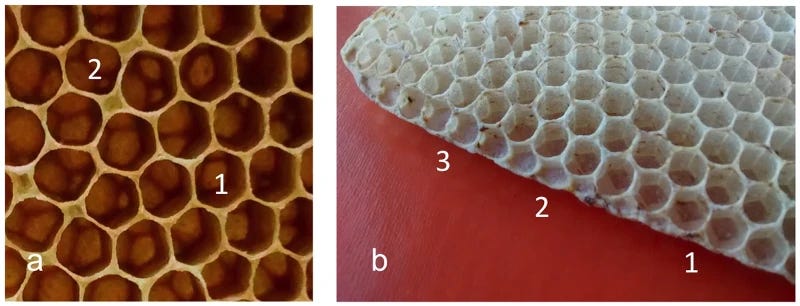
In 2016, Francesco Nazzi wrote about this in depth. As Darwin did, he attributes the hexagonal shape to a behavioural rule. We’re still arguing the finer points. Recent authors have said that the hexagonal shape comes purely from the blind physics of surface tension, but Nazzi points out that even so, this can only occur if the bees create cylinders that have identical diameters and are tightly packed, with each cylinder surrounded by six others.
Nazzi also shows that imperfections occur. If a cell isn’t surrounded by six others, it takes on the relevant polygonal shape, as shown in his Fig 1 reproduced above. The coefficient of variation of honeycomb cell dimensions is about 2.1%, similar to the COV of honeybee body parts like antennae. Researchers have even modelled the simple structural rules followed by hundreds of honeybees in making comb based on residual traces left in the environment by individuals (‘stigmergy’). Artisanal skills recede.7
The riddle answered
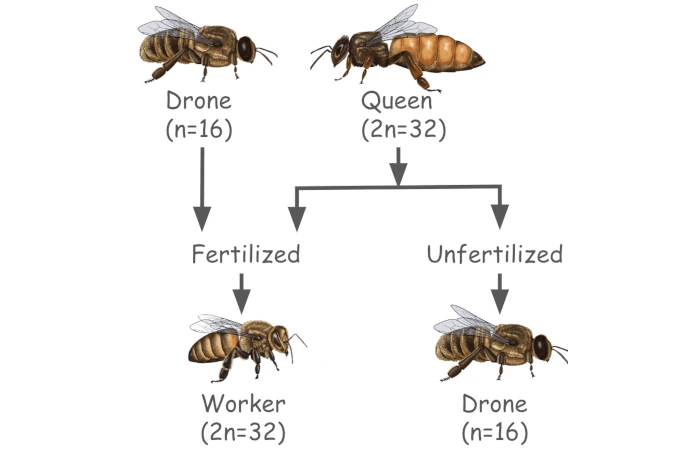
Naturally, Darwin wrote before we understood chromosomes and genes. Mendel was waiting to be discovered.8 To answer the riddle at the start, though, we do need a basic grasp of bee genetics. Which turns out the same as in other hymenoptera: ‘haplodiploidy’. Males are haploid, with half the number of chromosomes, because they develop from unfertilised eggs! Females get one set of chromosomes from mom, and one from dad: they are diploid.9
Why should this be? And why should it work so abundantly well? One rather glib answer is that in a colony with a single queen that mated once, the females are more closely related to one another, than would be the case with a diploid male. They are “more than sisters”, on average sharing 75% of their genes. With two options from a diploid male, sisters would on average share just 50% of their genes. This may work to bind the colony more closely together, but the point is vigorously debated.10
A clearer advantage of haplodiploidy is that the males weed out weak genes. If a lethal recessive gene is present, it will kill males that get it, as they only have this bad gene; there is no counter-balancing ‘normal’ gene.
The answer to the riddle is “A drone”. A briefly lucky drone. The fact that drones don’t have fathers or sons fits naturally with the idea that males develop from unfertilised eggs, and females from fertilised ones.
Kin selection
“I would gladly give up my life for two brothers or eight cousins”—JBS Haldane
The quote is reportedly based on a back-of-the-envelope calculation by Haldane in a pub called the Orange Tree. Like most pub calculations, it has limitations.
The idea here is that if an organism’s genes are to persist, then it makes sense for them to indulge in altruistic behaviour in a way that will maximise that persistence. This fits nicely with the diploid female bees being ‘happy to be workers’ in a eusocial society. Even if they are sacrificed, this is in the common good.11
Remarkably, Darwin pretty much anticipates all of this in his Chapter VII discussion about ‘neuter insects’. He appears to struggle a bit, initially:
“I will … confine myself to one special difficulty, which at first appeared to me insuperable, and actually fatal to my whole theory. I allude to the neuters or sterile females in insect-communities : for these neuters often differ widely in instinct and in structure from both the males and fertile females, and yet, from being sterile, they cannot propagate their kind.”
His problem is not differences in structure, but how these differences can be accumulated gradually. His solution is the nub of what several subsequent ‘experts on evolution’ have got wrong. Here’s Darwin in full flight:
“This difficulty, though appearing insuperable, is lessened, or, as I believe, disappears, when it is remembered that selection may be applied to the family, as well as to the individual, and may thus gain the desired end. Thus, a well-flavoured vegetable is cooked, and the individual is destroyed ; but the horticulturist sows seeds of the same stock …”
Even without genetics, he works out that “It’s about family”. We now know that the development of multiple varieties of worker ant is conditioned by a complex stew of environmental cues, pheromones, different feeding levels, juvenile hormone and epigenetic factors that govern this. But Darwin steps beyond this and makes the correct deduction, even without knowing about genes.
For me, this is a potent refutation of those who claim Darwin is pretty much obsolete, because we first had to work out genetics, and the Modern Synthesis.
A vote
I’m now tempted to further digress and discuss some modern theorists who made an awful mess of just the above point. But, on the other hand, we can defer this and instead talk about slavery next, with a particular focus on ants. Which would you prefer?
Okay, ⇶ slavery it is.
My 2c, Dr Jo.
⌘ This symbol is used to indicate posts where I’ve discussed the flagged topic in more detail.
Chinese-built Teslas seem more precise.
Bees, not US Tesla factories :)
Darwin says about 12–15 times as much honey, but modern exploration has shown that the relationship is rather complex, and likely lower.
They were called humble because they hummed while flying. Although ‘bumblebee’ dates back to 1530, it only became a buzzword in the late 19th and early 20th century. The generic name Bombus also refers to a buzzing, in Greek. ‘Dumbledore’ was always the rarest English word used for a bumblebee, ‘dore’ referring to a buzzing insect, and ‘dumble’ having the same root as ‘dumb’.
The sophistication of the associated technology, technical vocabulary and integration into ritual (the bee god Ah-Muzen-Cab) suggests a practice that extends back a lot further.
If I’m wrong and you know of an example, please point me to it.
This does not imply that the rules are ‘trivial’. Even more recent work suggests a much more active role for several templates within the brain of the worker bee.
Although in 1792 François Huber discovered that virgin queens can lay eggs and produce only drones, it was Polish apiarist Jan Dzierżon who looked at this in detail and in 1845 published his findings on parthenogenesis (and a lot more). Darwin doesn’t mention him in On the Origin, but his later work does; it turns out that Darwin comprehensively mucked up how genetics might work!
The ‘haplodiploidy hypothesis’. One extra nuance is that bumblebee queens mate with just one male, but honeybee queens usually mate with more than a dozen drones, so workers tend to be heterogeneous; this may have survival benefits.
We have already explored some benefits of altruism in the context of game theory.⌘ The kin selection argument becomes especially potent when we realise that humans across the globe are very, very similar genetically despite superficial differences. Haldane may be missing the bigger picture quite severely.
Discuss slavery, because the concept is SO socially-loaded these days, but maybe we need some perspective. Is there an innate tendancy to subjugate those of lesser power? Can we draw parallels between ants and humans, or other animals?
Fascinating, as usual! :-)