Beatings Will Continue until Morale Improves
(More Midweek Madness: Learning from New Zealand)

New Zealanders are doing it hard. This started fairly soon after our current right-leaning government got in. That’s actually understating it.
Personally, I had some good news yesterday. I learnt that a paper I wrote together with anaesthetic allergy experts around the country has been accepted in the leading journal Anaesthesia. But I still feel a bit flat and miserable, for several reasons other than Israel’s latest atrocity in Qatar.
Also yesterday, I went to the local dairy1 and noticed that the top shelf of the refrigerator, which used to stock a huge variety of yoghurt, had just two containers. The chap behind the counter was clearly uncomfortable when I brought this up. I don’t live in a particularly deprived area, but people aren’t buying. They are doing the hard yards.
Apart from my work in Perioperative Medicine, I also work in Internal Medicine in my large tertiary hospital. We have fifteen physician-led teams. Today, two had to close due to lack of staff—the other teams picked up the slack, but this is becoming more and more common. Internal Medicine is the workhorse that effectively ties adult medicine together. We’re tired. I think I might just retire, after all.
There’s a general feeling of gloom.
Why are things broken?
Where to start? Perhaps with the boss of our country, Christopher Luxon. Luxon is a businessman, formerly from Air New Zealand and fairly fresh to politics. Despite being a member of the God Squad,2 he formed an unholy alliance with two very strange minor parties, ACT (who are libertarian when they’re not saying “Bring back the birch!”) and ‘New Zealand First’ (who are so overtly racist that their boss was once recorded as saying “two Wongs don’t make a white”). So, right-wing.
Luxon has not demonstrated evidence that he is, after all, a chordate. For example, he can contort himself with such squid-like flexibility that he’s allowed ACT to put forward all sorts of legislation that pokes its tentacles squarely into the eyes of all Māori everywhere. But this racist bent is almost peripheral to the main thrust of his failure.
Now I’m not sure I have a good grasp of Modern Monetary Theory (MMT), which in any case many traditional economists regard as heresy. But here’s what I understand. Some of this is a little heretical; some may be just plain wrong:
Running a country is not like running a household, or even a company. You effectively can’t go bankrupt, as you can always licence banks to print more money.
Yes, banks do “print money”. Every time someone borrows from a bank, the bank effectively prints money—they never have reserves sufficient to cover all of their loans, so the excess is a promise that extends into the future. They’re printing money. The country’s Reserve Bank can however mandate a minimum amount the bank has to have in reserve (limiting leverage), and can also crudely tweak things by setting the official cash rate.
The government also affects the economy by spending. The goal here should be to spend enough to use the human capital the country has optimally. Spend too little, and people can’t add value (for example, they’re unemployed, they have little to spend, and the money doesn’t go round and round in virtuous cycles, creating wealth); spend too much and you feed inflation.3
The reason for taxes is not to fund the government’s activities. It can’t run out. The government can and should use taxes to pull back on inflation, and to maintain a fair balance between the haves and the have-nots. Taxation effectively destroys money!4
Now I’m pretty comfortable in noting that Luxon and his cronies really don’t get any of this. But even this doesn’t really matter too much. You see, I can see something that Christopher Luxon clearly can’t. Something that goes back to the 1980s. It’s this:
Gosh! Trickle-down doesn’t work!
Pretty much the first thing our current government did when it got into office was cut taxes on rich people. This is something they always do. It’s kind of a dogma with them.
The second thing they did was impose austerity. Everywhere. The consequences have been devastating, in so many ways:
Really competent people have flocked out of the country in droves. Expert scientists who were keeping New Zealand near the front of the pack have fled, especially to Australia, as the austerity bit, and their jobs were threatened or abolished.
The back-office functions of the public service have been decimated. Those who used to work there (a) now can’t spend, because they don’t have an income; and (b) compete for jobs in an increasingly sparse job market. In addition, those left behind are under more pressure, and more scared. Beatings will continue ...
The rich are hanging onto their cash. Property prices are falling because nobody has money to spend, and because people are leaving.
The newly qualified can’t find jobs. The best young doctors are leaving, and won’t come back. Half of our newly trained nurses can’t find jobs, so they flee to Australia. Similarly for engineers, builders, and many others.
Health care innovation is faltering as good people leave, and back-office functions are cut. Front-line professionals are ever more frazzled, and the government isn’t listening, so they are striking—both doctors and nurses. There are gripes about pay (as salaries erode), but there are even bigger gripes about staffing and patient safety.
As I see it—and correct me if I’m wrong—our current government is implementing the bad ideas of Milton Friedman from the 1980s. He argued that some people are ‘naturally unemployed’ and that we just need to accept this, because dropping the rate further caused inflation. He was frugal with the money supply. And he really punted “the free market” with minimal government intervention. He wanted to abolish medical licences (just let any convincing charlatan provide you with all the opiates or quack medicine you can be persuaded to want), deregulation (who needs safety when the free market will provide?), and a rampant private sector.5
And that, it seems, is what Christopher and friends have bought. Which is why New Zealand is now so screwed. At least, that’s how I see it.
Perhaps there’s something in MMT, after all? But even if there isn’t, there’s a clear lesson for us all. If you feed the rich cash and impose austerity on everyone else, the poor don’t spend, the money doesn’t go around, and the country is buggered.
It’s tempting now to say “Eat that, Luxon”, but of course I won’t :) There’s a difference between me and him. If you point out the defects in my crude arguments above—where I’m wrong—then I’m quite happy to apply reasoned Science. Embrace the idea that I’m wrong.
In contrast, Luxon and his ilk will never admit that they mucked things up. Instead, they will rationalise. Blame others. And beatings will resume shortly.
My 2c, Dr Jo.
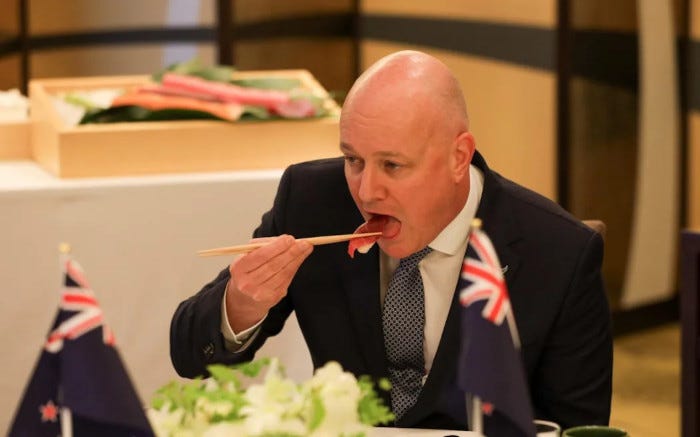
Image of Luxon eating sushi awkwardly is from Radio New Zealand’s “Christopher Luxon gets a ‘C’ on Japan trade trip”. I couldn’t bring myself to show that image of him eating KFC.
NZ term, I think this is more-or-less equivalent of ‘convenience store’ elsewhere.
Not really. This is a metaphor for his fervent religious beliefs, and has nothing whatsoever to do with that cult. Not at all.
It’s also wise to spend money on things that add actual value. Investing in the Gaza conflict, pouring cow piss into rivers, or mining conservation land might not be all that brilliant, overall.
There’s also the matter of MMT’s different view of bond issuing. Bonds are a tool to manage interest rates, not fund spending.
Not all of his ideas were bad. In his later years, he seems to have supported a form of universal basic income, which would not go down well with a lot of libertarians.
Sorry to hear you folks are going through your own version of a Trump.
In my ignorance I had thought that New Zealand was doing better than that, though I had noticed you sometimes complaining about it. Looks like they have found a similar, but slightly slower than us, way to go to go to hell in a hand basket. My condolences. I know you have given yours to us a couple of times. Small comfort, but we will have to make do with whatever comforts we find.