Old Twins
(How to design Weird Twin Studies)

There’s a strange paper that just came out in the journal Science. It’s called “Heritability of intrinsic human life span is about 50% when confounding factors are addressed”. The authors are Ben Shenhar, Glen Pridham, Thaís Lopes De Oliveira, and colleagues.
Let’s dissect this paper. Quite because it’s so weird (and so wrong) I’ll quote it liberally. I would hate to be accused of putting words into the authors’ mouths—especially as their own words are already so strange. We begin.
First up
I’ve previously said “How I read a journal article”.⌘ Let’s apply these guidelines.
Soo. Science is about as far as you can get from a predatory journal, and the article hasn’t (yet) been withdrawn. What’s the conclusion?
In summary, correcting for extrinsic mortality raises the estimate for the heritability of human life span in twin and sibling studies to ~55%, more than twice previous estimates and in line with heritability of most human traits. Identifying the genetic variants underlying this heritability would help us to understand the fundamental mechanisms of human aging.
This is odd (for reasons we’ll explore) but at least it fits the end of the abstract closely. Next, ‘study limitations’? Dreadful. The authors have a single line of ‘limitations’:
Limitations of this study include reliance on assumptions of the twin design, such as the equal environment assumption.
Not only is that the only limitation they see, but they immediately follow it by “Nonetheless …”.
Let’s give them some limitations, then
The thing to do is look for the really obvious badness. Here, this isn’t hard. We’ll get to the deep rot soon, but first up, we read that they …
used model-independent mathematical analysis and simulations of two human mortality models to partition mortality into intrinsic and extrinsic components.
This already makes me doubt their conclusions. Can you spot the problems? Yep. Their maths is “model-independent” but they immediately move on to two [assumed] models. There’s more back-to-front legerdemain, even here: they write as if the partitions flowed naturally. We’ll find they are quite artificial.
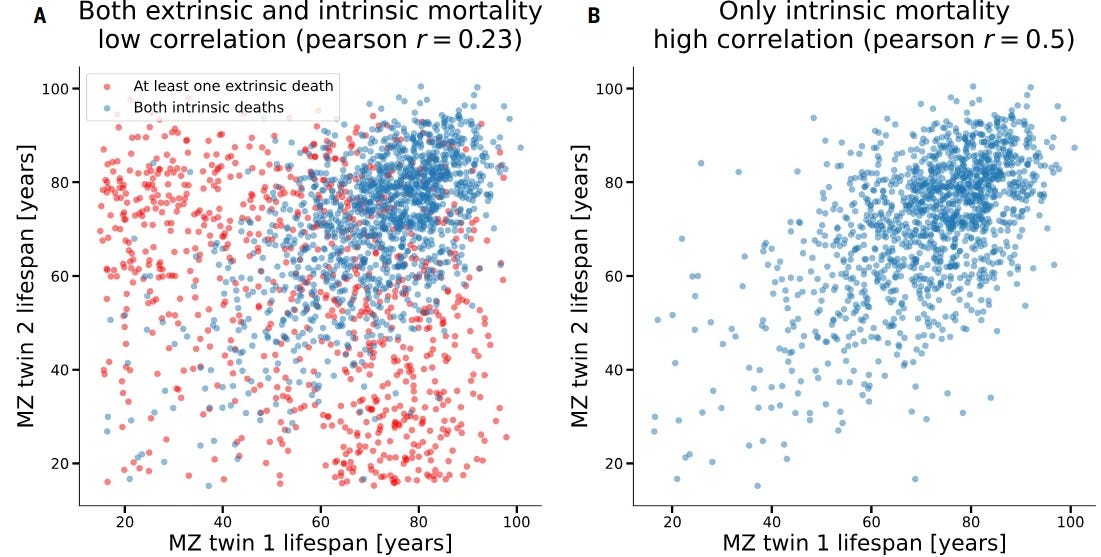
There’s something else that’s even more obvious. Look at the top two panels of their Fig 2, reproduced above. On the left we have effectively no correlation between lifespan in monozygotic twins (Twins from the same egg, with the same DNA; r2 is 0.05). On the right, after they remove what they call ‘extrinsic mortality’, we have an r2 of 0.25. Note that this value is 0.5 squared.
We know from basic statistics that if we subtract the square of the correlation coefficient from one, this pretty much tells us how much of the variation between the matching individuals is unaccounted for. Here, 75%. You’re now going to have to twist my statistical arm hard to persuade me otherwise.1 Even with that arm twist though, there’s a more fundamental problem with this study. It’s a gaping defect …
“Intrinsic mortality”
What on Earth is ‘intrinsic mortality’? They say:
Extrinsic mortality refers to deaths caused by factors originating outside the body, such as accidents, homicides, infectious diseases, and environmental hazards. By contrast, intrinsic mortality stems from processes originating within the body, including genetic mutations, age-related diseases, and the decline of physiological function with age.
and …
Because current extrinsic mortality is nearly an order of magnitude lower than in historical cohorts, and cause-of- death data for historic twin cohorts are unavailable, inferring the heritability of life span due to intrinsic mortality (mortality from nonextrinsic causes) is of interest.
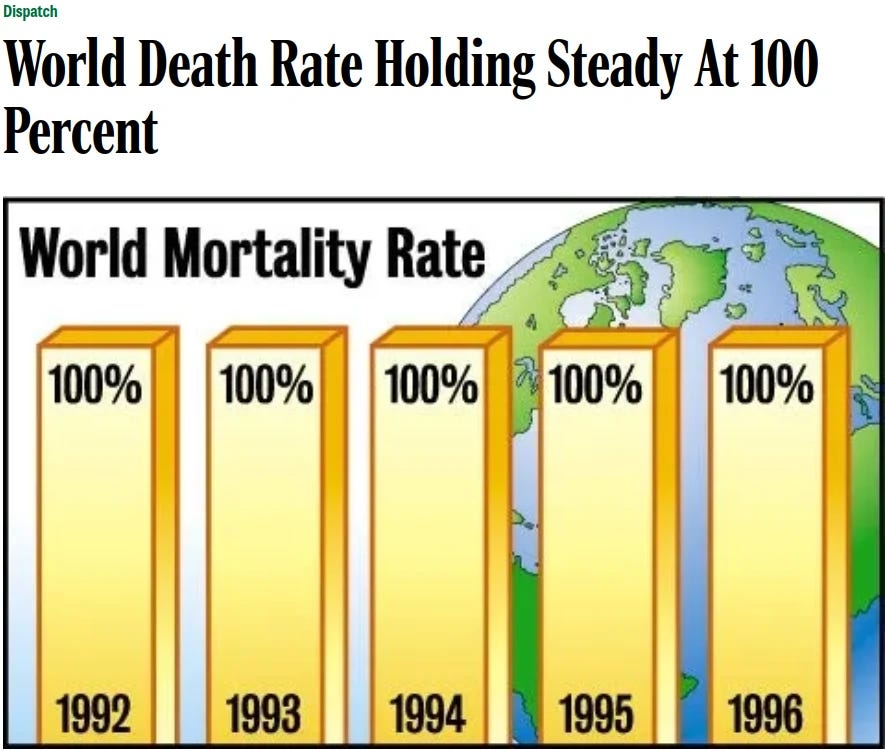
All they seem to be saying is that ‘people are living longer’. As The Onion pointed out in 1997, human mortality is still 100%. So how do the authors determine that ‘old age’ contribution, and what does it mean?
Can you see the huge red flag2 related to ‘intrinsic mortality’? We know that in ‘developed’ countries and increasingly in developing countries, mortality is mostly due to non-communicable diseases (NCDs).⌘ These are conditions like high blood pressure, cancer, diabetes, and failing hearts, kidneys, lungs and so on.
A wealth of studies asserts that environmental factors play a large role in all of these conditions that increasingly kill old people. There is certainly an interplay between genes and all of these conditions, but the bulk of evidence shows that dosing entire communities with things like salt, alcohol, sugar, high-energy-density foods and tobacco shortens lifespans.3 There are even actual twin data (ignored by these authors) that look at these factors.
These authors tacitly attribute deaths due to NCDs to ‘genes’, an action that is starkly and flagrantly incorrect. ‘Age-related diseases’ are assumed to be ‘intrinsic’!
I could stop here, but the study has even more defects!
We’re not done yet
There are at least two other defects in this study. Both are statistical in nature. The first follows on their defective assumption about NCDs and genes; the second is an egregious hand wave about what you can do with statistics if you ignore Science. Let’s take these in turn. The authors use older data to determine that:
“Crucially, extrinsic mortality declined sharply during the 19th and early 20th centuries”.
In their perfect world, they can now establish a ‘rule’. This is that:
an exponentially rising extrinsic mortality yields nearly identical results to treating extrinsic mortality as an age-independent constant mex for each cohort.
We already know that their definition of ‘intrinsic mortality’ is flawed. We know that ‘extrinsic mortality’ has simply changed over time, as medical science has conquered infections. People have lived longer, and NCDs have substantially supplanted infections. Asserting that extrinsic mortality is ‘age independent’ is obviously dodgy.
Let’s take someone who smokes, starting at age 15. They develop chronic obstructive airways disease, and at age 70, they get cancer. They die. This is not surprising—60% of smokers will die as a consequence of their addiction, and on average smoking clips 10 years off your life. Our authors seem to be imputing both that the impact of this extrinsic assault is ‘age-independent’, which is daft; and that the death is not extrinsic at all but solely intrinsic, some sort of “genetic mutation, age-related disease, or the decline of physiological function with age”.
Which brings us to their statistical abuse. We know that good Science works by making models and then trying to break them.⌘ We break them in two ways: by spotting internal defects, and then by testing models in reality. Where there are competing models, we often end up choosing the model that is least defective.
We’ve already seen that their model has fatal internal defects. But do they at least try to test it destructively? Not a bit. They just assume two similar models and arbitrarily use one of them:
We used two models to simulate life-span distributions: (i) the Makeham- Gamma- Gompertz (MGG) model, a flexible empirical fit to mortality data (24), and (ii) the saturating-removal (SR) model (25), a biologically motivated mechanistic model in which aging emerges from the interplay between rising damage production and a removal process that saturates at high damage.
They don’t explain where the damage comes from (environmental factors like smoking!), apparently tacitly assuming it’s in the genes. And it gets worse:
All three estimates agreed within one SE (fig. S7), supporting an additive genetic model of life span, with a combined variance-weighted estimate of 0.33 ± 0.06.
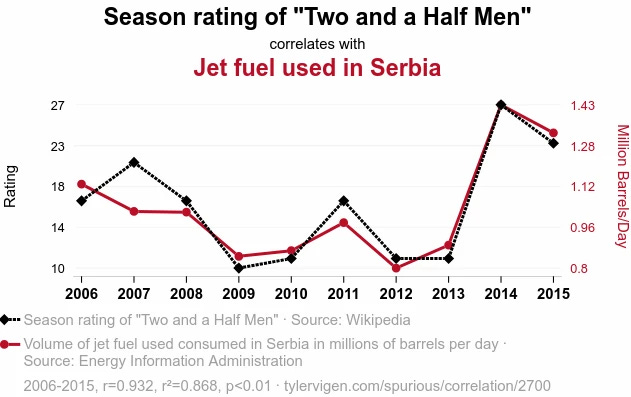
This is about as convincing as the spurious correlation between season ratings and jet fuel use shown above, from TylerVigen.com. Competent scientists and competent statisticians should be aware that ‘similarity’ doesn’t prove anything. In fact, we can’t prove things in Science. We need to be brutal in our criticism of our best models, and only provisionally accept those that survive our sharpest arrows.
These authors don’t fire a single arrow at their ‘model’. This is not Science. They make bold claims. Bold claims require vigorous testing for flaws. They don’t do this. They don’t even put up an alternate model where external, non-communicable diseases interact with genes, as a foil against which they can test their assumptions.4 As Carl Sagan said repeatedly:
Extraordinary claims require extraordinary evidence.
Instead, they have given us ‘extraordinary analysis’, which is less desirable.
How might they have done better?
From the above analysis, you can work out not just where this paper went wrong, but how it might have been improved. In summary:
Solid self-criticism is not an optional extra. It is the lifeblood of Science. This paper would surely have turned out differently if the authors had bothered.
If you’re going to disagree with pretty much all of the work that emphasises the role of the environment in influencing non-communicable diseases and ultimately mortality, you need a powerful argument supported by really solid data.
Mere statistical manipulation is unconvincing, no matter how involved and swanky. But it is even less convincing if you don’t test it well against a model that disagrees with yours.
If you generate a line on a graph that looks similar to another line, this pretty much tells you nothing.
Get your basic assumptions right. Here, everything went downhill after the authors made a flawed assumption about ‘intrinsic mortality’.
I’d suggest that the peer reviewers who read this article really let down both Science and the authors. The only reason why I’ve gone on so long is to to show how badly smart people can go off the rails if they don’t understand and apply the rudiments of good Science.
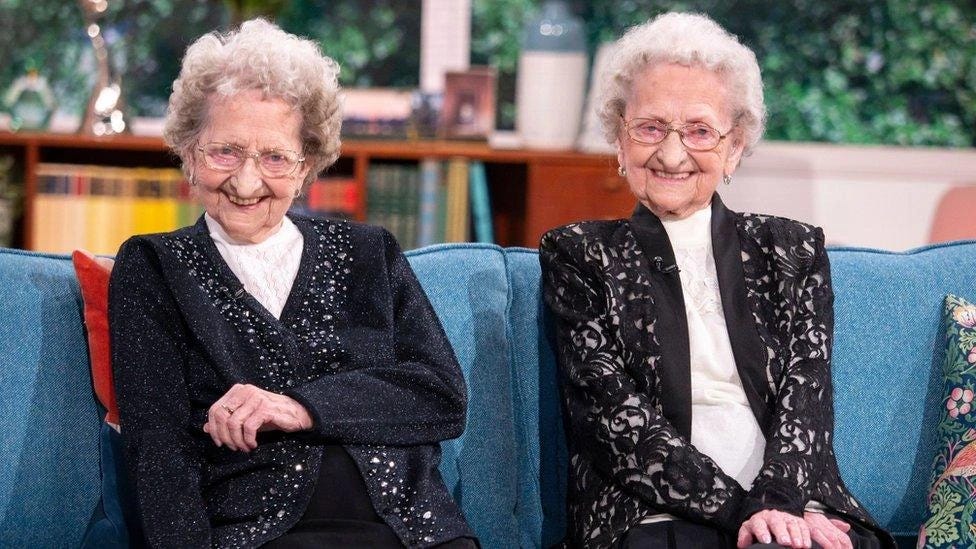
The wonderful ‘Tipton twins’ pictured at the start of my post are unusual in that they both made it to 96 years of age.5 And then, following on Boris Johnson’s blunders, an external cause (COVID-19) carried one of them off; the other survived.
Which, come to think of it, isn’t that surprising. Environmental factors are really important, even in that small group of very special survivors who attain nearly 100 years of age.
My 2c, Dr Jo.
⌘ This ‘of interest’ symbol is used to indicate posts where I’ve discussed the flagged topic in more detail.
It turns out that in monozygotic twin studies, the maths is ‘special’. If you look at Fig 2A and the associated Pearson’s correlation coefficient, this tells you that “If I know the lifespan of Twin A, then this explains just 25% of the lifespan of Twin B.” The genetic study is claiming something more Platonic: that they can use r instead of r2 to impute ‘underlying genetic tendencies’. This is based on the multiple, simplistic assumptions that underpin Falconer’s formula.
These assumptions have been roundly criticised. For example Richard P Bentall shows how interpretation is doctored to raise apparent rates of concordance (tweaking definitions, probandwise calculations, ignoring gene-environment interactions, and misinterpretation of h2)—if everyone smoked 20 cigarettes per day, then genetic studies would likely attribute 100% of lung cancer to ‘genes’! Stephen Rose is even more scathing: “Heritability refers to the genetic contribution to variance within a population and in a specific environment” and “Implicit in the measure is the assumption that the contributions of genes and environment are additive, although a fudge factor for small interactions is included”. He’s quoting Richard Lewontin, who in his concurrent analysis points out that “A trait can have a heritability of 1.0 in a population at some time, yet this could be completely altered in the future by a simple environmental change.” Perhaps the most important defect in heritability studies is that they shift the focus from addressing causation to naive dichotomisation and simplistic examination of correlation.
There are other strange features. For example, in their Fig 1B, male and female ‘extrinsic’ mortality appear the same (Thanks, Jaqlin).
For example, over the last have century, obesity rates have surged. It’s not the genes that have changed! The important observation here is that we can address these causes, provided we have the political will, by altering advertising, availability and price. As some countries have done with tobacco products.
This study could be checked in a multitude of other ways. For example, we might ask questions like “What’s a ‘death due to dementia’?”. We might become really irate about twin data that examine things like smoking—and that these show quite the reverse of what these authors assert. But given the obvious defects we’ve already identified, this would likely be a waste of time.
You can work this out from the authors’ Fig 2A.
I don't even read this kind of article (mild autism keeps me that way).