Charles Darwin and the Herbivorous Spider
Evolving evolution ... Part IV

Thank you, everyone who voted.⌘ There was overwhelming support for the scenic route, revisiting On the Origin of Species at a leisurely pace. All references are again to the first edition.
In the past, I’ve sketched an approach to reading scientific papers⌘; you can do something similar with science books. After making sure you’re up to the task and that the publication isn’t obviously designed to deceive,⌘ first assess the conclusion and make sure the summary makes sense. With Darwin, we’ve pretty much done this already. Then, it’s vitally important to look for self-criticism: ‘study limitations’. If this is absent, someone is trying to sell you something. Often something nasty.
In contrast, Darwin is refreshingly honest and self-critical. He has, after all, had a few decades to probe, test and try to destroy his theory: that species change and give rise to new species, and that natural selection works and is important in determining how species arise. He’s also discussed this with a lot of really smart people. So when it comes to self-criticism, he shines. We’ll work through Chapter VI, but for the full picture, I’d strongly suggest you read the original. It’s still worth the effort!
First we will list Darwin’s concerns about his theory; then we’ll start to appreciate the non-linearities in his explanation, especially when it comes to divergence of new species. After examining the arbitrary nature of this divergence (using the titular spider), we’ll encounter an exacting and electrifying test of Darwin, before ending off with a bit of philosophy.
The strange attraction of Difficulties of Theory
“The wizards were good at wind, weather being a matter not of force but of lepidoptery. As Archchancellor Ridcully said, you just had to know where the damn butterflies were.”
—Terry Pratchett, The Last Hero.
Darwin kicks off with obvious concerns:
Why don’t we see innumerable transitional forms?
How can something like a bat possibly have formed from an animal with wholly different habits? How can something wonderful like the eye be put on the same pedestal as say the fly-flapping tail of a giraffe?
Surely ‘instincts’ like that which drives a bee to make hexagonal cells could not have originated spontaneously?
How do we account for the sterility of crosses between ‘species’? (But not of ‘varieties’?)
We then discover that, not content with one chapter of self-criticism, Darwin points us to several more—Chapter IX on the Imperfection of the geological record, and entire chapters (VII and VIII) on Instinct and Hybridism, too. I’ll cover these in future posts.
Darwin is revolutionary in many ways. The 17th century polymath Gottfried Leibniz promoted the idea of a pre-determined, clockwork universe, rationally set up by God, and running on smooth rails. “The best of all possible worlds.”1 He had little time for disorder or variation.
As I see it, Darwin is a powerful antidote. As many of his early readers doubtless did, I find his argument about transitional forms compelling. Life is subtle, variable and interconnected. It can’t not be so—individuals with tiny variations are competing not only against other members of the species, but also against every other species that might occupy a vacant niche in a complex and varying environment.
Once you have accepted that a species adapts minutely and continually based on the slightest advantages it can gain, it becomes logically inevitable that suboptimal transitional forms will vanish due to competition, especially once finely-tuned ‘optimal’ organisms have been established in a relatively stable environment.
In contrast to the tick-tock universe of Leibniz, small effects can have unboundedly large ultimate consequences. But this doesn’t imply that “everything is chaos”. Nonlinear dynamics is, in fact, both pervasive and subtle. There’s a quote attributed to the mathematician Stanisław Ulam that talking about ‘non-linear dynamics’ is …
like defining the bulk of zoology by calling it the study of ‘non-elephant animals’.
Darwin is a century too soon for nonlinear dynamics, but his ideas of minute, random or seemingly random divergences picking up a specific trajectory fits nicely with the concept of a dynamical system with attractors. Starting from multiple different points in a setup that seems chaotic, things can settle down into one of a variety of fairly straightforward states.2 (As an aside, if the space in which the attractor evolves is fractal, with dimensions that aren’t integers (!) then we’re dealing with a strange attractor.)

New species
This still doesn’t quite explain how one species can diverge into two. Even if we have two different ‘variants’ that are optimised to two different micro-environments, why don’t they intermingle and blur into one another at the boundaries?
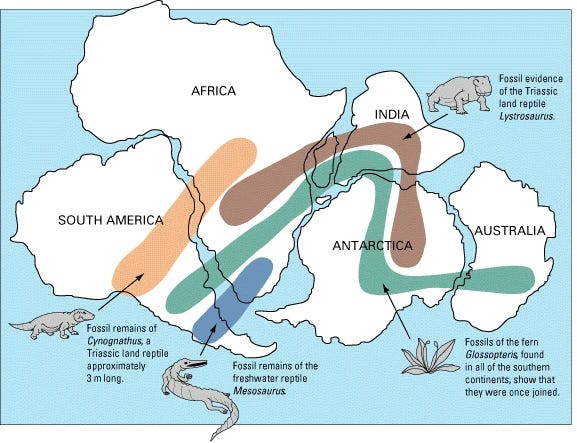
It’s clear that continental drift provides a glorious opportunity for separation of huge numbers of species, especially over geological time. Consider Australia or New Zealand with their unusual complement of animals. But we must also understand that Darwin’s ideas predated our current understanding of continental drift. He’s writing in 1859; later, when Alfred Wegener comes up with the idea of continental drift in 1912, he’s laughed out of court.3 Now, of course, we know that plate tectonics is powerful and explanatory—Africa and South America fit like a jigsaw because they were once connected.
Darwin however points out that even local variation can do something similar:
In the first place, we should be extremely cautious in inferring, because an area is now continuous, that it has been continuous during a long period. Geology would lead us to believe that almost every continent has been broken up into islands even during the later tertiary periods; and in such islands, distinct species might have been separately formed …
On page 174, he goes one step further—even this sort of separation is not necessary. As he explains, the major driver is not subtle variations in local conditions, but the consequences that result from the interaction between competing species in these slightly different environments. There’s a nonlinear effect here! Even more profound is his observation that if there is an intermediate form at the interface between two species, this zone is likely to be small. There’s every reason for the variants on either side of the small buffer zone to diverge more. Because they have a greater population, that will vary more than the small, overlapping population.4


Peculiar habits
For me, the evolutionary show-stopper is how species find gaps. If you’re of a Platonic mind-set, then each species has some sort of archetype or ‘true form’. To take a random example, spiders aren’t herbivores.
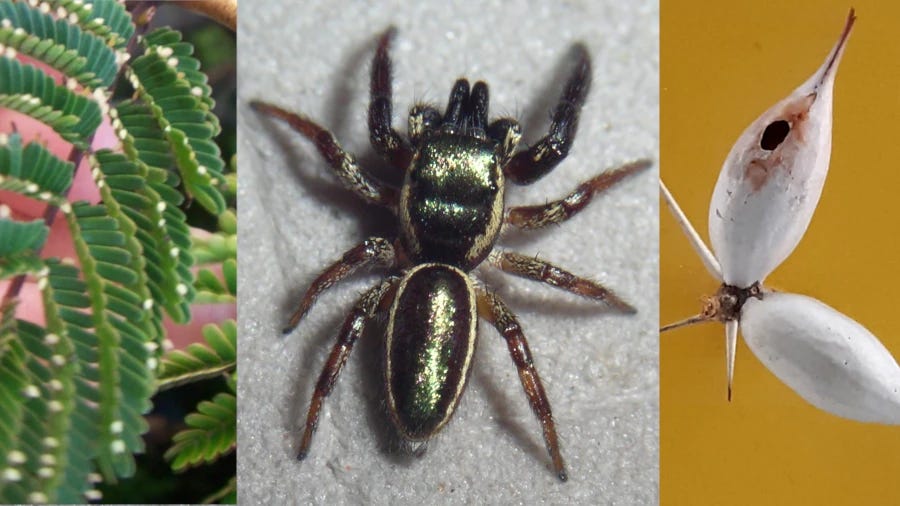
Except for the improbably named Bagheera kiplingi pictured above. This tropical jumping spider lives on Mimosa trees of the genus Vachellia, which itself has a strange relationship with Pseudomyrmex ants. The Mimosa tree provides protein-, sugar- and fat-rich food (Beltian bodies) and in return the stinging, biting ants protect the tree from animals that might fancy a bit of Mimosa. The tree gives the ants shelter in specialised little plant homes called domatia5; the ants even kill surrounding vegetation that might otherwise compete.
A grand paper in Current Biology looks at this vegetarianism in perhaps more detail than the unserious scientist might desire.6 The spiders clearly eat Beltian bodies often, but there’s a better way to demonstrate predominant herbivory. Tissues of herbivores tend to have lower ratios of certain nitrogen isotopes, and this is what we find with this particular spider.
This is more than just a brilliant example of the interdependence of species. If there were some ‘dominant spider archetype’, or driving force that dictated the inevitability of how spiders work, then the occurrence of a predominantly herbivorous spider would seem perverse. In contrast, it’s easy to see how the spider might have started as a carnivore and graduated to herbivory. An agile jumper can outwit the ants and eat their offspring—but now there’s all this free food just lying around!7
I’ve jumped ahead: Bagheera wasn’t even described until 37 years after the publication of On the Origin. But Darwin himself provides a wealth of ideas and examples. He starts with how flight might have evolved. At first, something like the perfection of the wing of a bird or bat seems (literally) miraculous; but Darwin points out that we do have ‘transitional forms’ for gliding organisms like flying squirrels and colugos. Again, he makes the point that it is precisely the perfection of flight in birds that would suppress less capable ‘intermediate forms’. If you need more examples, read page 183 and the following discourse.
And then we have the greatest argument of all in support of the random, undirected aspects of evolution—the eye. But we’ve already seen more than enough on the eye and its variants in my previous posts! Darwin does a great job here too (pages 186–189).
Self-examination
What do you make of this comment by Darwin?
If it could be demonstrated that any complex organ existed, which could not possibly have been formed by numerous, successive, slight modifications, my theory would absolutely break down. But I can find no such case.
This is how we do good Science. We test and test and test our model, and then, when we have exhausted our current tests, we provisionally accept it as true. This doesn’t mean that we won’t think up even more exacting tests in the future.
Video of electric eel shocking and eating prey
Jump!
Naturally, Darwin makes some mistakes, even in his self-criticism. For me, the biggest one is that he says with some firmness (Page 194):
Natura non facit saltum
This translates along the lines of “Nature doesn’t make a jump”. Ironically, one of the origins of this bon mot may have been Leibniz (“la nature ne fait jamais des sauts”). Previously, I noted how the spirit of Darwin seems to be in favour of divergence and non-linearity; but some bad old habits are difficult to kill.
Let’s gently juxtapose that observation, and one other point that Darwin struggles with a bit. There’s a variety of organisms that stun their prey and ward off attackers by giving them an electrical jolt. As he says:
“The electric organs offer another and even more serious difficulty; for they occur in only about a dozen fishes, of which several are widely remote in their affinities … Nor does geology at all lead to the belief that formerly most fishes had electric organs, which most of their modified descendants have lost.
He then neatly describes the concept of convergent evolution—but how can such shocking organs arise, repeatedly and independently? What would an ‘intermediate form’ look like, and how would it benefit the fish?
Fortunately, 150 years later we now have a wealth of information about just this topic! It also involves jumps. The first point to note is that the electric eel kills its prey (and attackers) by running an ampere through them at well over 500 volts.8 There seems to be little benefit of antecedent species building up to this by generating a tiny tingle when attacked.
But from a previous post about the elephantnose fish,⌘ we already know that fish can use electrical fields for different things—specifically, for accurately sensing their surrounds in murky water. Refine this progressively, and eventually your electric field will take on shocking properties. And indeed, the electric eel locates prey using electroreceptors; they even have three different types of electric organs. They can do low- and high-voltage discharges; they signal to other eels too.9
We now understand electric fish at a molecular level. Recent work ties together the convergent evolution of several species. We’ve previously discussed both transmembrane receptors⌘ that can sense environmental changes like incoming light, and also similar transmembrane proteins that instead channel ions.⌘ It’s not surprising that similar themes are present here.
First, sensors. Some organisms have found benefit in passive sensing of electrical fields of other organisms—electroreception. Electroreceptors go way back: coelacanths and sturgeons have them, as well as cartilaginous fishes such as sharks.10 It was only in 1960 that we worked out that the Ampullae of Lorenzini on their noses (first described in 1679) are electroreceptors. Effectively, the ampullae are nerve-rich pores containing a conductive gel. They transduce the potential difference between the apex of the pore and the base of the electroreceptor cells.
Moving to voltage generation, as with so much else in biology, the underlying substrate is already there. Muscles depend for normal functioning on a voltage-gated sodium channel, Nav1.4, coded for by the Scn4a gene. Nerves incite the muscle to rapidly change the voltage across its cell membrane, using these channels. The electric organs of fishes evolved from these building blocks: stack up multiple layers of membranes densely populated by such proteins, and you can generate quite a voltage.
Where’s the jump?
Darwin couldn’t know about genes, chromosomes and mutation. He also couldn’t have guessed that there’s a singular way that a new species can arise, practically overnight! This is called a whole genome duplication (WGD) event: the organism doubles its number of chromosomes. This is thought to have happened twice in the development of early vertebrates.11
The obvious disadvantage of WGD is that it’s likely the offspring can only breed among themselves, excluding other members of the source species. The long-term advantages are however huge, as every gene has twice as many copies, allowing one of those copies to be used for something else, and protecting against loss of important genes due to mutation. About 286–267 million years ago (Ma) the ancestors of modern bony fish underwent a third WGD known as ‘3R’.
More than half of all living vertebrates are ‘bony fish’ or teleosts. The ray-finned fishes (‘crown teleosts’) diversified explosively 50–100 Ma, perhaps because they could fill many gaps after the CP mass extinction. Some have claimed that their ascendancy is related to 3R, but it’s likely more subtle. The crown teleosts only really took off ages afterwards. But with 3R, there were suddenly two copies of Scn4a: scn4aa and scn4ab. Subsequently, in electric fish, scn4ab stuck around in muscle, while scn4aa became confined to the electric organ. A single gene may influence this change, too.
This all underlines the random direction of evolution. Evolution is what works. There are no ‘higher’ and ‘lower’ organisms. We all just sidle into whichever niche will accommodate us—provided another organism doesn’t get there first.
A rider
There is a rider to this approach of rigorous self-criticism that sometimes seems to be forgotten. If someone comes by and puts up yet another test of our theory, are we obliged to spend a lot of time and effort pursuing it? As I see it, the answer is only a resounding ‘Yes’ if several prerequisites are met:
The test should be new, relevant and articulate. Often, a good person to propose a test is someone who is fluent in the underlying theory and its history.
The test can discriminate: we must be able to answer “Why this test?” For example, some theories of how smell works are based exclusively on the shape of the molecule. If your test asks and possibly answers questions like “Why do many sulphur-containing molecules smell of rotten eggs, despite varying hugely in shape?” then that’s a good test.
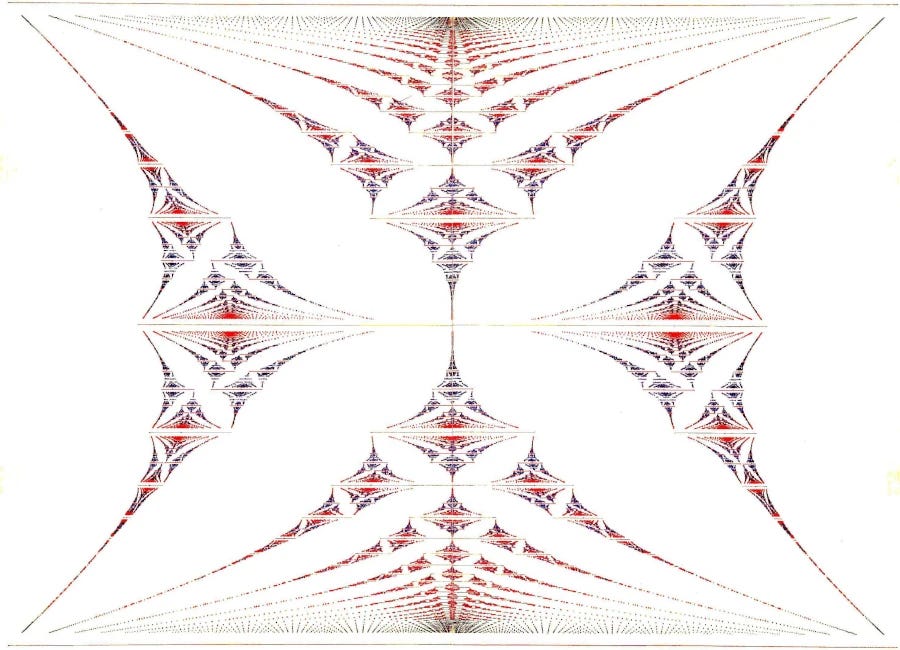
The test can actually be performed. Take Hofstadter’s butterfly—the pretty and perhaps somewhat gratuitous picture at the start of this post. It’s a very early example of graphical data visualisation (part of his 1976 PhD). It’s also fractal and quite arcane, describing the energy spectrum for “non-interacting electrons confined to a two-dimensional lattice in a magnetic field”. And with most materials, you can’t achieve it in the lab because the magnetic fields needed are just too intense. Until 2025, when Kuckolls and colleagues accidentally pulled out just this pattern from twisted graphene molecules. A lot of innovation is lucky rather than directed, and likewise for some of our most challenging tests. Leibniz would not be happy.
The above re-emphasises the importance of competing theories. Like living organisms, theories don’t exist in a vacuum: they bump into one another, and feed off one another, and compete. If we’re honest, then we can see that natural selection can be applied to theories too!
When it comes to the selection of more suitable theories, the Grim Reaper needs to be particularly severe. In terms of logic, a single flawed assumption will taint every deduction that depends on it.
We can’t allow someone to immunise a theory with special privilege. For example, if someone said “This Rule steers the formation of species”, we need to start asking questions like “Can you specify your Rule precisely?”, “Why this Rule’?” and “How have you tried to break your Rule?”12
In my next post, ⇶ we’ll explore how important it is to have a deep understanding of theories. Remarkably, after pretty much everyone read Darwin, understood Darwin and accepted Darwin—apart from a few vocal naysayers—this was followed by a long period during which his main theme fell into disfavour. There are so many parallels relevant to some of our current predicaments, that it’s reasonable to diverge slightly before continuing our study of On the Origin. We did say we’ll take the scenic route :)
My 2c, Dr Jo.
⌘ This symbol is used to indicate posts where I’ve discussed the flagged topic in more detail.
So brilliantly mocked by Voltaire in Candide.
This may also help to explain a concept we’ve already covered—convergent evolution.⌘
Although Abraham Ortelius first came up with the idea of continental drift in 1596.
This argument is hugely strengthened once Mendelian genetics is deployed. But Mendel only published his paper in 1866, and this lay fallow until the spring of 1900. We now have a large literature on sympatric speciation (and parapatric speciation). The current ‘Modern Synthesis’ is that most species form at independent locations (allopatric); there is now evidence that this is at best a Lie to Children.
Technically, myrmecodomatia.
On the plus side, there are neat videos of spiders harvesting Beltian bodies.
When in a later post we get to parasites, then we will see that any form of ‘directed design’ of organisms either blows up or directs one to the conclusion that the designer is more than a little bit bonkers, but I’m jumping ahead.
Recall that⌘ “It’s the volts that jolt but the mils that kill”—here the milliamps are amps.
Interestingly enough, Alessandro Volta invented the electric battery after reading reports on the electric eel by anatomist John Hunter, and studies by two other doctors, John Walsh and Hugh Williamson. Man imitating nature, once again.
Platypuses and echidnas evolved their own.
Plants have even more fun. The plant that gives us robusta coffee is boringly diploid; in contrast, Coffea arabica has double the chromosomes.
And if that Rule is now said to involve some sort of deity, we still need to ask the same questions—gods don’t get a Get Out of Jail Free card.
What, "gods don’t get a Get Out of Jail Free card”? Of course they do, that’s what makes them divine. It’s like presidents, who swear to uphold the constitution and execute the laws faithfully, but are immune from criminal prosecution.
It’s not logic, it’s religion.
You threw me for a moment with “About 286–267 million years ago (Ma) the ancestors of modern boy fish underwent a third WGD known as ‘3R’.” I was wondering how they managed to reproduce if the “girl fish” didn’t also duplicate their genome. Perhaps you were going to introduce sex chromosomes. Then I realised that it was a typo: “boy” for “bony” 🙂