Let's start with receptors
An evolving series of posts ... Part I

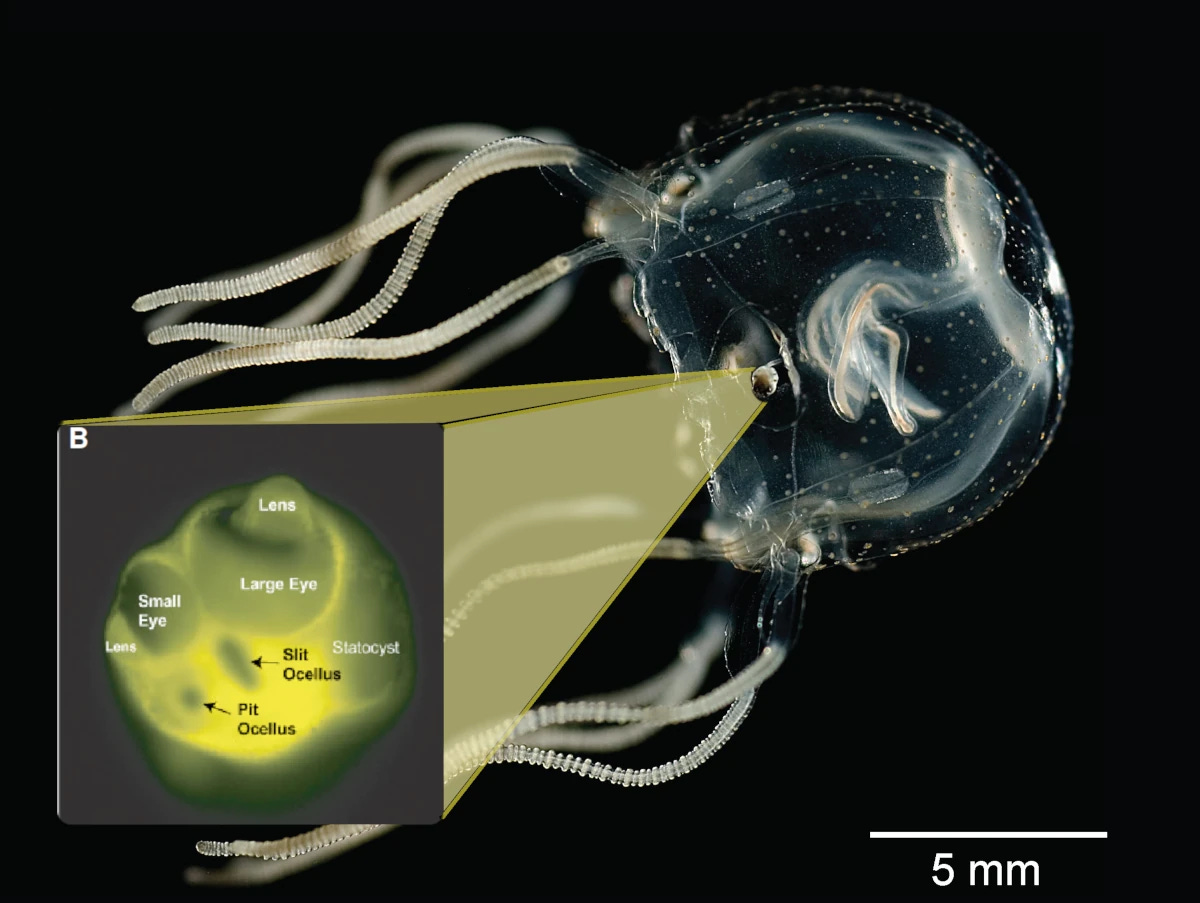
Thanks to everyone who voted. ‘Origins of life’ won over ‘fixing software’. As promised, this will take several posts.
Living organisms are remarkably complex. Trying to grasp this complexity can be mind-bogglingly intimidating. Consider that tiny jellyfish above with its 24 eyes. Why are they there? How do they work? There are other possible questions too, that touch on origins and can mislead the unwary.
Surely the massive complexity of Nature is compelling evidence that there is some ‘designing’ force or principle behind the complexity? When I learnt about how DNA gives rise first to messenger RNA and then proteins, the minimum necessary complexity required seemed immense. What were the chances that, with the first organism, a DNA strand, however simple, would match up to even a single protein (however simple) that did the necessary work? Let alone the vast complexity that seems needed in even the tiniest organism. If you’re incautious, religion may even intrude on such thinking, as seems to be happening more and more in the USA, today. We may be unwise to ignore this completely.
A personal note
When I was young and even more naive than I am now, I started asking origin questions. I was lucky to do so from a precarious point of balance: my parents were polar opposites. My father was an atheist, but my mother was devout.
So, for the first two decades (and a bit more) of my life, I was steeped in religion. And not just staid, run-of-the mill churchgoing-on-Sunday religion. Nope, there was more than a soupçon of fanaticism on display. I became quite familiar with at least one religious disposition—fairly fervent charismatic Christians.
Yep, in my youth, I was paid-up member of the ‘Happy Clappies’, with people crying “Praise the Lord” at the top of their voice, and speaking in tongues all around me.1 Atheism finally won out over a belief in miracles, but why?
Fortunately, I did two things. I read the Book and, as noted elsewhere,⌘ found a multitude of unpalatable and very ungodly actions by the purported Christian God: sending bears to tear apart children who mocked one of his prophets, and Him sanctioning or even promoting child sexual slavery and genocide. This god was as unsupportable as Jeffrey Epstein.⌘
I also thought a lot, and worked out that the other major justification put forward for most belief in religion—the idea that the human ‘soul’ somehow exists and persists separate from functioning nerve tissue—is a relic of past centuries that I could not sensibly endorse,⌘ given even a basic knowledge of neurophysiology. As quaintly implausible and anachronistic as phlogiston, élan vital or pneuma.
But there’s still that problem of complexity. It is however wise to preface further discussion with three observations. First, it’s daft to give religions a free pass—they should surely be susceptible to well-reasoned science.⌘ Second, people of religion need to be honest about whether they have religious ‘non-negotiables’, or whether they will actually follow the science. Third, across all religions, there’s no agreement on pretty much anything. If someone brings up ‘God’, you always have to ask “Which god are we talking about, precisely? And why? What’s wrong with others’ gods?” This can become a bit messy.
Perhaps it’s best not to dwell on the religious backlash to science, despite the fact that modern biology may seem similarly complex and messy. The key point is that we all need to be self-critical, above all else. We need to look for and fix parts of our own models of reality that just don’t work. With this in mind, let’s move on to receptors.
Receptors
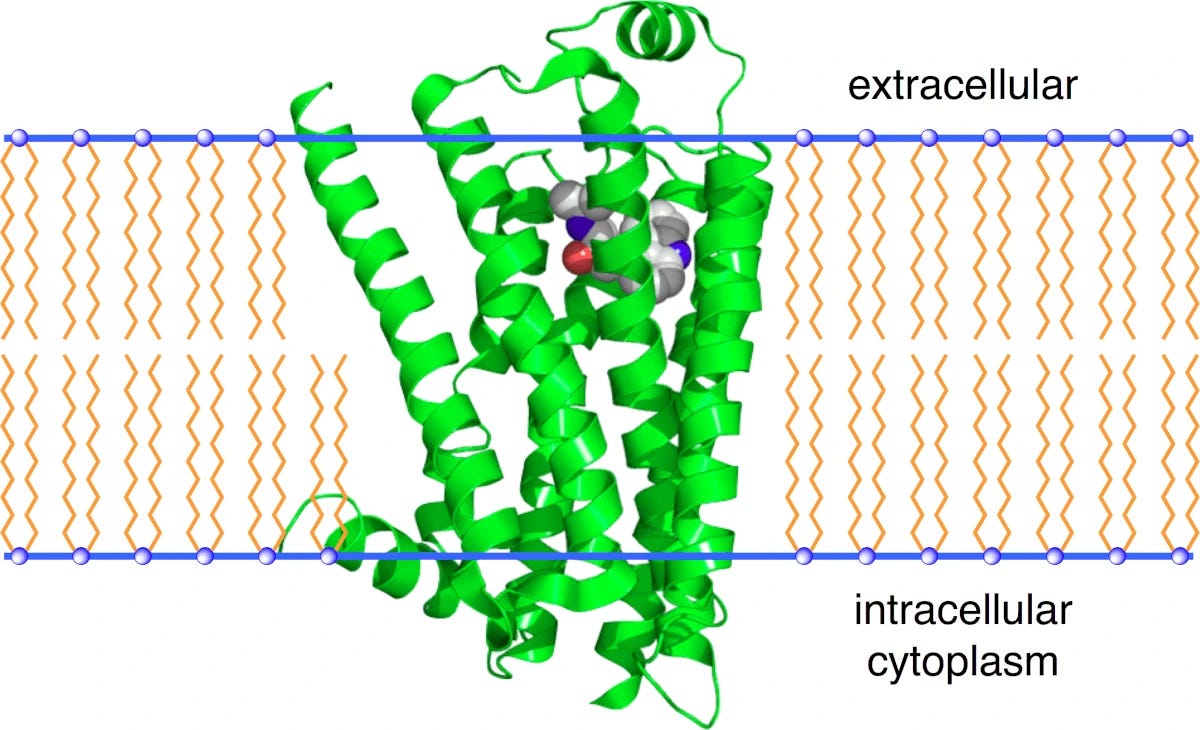
A receptor is a protein. When certain molecules bind to a receptor, it may change its shape, and shape change leads to a change in behaviour: a cascade of downstream effects are observed. In the above picture, the β2 receptor protein (in green) spans the membrane of a cell. A molecule2 like adrenaline binds, and things happen.
We can interpret this whole process as signalling. Adrenaline is a typical example: a bound receptor alters its own binding to another protein called a G protein. This ultimately has profound consequences. In humans, your heart speeds up, your blood pressure rises, your pupils dilate and your liver makes more glucose. Your ‘fight-or-flight’ response is activated. But how does this work? This is where it becomes messy.
Ordinarily, the alpha subunit of the G protein is bound to something called GDP. When that receptor is activated, the G protein can now bind the subtly different molecule GTP. And when this happens, part of the G protein—the beta-gamma subunit—pops off. This is like a molecular switch: the alpha subunit can now activate an enzyme called adenylyl cyclase that churns out messenger molecules called cyclic AMP. And these in turn cause a whole cascade of events.
What was I just saying about complexity? If you’re very familiar with biology, then the preceding paragraph is trite. If you’re not, it may be densely inscrutable. How do we bridge the gap? There are ways …
Lies to Children
Previously I’ve discussed ‘Lies to Children’.⌘ As I noted there, most popular descriptions of how things work are simplified. Pretty much all ‘popular science’ is, whether we’re talking about how rainbows work, how electricity is supplied, or human metabolism.
Lies to Children have value. They can draw us in towards wisdom. They introduce difficult concepts with easily digestible metaphors.3 However, if we are to grow in our wisdom, it’s often wise to point out the ‘Lie’, and to suggest a better model, which is often a more sophisticated Lie to Children! Let’s do some of this—and let me know in the comments if I’ve overstepped the mark in either direction.4


Lock and key—the first lie
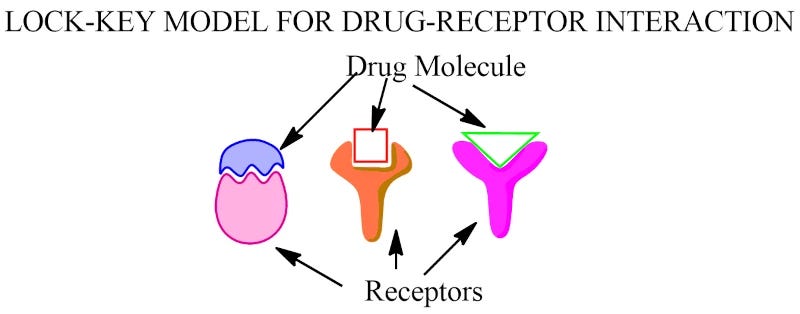
I still encounter medical students who see a receptor as a “lock and key” mechanism. “Turning the key” as an analogy for “receptor activation” is still being promoted. Its simple, after all.
The Lie to Children here is pretty stark: the adrenaline molecule (the ‘key’) saunters along to some sort of keyhole in (say) the β adrenoceptor, turns the lock mechanism, and things start happening. Ugh. Let’s try to do a bit better.
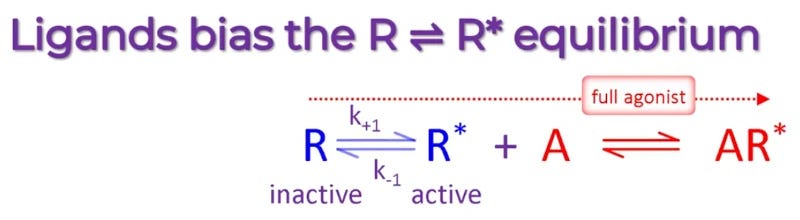
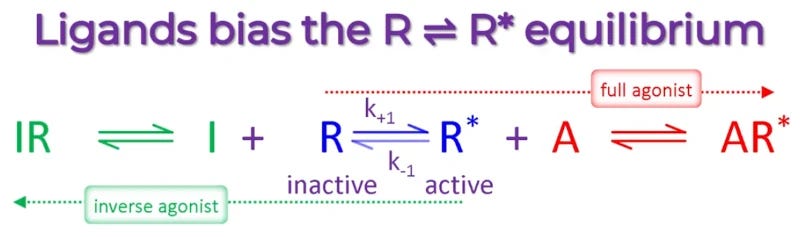
Below is a slightly more sophisticated model. At body temperature, many proteins are rather flexible, and flip between several shapes, ‘states’ or ‘conformations’. The receptor exists in two states, R and R*. There’s a balance between the two, that often strongly favours the R form, where the receptor is inactive. This is a ‘two-state’ receptor model.
When the adrenaline molecule comes along, it binds preferentially to the R* form, and stabilises this. The balance is shifted to the right, and the cascade of consequences happens, as already hinted at. Here’s a graphic:
Imperfect
Am I just nitpicking, though? Nope. Let’s find out why the difference is important. We’ll need a bit of background.
Experimental pharmacologists tend to play rather a lot with strange, new molecules. Generally this boils down to identifying some sort of receptor, finding which drugs interact with it, and then tweaking the shapes of those drugs and seeing what happens. Clearly, to see an effect, we need some sort of response, and often this involves doing terrible things to mice, or somewhat less terrible things to cells. We identified several general properties of this drug/receptor interaction:
agonism—stimulation of the receptor.
partial agonism—stimulation of the receptor, but not as intensely as ‘full agonism’.
antagonism—the drug binds to the receptor, but far from stimulating it, it gets in the way, and prevents agonists from doing their job. It ‘blocks’ the receptor.
From these observations, we worked out that different drugs had different binding strengths at the receptor (different affinity) and that various drugs also differed in their intrinsic activity: how much they stimulate the receptor when bound. How big the response is.
Take the benzodiazepine receptor. Yep, we’re talking Valium. The biggest-selling drug between 1968 and 19825 mainly generated a new bunch of somewhat sedated addicts, but all sorts of variants were made. We found that diazepam is not just sedating; it also has anti-epileptic properties. Diazepam binds avidly to the GABAA receptor (has high affinity, or a tiny dissociation constant), and also has fairly impressive intrinsic activity.
But some strange new drugs emerged. These new agents (beta carbolines and Ro 15-4513) certainly bind that receptor well, but they have opposite effects! They cause mice to become agitated and have seizures. Clearly they’re not very useful in people, but how on Earth do they even work?
The lock-and-key model just doesn’t fit. How can a molecule “turn the lock in the opposite direction?” Embarrassment. But think about it: with the R/R* model, things make perfect sense. All we need at baseline is for the balance to be a bit more in the direction of R*. The benzodiazepine receptor itself has built-in ‘constitutive activity’—it’s ‘on’ a lot of the time. Agonists stabilise the R* form, and inverse agonists stabilise R.
Once we’d worked this out, we realised that a lot of the drugs we’d labelled as ‘antagonists’ are actually inverse agonists. Pretty much all beta blockers, for starters.
Better models
And, of course, the two-state model is also a Lie to Children! An over-simplification. You can work out that the floppiness of the protein doesn’t need to be binary—there can be multiple states. All sorts of complex things can happen downstream, too. The various rate constants like k+1 and k-1 can and do differ. But we’ve made a model that has flaws that are less obvious.
We’re simply doing Science.⌘ Now let’s say we want to jump from seeing how beta adrenergic receptors work, to how they differ. There are three human β-adrenoceptors coded for by three genes: ADRB1, ADRB2 and ADRB3. We can look at how these receptors differ in humans across the globe, or we can even examine other species. But once we’ve decided to do this, we need to understand some of the tools required.
Without this, the literature becomes opaque. For example, pick up the article Diverse Evolutionary Histories for β-adrenoceptor Genes in Humans in the American Journal of Human Genetics. You’ll immediately encounter terms like ‘neutrally evolving’, ‘inferred haplotypes’, ‘major clades’, ‘balancing selection’, ‘Hardy-Weinberg equilibrium’, and so on. Whew! Perhaps we need to step back a bit?
Seven-spanning
Let’s step back rather a lot. If you consult a simple text like the Wikipedia page on G-protein coupled receptors (GPCRs) you’ll see that there are a heck of a lot of them. The human genome alone appears to have over 800 unique GPCRs. They mediate all sorts of different messages, but they have themes in common.
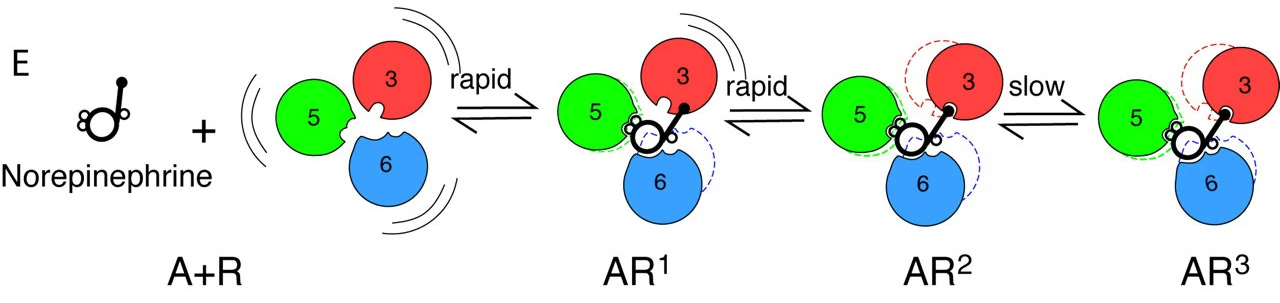
Look at the above image. It’s an even more complex (and better) model, this time how noradrenaline binds to the β2 adrenergic receptor. Consider the coloured circles. The numbers 3, 5 and 6 refer to three of the seven receptor components that pass through the membrane. A theme here is that GPCRs are all “7TM”—the protein passes seven times through the bilipid membrane that encompasses the cell. ‘TM’ stands for ‘transmembrane’.6
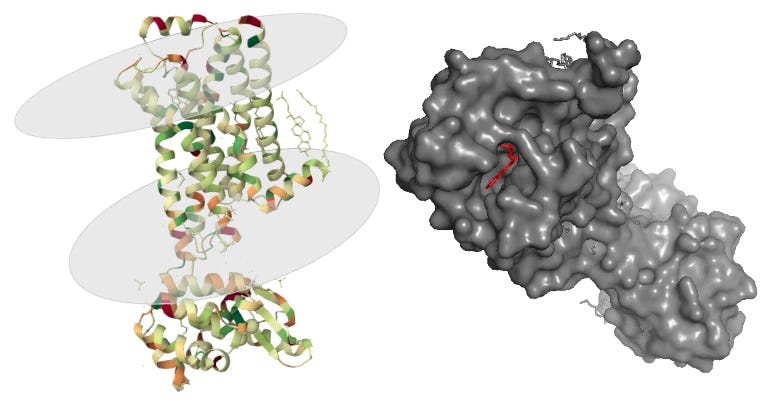
On the left of the following image is a sophisticated rendering of how the β2 receptor fits into the membrane.7 Can you see all 7 helices? On the right I’ve used PyMOL to show a surface view from above—with the bound carazolol molecule in red.
Another theme is GTP/GDP binding. That’s the ‘G’ in G-protein. We know that GTP binding changes the shape of the receptor, resulting in down-stream effects. It seems this setup works so well that we find GPCRs throughout the animal kingdom, and beyond. They’re present in plants, fungi and seaweeds, and even in a very specific subset of of single-celled organisms: those with a membrane-bound nucleus. But they’re absent from other organisms—the Bacteria and Archaea. Why? In my next post, I’ll explore a rational answer that involves a mechanism called natural selection.
But before we end, let’s go back to our box jellyfish from the start. We asked “How do those eyes work?” We can now start to formulate an answer. The eye cells use GPCRs to signal they’ve detected light! In my next post, we’ll look at this in more detail, too. Receptors can be used to draw lots of ideas together, as we try to make sense of the complexity of life.
My 2c, Dr Jo.
⌘ This symbol is used to indicate posts where I’ve discussed the flagged topic in more detail.
Some years after my emancipation, as a medical student I sat in on an interaction between a psychiatrist (Let’s call him “Vernon”) and a distressed young woman. I do not know whether she was actually psychotic, but I do know that Vernon’s interpretation of her ‘symptoms of psychosis’ were entirely concordant with my experiences in the fundamentalist group she was embedded in. As a good, conservative Jewish psychiatrist, Vernon didn’t understand her context. The scary bit here is that I was too intimidated to point out his ignorance. In retrospect, this was fortunate. A close friend of mine did point out an error made by a meta-obsessive compulsive psychiatrist (One of Vernon’s colleagues, who carefully collected and arranged ‘obsessive compulsives’); she was hounded by him for years afterwards.
Technically, in that graphic the molecule is carazolol: it was used to stabilise the structure of the receptor in the ground-breaking work that characterised the β2 adrenergic receptor.
We can also get stuck on the Lie. I get stuck, quite often, and find that those who have promoted the lie have neither bothered to point out that it is indeed a Lie to Children, nor have they provided a way to transition out of it that doesn’t involve postgraduate work! This tends to make me a bit grumpy.
I’ll try to put most of the really fiddly bits into footnotes.
There is also a lot of fiddly stuff related to those four different states of the receptor, and how quickly or slowly transitions happen.
You can click on the link and play with the molecule, moving it around in 3D space.
My brain hurts - and this is just the start! I'm so glad I did my degree when genetics was in its infancy. It's absolutely fascinating, though, and it gives me a glimmer of hope that my son's genetic problems may one day have at least a partial answer. It involves missing receptors, so perhaps this is a vain hope.
Lies to children never stops. Almost every aspect of science gets more complicated when you look at it more closely Even when you get your PhD there will be more details just beyond your grasp. It's a common meme that in finding an answer to a question they discover at least two more questions.
Lies to children get particularly poisonous when legislators pass laws based on their high-school science education.