Sex, Death and Darwin (III)
Evolving evolution, part VIIIc—Just the two of us

This is the third act. The same invitation applies. If you just got here, you may wish to read the primer first, or skip back to the previous post.
“Boys and Girls”
In biology, wherever we make a rule, Nature will have her little games. As noted previously, biologists define a male gamete as small, and a female gamete as larger. In addition, the male gamete tends to be motile; the female not. We’ve come up with several names here— ‘anisogamy’ refers to different sizes; this is not entirely synonymous with ‘oogamy’, where there’s an actual egg cell. It seems clear that all of this is just an extension of isogamous mating types.
Let’s try to break some rules, then. Or at least, explore. Good biologists will know that despite the rule that “male gametes are smaller and motile”, there are a number of exceptions. Actually, over 30 taxonomic groups have representatives with aflagellate sperm. The cost of wiggling sperms is high, so where this isn’t needed, natural selection will find a way.1
Spermatozoan size varies. Some take this to ridiculous lengths. For example, males of the fruit fly Drosophila bifurca have a body length of about 3 mm, but each sperm is 58 mm long when uncoiled! This weirdness may be based on something called ‘Fisherian runaway’, where longer sperms have a competitive advantage … but then the female enlarges her seminal receptacle, for reasons that are poorly understood. The race is on! The testes of this unfortunate fly make up 11% of the male’s body mass, and he needs a special “sperm roller” between the testis and seminal vesicle that packages his few sperm into hypercoiled pellets!
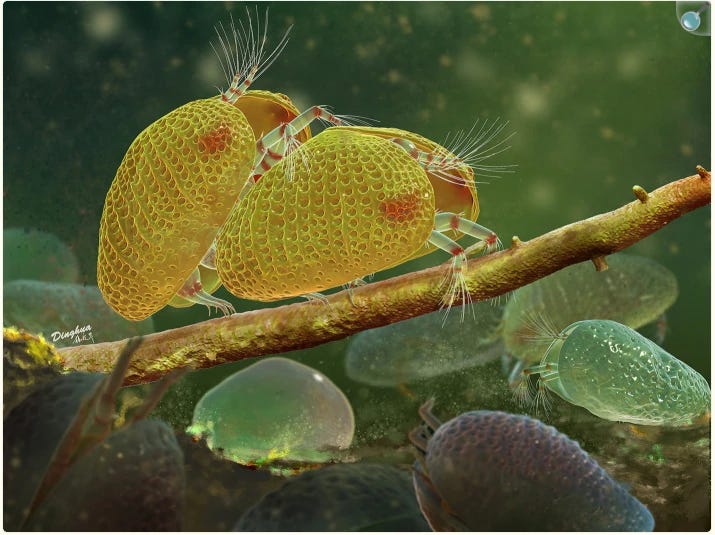
Can we find organisms that top this? Remarkably, yes. As documented in the seminal work of Renate Matzke-Karasz, nonmarine cypridoidean ostracods (‘seed shrimps’) like those pictured above produce giant, nonmotile spermatozoa. Here, sex is taken to extremes:
“For copulation (figure 5), cypridoidean males use their sexually dimorphic fifth limbs, which have hook-like endopods (claspers, figure 4b), to grasp a female while introducing their hemipenes into the female’s paired vaginas. The male’s pair of Zenker organs then transfer the exceptionally long but immotile sperm via the male hemipenes into the female.”
Yep, they have a customised, high-pressure organ (Zenker’s) that is used to ram their giant immobile sperm home. Even these sperm are only about 1% of the weight of the ovum, though. In 1967 Paul R Burton found a more extreme example. The frog lung fluke Haematoloechus medioplexus has spermatozoa that are about 70% of the weight of ova! There may even be flukes out there with ‘isogamy’, by definition.
But, rather than arguing about size, let’s reflect on what’s important here2: appearances should be subordinate to function at both a genetic and a behavioural level. These strange organisms have evolved their baroque sexual mechanics quite because in context they just work, regardless of our definitions.
_PC301461.JPG)
Not done yet
“I’m a tri-sexual. I’ll try anything once”—Samantha, Sex and the City.
This post would be incomplete without discussing the different ways sex is determined. Here, Nature demonstrates her, ah, flexibility. Some of this is just crazy.
We’re all familiar with the XY system found in placental mammals and marsupials, where presence of the single SRY gene generally controls whether someone is phenotypically male, but numerous factors can interfere, as we already know.3
Strangely enough, a similar XY system is found elsewhere, in some snakes and turtles, guppies, fruit flies (where the ‘strength of the X signal’ determines female sex4), and even plants like cycads and the Ginkgo tree. The XY system seems to have evolved independently on many occasions.
In contrast, there’s ZW sex determination. This is found in birds, but also in a number of insects, fish, crustaceans, most snakes, lizards, and even schistosomes, the cause of bilharzia, where male and female spend their entire adult lives in copula, the slender female lying within the male’s gynaecophoric canal. It has also often evolved independently in plants. Here, the ovum determines sex: males are ZZ, and females are ZW. The Z chromosome is the larger of the two.
Then we have XO and ZO systems, the latter only in caddisflies and some moths. In the XO system, females are XX and males XO, lacking that second chromosome. This is found in numerous insects, and a few mammals. Strangely, males of the nematode Caenorhabditis elegans are XO, but worms with XX are hermaphrodites.
Then there are the weird ones. The platypus has five different X chromosomes, and five different Y chromosomes; males are X1Y1/X2Y2/X3Y3/X4Y4/X5Y5; for females, replace the Ys with Xes. Bryophytes (mosses), and many algae have a UV system, where independent, distinct, haploid male (V chromosome bearing) and female (U) organisms produce male and female gametes (respectively), and these unite to give rise to spores. This underlines the continuity from isogamy to anisogamy.5
In contrast to the systems already mentioned, where sex chromosome sizes differ, some organisms like pythons and pufferfish have almost identical sex chromosomes (‘homomorphic sex chromosomes’). In others, the sex-determining part of the chromosome can jump around.
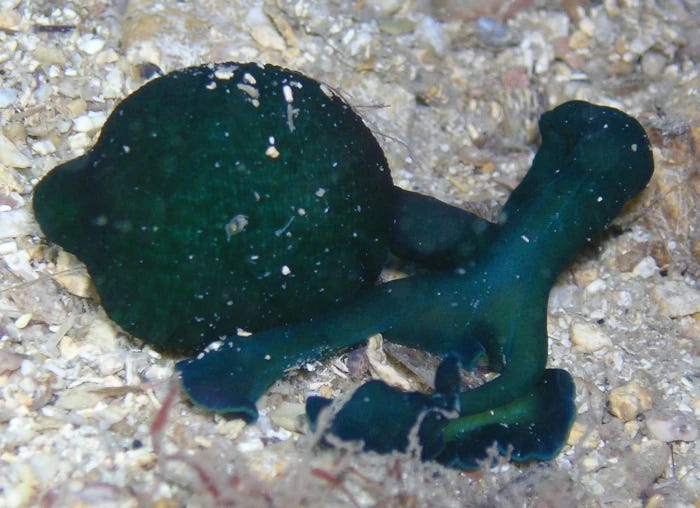
But wait! There’s more. We have organisms like the green spoonworm Bonellia viridis, pictured above. Larvae become male if they touch a female. Infection with Wolbachia can turn ZZ genetic crustacean males into functional females who are able to reproduce. And we don’t talk about Clarias gariepinus, or the long list of unisexual vertebrates.

Let’s end with frogs
If you thought all that was weird, well then, let’s get back to fertile hybrids. Frogs of the genus Pelophylax often mate across species. In fact the edible frog—still popular in France—is a cross between the pool frog P. lessonae (L) and the marsh frog P. ridibundus (R).
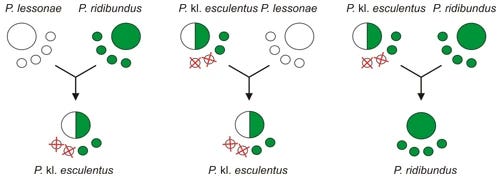
The fun starts when, say, an LR hybrid mates with either a pool frog or a marsh frog. They will tend to indulge in a bit of hemiclonal hybridogenesis: one parental genome will be completely excluded, with no recombination. This results in either a similar hybrid, or offspring that revert to one of the original species.
Previously we met a molly⌘ who reproduces by gynogenesis, excluding male DNA; now we have a hybrid species that also uses some DNA from another species, discarding that of one of its parents.6 Look at the picture above: on the left, we have the LR hybrid forming; when LR meets L in the centre, we ended up with another LR, but in the example on the right, LR + R resulted in RR.
The system is ‘hemiclonal’, because half the genome is sexually renewed with every generation and the other half is cloned. Things become very messy when hybrids mate with hybrids, though—we tend to run into variable degrees of genome exclusion, and triploidy.
Did I mention that in different populations of frogs, it may be a bit tricky even determining which are male, and which are female? This is most prominent with the Japanese wrinkled frog Glandirana rugosa, populations of which may run on XX/XY or ZZ/ZW. Finally, Hochstetter’s frog from New Zealand is a bit ‘WO’, and can have between one and sixteen supernumerary sex chromosomes—just one is sufficient to make the frog a female.
Species only looks simple, and when it comes to sex, most bets are off. Nature does what she wants to do—what works at the time. Evolution has a wonderful, random component that explores the space of what is possible.
And now we’re done. In my next post, ⇶ I’ll dip into a maelstrom. If you thought we’d found the weirdest things Nature has to offer when we did sex, you may want to sit down carefully before we explore parasites.
My 2c, Dr Jo.
⌘ This symbol is used to indicate posts where I’ve discussed the flagged topic in more detail
In contrast, the giant northern termite Mastotermes darwiniensis—another Darwin connection—has spermatozoa with a hundred flagella.
We should in all fairness note that the immotile spermatozoa of Mytilocypris mytiloides gain motility in the female receptacle.
Including, but not limited to some types of congenital adrenal hyperplasia, MRKH syndrome, conditions with unusual numbers of X and/or Y chromosomes, XY gonadal dysgenesis and related disorders. The SRY gene may be present but inactive; the SRY gene can rarely cross over to an X chromosome. Androgen receptors may not work. Then we have mosaicism, and a variety of other conditions.
Fruit fly sex determination is complex, basically depending on the autosome-to-sex-chromosome ratio, which activates the ‘Sex-lethal’ (Sxl) master gene.
There’s a slight nomenclature burden here. The volvocines and most other green algae have a haplontic life cycle; most are dioicous (aka heterothallic). Our friend from before, Chlamydomonas with its isogamy lies outside the volvocine clade. Thank goodness for dictionaries, so we can all play! Mostly. But if you’re not familiar with the term ‘gametolog’, it may cause a bit of noggin-scratching, as it was only invented in 2000: it refers to similar (homologous) genes on opposite sex chromosomes. It should also be clear that in these organisms, formation of gametes involves mitosis, not meiosis. All good?
Technically, a species that requires input from another taxon is called a ‘klepton’.
Nature just says "I'll try anything once."