Parasites are Galling
Natural selection really gets going: Part IX

Men, are just bigger, more complicated gall wasps.”—Alfred C Kinsey (author of The Kinsey Report)
The Vermin only teaze and pinch
Their Foes superior by an Inch.
So, Nat’ralists observe, a Flea
Hath smaller Fleas that on him prey,
And these have smaller yet to bite ‘em,
And so proceed ad infinitum:
Thus ev’ry Poet, in his Kind
Is bit by him that comes behind—Jonathan Swift, 1733 (On Poetry: A Rhapsody)
From my last tripartite post,⌘ you might deduce that with sex, Nature has provided her most baroque exploration of what is possible in the realm of natural selection. Not even close! Pride of place must surely go to parasites.
Sex mostly boils down to the tricks you can get up to with two gametes (putting aside our exploration of organisms with thousands of sexes⌘); with parasites, there is a far more expansive space to explore. Parasites have been outrageously, uproariously, astonishingly successful. (You only need look at those quintessential macroparasites, billionaires.) They are also, often really disturbing, so readers with a weak stomach may wish to read on with caution.
What is a parasite?
The word ‘parasite’ evolved through Mediaeval French and Latin from the original Greek παράσιτος, somebody who ‘eats at the table of another’, alternatively perhaps “food on the side”. Today we emphasise harm to the host, to tease it out from commensalism,1 where the host suffers no harm, and mutualism, where both organisms benefit.
As happens every time we try to categorise, grey areas pop up. This hasn’t of course stopped biologists from being pedantically precise. They have meticulously categorised the various kinds of parasite. This too is messy—we get obligate parasites that simply must have a host, and facultative ones that don’t; we get ectoparasites that live on you and endoparasites that live in you; as Jonathan Swift suggests, we get parasites of parasites. We encounter microparasites, which tend to reproduce within you, so harm is independent of the initial number of infecting organisms, e.g. malaria; and macroparasites like ticks and tapeworms. The margins can blur.
Parasite patterns
Among the hundreds of different ways parasites have explored what they can get away with, patterns emerge. Robert Poulin and Haseeb Randhawa identify six common approaches. These represent convergent evolution—some things work, others just don’t. They tease out:
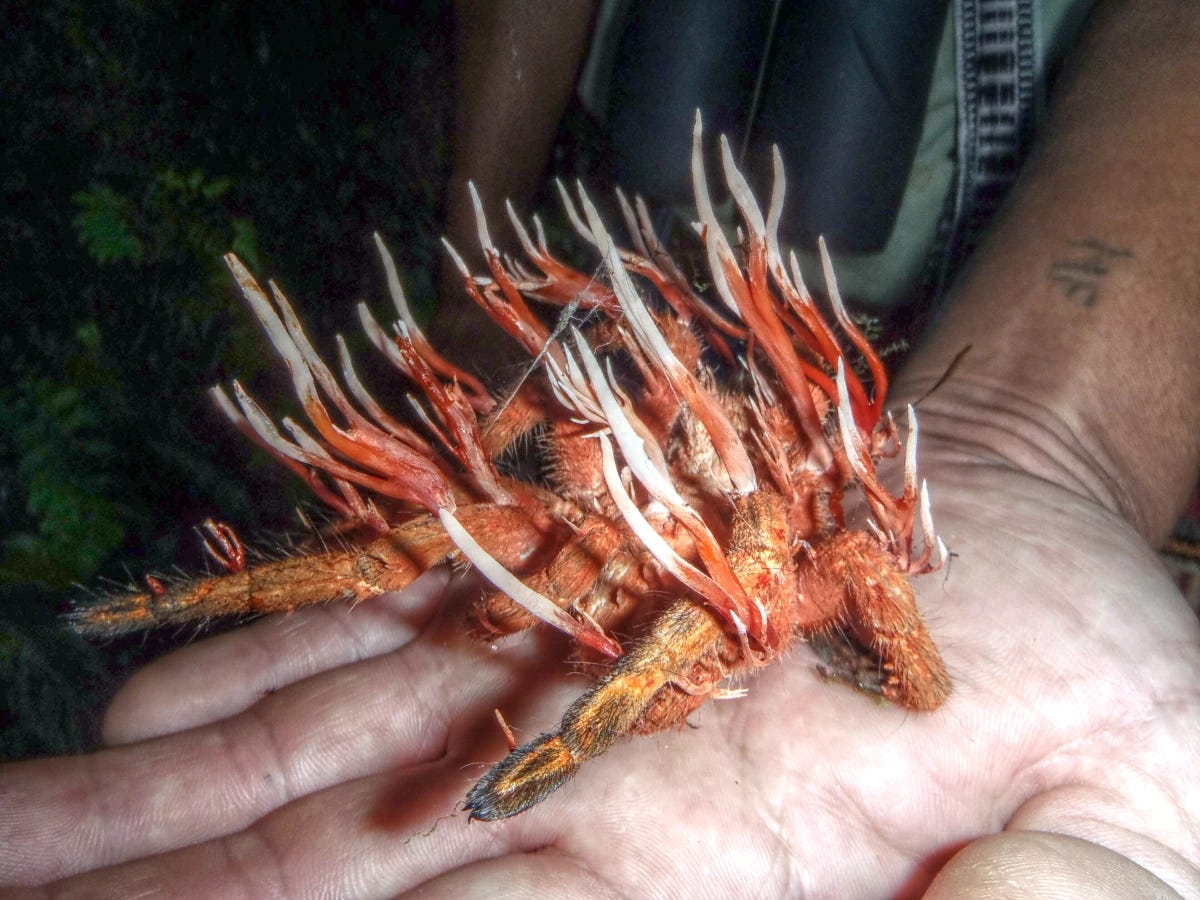
Parasitoids—parasites that grow within the host, eating it from the inside, generally until it dies. These include any number of wasps that inject eggs into other animals, often stabbing them with extremely long, slender ovipositors in order to embed that egg; and the remarkable Cordyceps fungi2 that inspired the zombie fungus game (and TV series) The Last of Us. The picture at the start of my post is representative, disturbing and even rather pretty.
Parasitic castrators—yep, you read that right! In various ways, they take over the host resources that would have been used for reproduction, for their own purposes.
Directly transmitted parasites—these tend to proliferate on or in the host, and then spread in a variety of interesting ways. Examples are viruses, bacteria, lice, mites, fungi, and many other types of organism.
‘Trophically’ transmitted parasites—These are more exotic. They require at least two hosts, in a specific order, with the definitive host generally eating the preceding host. Think tapeworms, flukes and many ‘protists’ like Toxoplasma.
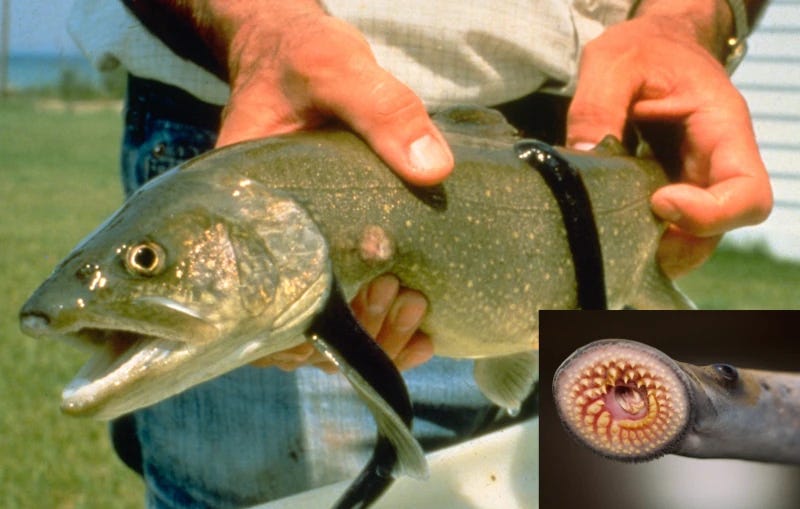
‘Micropredators’—rather than eating their victim, like a true predator, a micropredator is content with just a sample, usually blood. They range from ticks, leeches, mosquitoes and fleas, to lampreys (which bore into the flesh of other fish) and vampire bats.
Vector-transmitted parasites—these work hand-in-hand with micropredators, often hitching a ride on the latter. For example, malaria parasites require a mosquito; Trypanosoma, which causes sleeping sickness, needs a biting fly; many other organisms are transmitted by micropredator vectors. We all know of rabies and vampire bats.
Naturally, there’s a lot of cross over. As Poulin and Randhawa point out, the patterns are pretty general—they work for plants too, include sap-sucking micropredators (which transmit parasites in their own right), and parasitoids like strangler figs.
First I’ll hijack your brain, then castrate you. Next, you’ll be swallowed alive
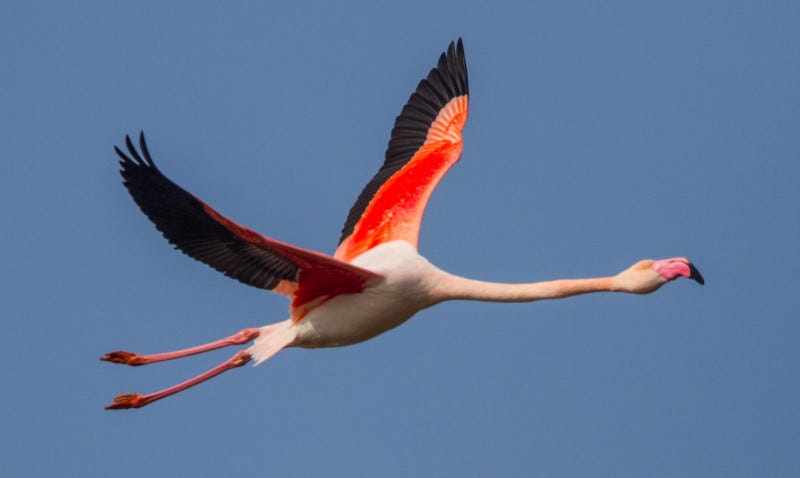
Flamingolepis liguloides is a tapeworm. It’s also a parasite that castrates the brine shrimp it infects as an intermediate host. It then modifies host behaviour so that they gobble up large amounts of carotenoid pigments and congregate near the surface, making the bright red shrimps easy targets for hungry greater flamingoes, the definitive host.
Nicolas Rode and colleagues studied this in detail in Artemia brine shrimps (You know these as ‘sea monkeys’). They argue that the most reasonable explanation for swarming of these shrimps is manipulation by parasites, finding that swarming is much more common in shrimps infected by this and other parasites.
The interesting wrinkle here is that carotenoids are immensely valuable to the flamingo. First, the flamingo uses them as cosmetics—the uropygial gland secretes carotenoids3 which they then apply to their feathers. They also secrete carotenoids into the crop milk they feed their offspring—so care-worn mother flamingos fade to pale as their offspring thrive.
The other Kinsey
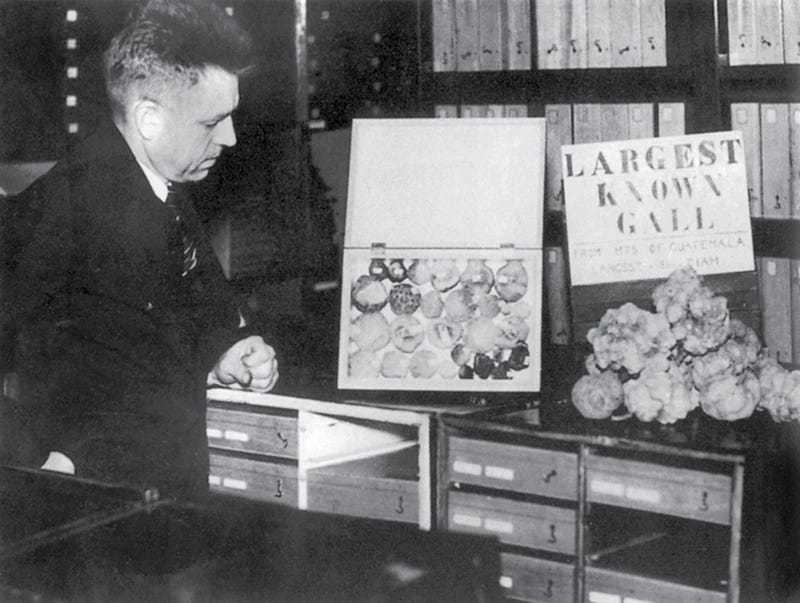
Everyone knows zoologist Alfred Kinsey as the author of the Kinsey Reports on human sexual behaviour. The 1948 release of Sexual Behavior in the Human Male was compared in its effect to an A-bomb. Few people know that before this, Kinsey was an avid collector of gall wasps.
When I said ‘avid’, I likely understated things a bit. The jewel in the crown of the American Museum of Natural History in New York may be Kinsey’s collection, housed in a twenty metre long room. Before he turned to sex, Kinsey spent two decades collecting an astonishing 7.5 million specimens, meticulously labelling each one.4 Later, he merely transferred his passion for meticulous collection to, well, human sexual histories. But what even is a gall wasp?
Galls are fleshy outgrowths on plants.5 They serve no function for the plant. They are weird organs produced in response to substances secreted by the larva of the gall wasp, and provide nourishment and protection until it’s ready to chew its way out and repeat the cycle. An added complexity is that the gall wasp often alternates between sexual and asexual generations—and the two generations produce galls at different sites. For example, asexual Belonocnema kinseyi form galls on the undersides of leaves; the sexual generation forms galls on roots.
Galls are not simple.6 One theory of the origin of galls is that they are not just food, but also provide protection from other wasps—parasitoids—that lay their eggs in the body of the gall wasp larva. The ‘Enemy Hypothesis’ suggests that similar gall defences will exclude similar parasitoids, resulting in different communities associated with different gall structures. For example, thick or hairy galls will necessitate parasitoids with long ovipositors. There is specialised competition here, with the gall wasp and the parasitoid in yet another Red Queen’s race.
Galls form a small but complex parasite ecosystem. There can be multiple different levels of interaction between species going on. For example the parasitoid wasp Hobbya stenonotus is a hyperparasitoid: it parasitises Torymus cingulatus, which is itself a parasitoid of various gall wasps. Then there are the inquilines: wasps that lay their eggs in the galls, but can’t form galls themselves. These are commensals rather than parasites, but some are nevertheless effectively kleptoparasites, stealing food from the gall wasp larva.7


.jpg)
_(8521269688).jpg)
.jpg)

Louse got your tongue?
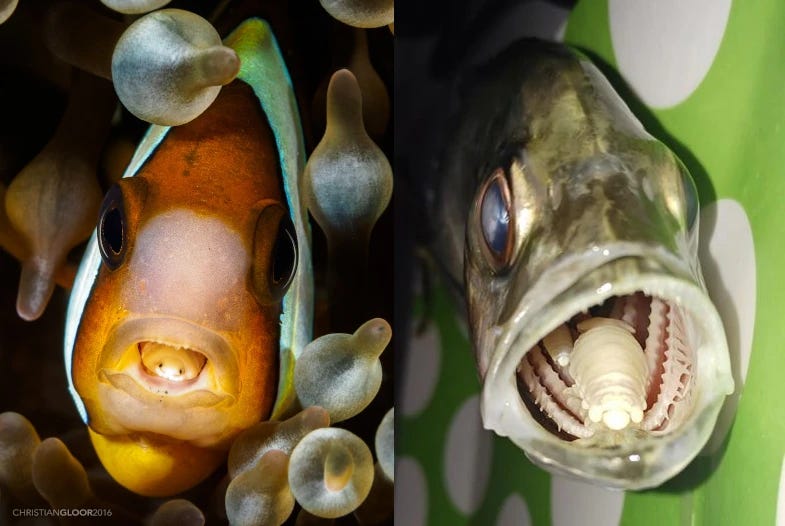
Aficionados of the bizarre will likely have met the popular Cymothoa exigua, the parasitic isopod that enters the gills of the fish as a juvenile, clamps down on the tongue, and then replaces it.8 When it comes to other crustacean parasites, though, C. exigua is pretty mild. The parasite/tongue mostly still works.
Take Sacculina carcini, a parasitic barnacle that commonly affects the green crab. A female larva (cypris) settles on the crab and crawls over it until it finds a soft spot. It then changes, forming a tiny ‘kentrogon’, which injects a mass of cells (the ‘vermigon’) through a tube in its head that resembles a hypodermic needle. Once inside the crab, the vermigon forms threads that ramify throughout the host.
The parasite then castrates the host, and if the host is male, converts it into a female in form and behaviour. It extrudes reproductive organs in the form of a sac-like ‘externa’, with an ovary and a mantle. The externa then release pheromones, which attract male cyprids. The males are hyperparasites, going through a very transient stage (the ‘trichogen’) that burrows into the female, and then parasitises her, becoming reduced to a mass of reproductive tissue.
Then the fun really starts. A female crab would normally carry its egg sac just where the externa sticks out—and the vermigon forces the crab (including feminised males) to care for the externa just as if it were her egg sac, defending it against predators until the cycle is ready to be repeated.
_The_Emerald_Cockroach_Wasp_or_Jewel_Wasp_(15683609164).jpg)
Stereotactic brain surgery
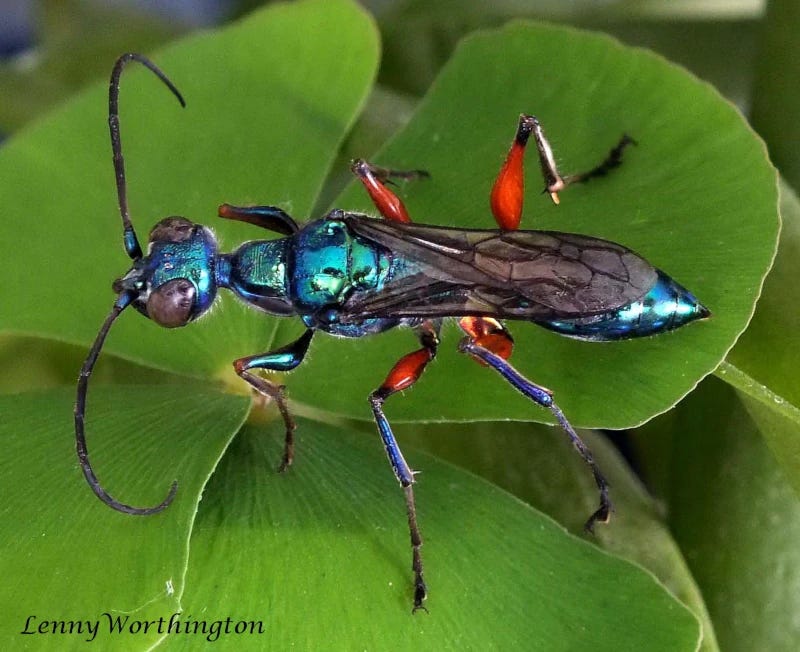
Beautiful, isn’t she? The emerald cockroach wasp above is also skilled at brain surgery. She hunts down and stings a cockroach—twice. The first sting is into the thoracic ganglion, transiently paralysing the front legs of the victim. She then very precisely places her stinger in the victim’s brain, turning off its escape reflex.9 The roach grooms itself intensely for half an hour, and then settles down.
This is just the start: the victim, which is larger than the wasp, first has its antennae docked, after which the wasp feeds on its haemolymph (‘blood’) and leads it to her burrow. After laying an egg or two on the roach, she closes the burrow, leaving the parasitoid larvae to chew their way selectively through cockroach viscera, carefully eating the least important bits first so as to prolong the life of the victim. The cockroach won’t try to escape, as the effect of that second sting lasts for over two weeks, enough time for it to be consumed. The larvae then pupate and burst forth from the remnants of the roach as adults.

Baroque cycles
Other parasites have more complex cycles. Take Dicrocoelium dendriticum. This liver fluke usually infects ruminants like cattle, sheep and goats (definitive hosts), but can also infect humans in two different ways. We’ll get to that, but first, the normal life cycle.
The adult fluke lives and mates in the bile duct of the host liver; eggs pass through the bile into the faeces. A land snail then eats the poo, and miracidia are released. The snail walls off the parasites in the gut, and then passes the juvenile parasites out, covered in mucus.
Next, we have an ant, which eats the snail ‘slime ball’, together with hundreds of juvenile flukes. These mature into metacercariae, which move to a cluster of nerve cells just below the gullet of the ant, and take over its behaviour. Every evening, the ant moves away from its colony, climbs to the top of a blade of grass, clamps the tip of the blade with its mandibles, and stays till dawn, when it rejoins its group. Eventually, a grazing animal will eat the ant, and the life cycle is complete.
Very occasionally, humans will ingest such an ant, and D. dendriticum will infest their bile ducts. But there’s another way. This is called halzoun. If you eat undercooked liver containing the flukes, the flukes themselves invade your throat and nose, causing severe allergic symptoms that are difficult to diagnose as fluke-related.
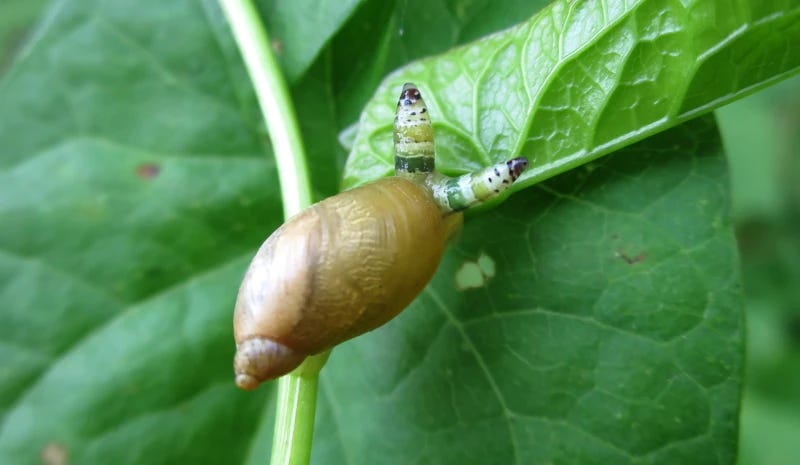
If we’re looking for weirdness, though, pride of place may go to Leucochloridium paradoxum, pictured above. The eyes have it! The caterpillar-like eye-stalks of the snail are actually pulsating broodsacs of the parasite sporocyst. These can even become detached from the snail, and live an independent existence for about an hour—enough time for a caterpillar-loving bird to gobble them up, at which point metacercariae emerge from the thick coat of the sporocyst and migrate to the bird’s cloaca, where the adult hermaphrodite flukes lay eggs. A snail eats a shed egg, hatching into a miracidium that penetrates the gut of the snail, moves to the liver, and forms a sporocyst. The cycle continues …

Lend us a leg?
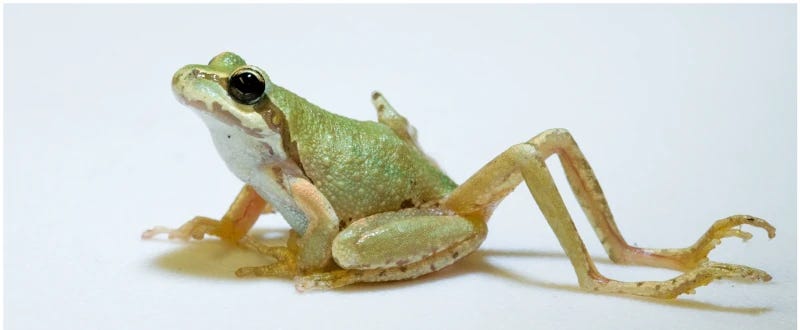
The definitive hosts of the flatworm Ribeiroia ondatrae are predators that eat frogs: herons, hawks, ducks and even badgers. As you can see from the picture, this trematode has found an extraordinary way to slow down the frog so that it’s easier to catch.10 Because the free-swimming cercariae attach themselves to tadpoles and then burrow into the regions where limb buds are forming, limb abnormalities result, including rather useless extra legs.
Once the frog is eaten, the flatworm reaches sexual maturity in the gut, releasing eggs. The eggs hatch to form miracidia, which home in on a particular type of water snail. This releases cercariae, and the cycle repeats.
Cuckoos—back to Darwin
One way to look at all of the above—rather nauseating—variety is simply to marvel at its strangeness. Another is to realise that the reason why all of this weirdness comes about is simply because certain patterns work, and through natural selection, a multitude of patterns is continually being tested out.
In many ways, this is like the eyes we explored near the start of our Darwinian journey.⌘ A multiplicity of different eyes arise, simply because they can arise. There is no deeper meaning.11
Vigilant readers will already have noticed that when I explored the seventh chapter of Darwin’s On the Origin of Species, I did bees⌘ and then explored eusocial animals and slavery⌘ (aka ‘dulosis’); but I skipped over cuckoos. This was mostly because cuckoos are a form of brood parasite. With our current focus on parasites, it’s time for cuckoos.
I’m not going to labour the point. Here, we have yet another pattern. Bringing up offspring is advantageous but energy-intensive. Teleologically, if you can deceive someone else into looking after your own descendants, why not? We see brood parasites emerging wherever we look. Among birds, it’s not confined to cuckoos; we have cowbirds (which are like brood parasite mafia, destroying the nests of parasitised birds that kick out the parasite), whydahs, honeyguides, indigobirds and the black-headed duck. There is even a cuckoo catfish (Synodontis multipunctatus).12 There are cuckoo bees and bumblebees; and many different species of butterfly use pheromones to trick ants into raising their larvae as if they were their own brood.
If we return to Darwin’s chapter on ‘Instinct’, we find him puzzling about how this sort of complexity might come about. As we’ve previously found, his intuition and explanations hold good—minor variation combined with natural selection can, over time, lead to the most baroque refinements to behaviour. Refinements that overflow into every aspect of biology. A bird accidentally lays its eggs in the nest of a different species; this succeeds so well, that all sorts of refinements develop.
Again, Darwin simply makes sense. ⇶ In the next chapter, I’ll end off our exploration of Darwin’s book, at which point we’ll move on to some more recent wonders.
My 2c, Dr Jo.
⌘ This symbol is used to indicate posts where I’ve discussed the flagged topic in more detail.
From the Latin for sitting at the same table.
Ophiocordyceps robertsii is a New Zealand fungus that parasitises caterpillars. Charred, this was used to make ngārahu, the ink used for traditional tattoos.
Notably canthaxanthin, E161g—not approved for use in New Zealand, but permitted to be added to trout, salmon and poultry feed in the EU.
With the help of students
For centuries, the pigments in galls have been a vital component of ink.
Oak gall wasps have been astonishingly successful. There are hundreds of species that affect over 150 oak species in the Nearctic realm alone—Kinsey’s foraging ground. Worldwide there are well over 1000 species. There is a lot of argument about classification.
Kleptoparasitism is extraordinarily common in nature.
As C. exigua is a protandrous hermaphrodite, only males enter the gills. Later, they may develop into females.
Her venom acts as an octopamine blocker.
Salamanders and fish can also be used as secondary intermediate hosts.
If, instead, we try to perceive some sort of prime mover behind all of this, we are quickly driven to wonder what kind of weird mind or intelligence could even conceive most of this stuff, let alone voluntarily reify it in flesh.
The cuckoo wrasse, however has nothing to do with cuckoo-like behaviour.
This is wonderful! Plus now I have something nice and concise to point to when warning a non-biologist friend about inviting a parasitologist to dinner
It may be a bit far afield, but I'm led to think of one social equivalent of a parasite, the 'career politician'. There was once a time that politicians performed a semiskilled service job and then step aside, but they've evolved (perhaps initially in the U.S., now widespread elsewhere) to hold on to their 'public servant' roles indefinitely and monetize them to the greatest extent possible. Of course they give the appearance of offering some value (mostly to business interests and wealthy constituents), but it's pretty clear they 'eat at the table of another' with no compunction for any harm done to their citizen hosts.