Living in a Simulation
Well, are we?

‘The poet Hoha once dreamed he was a butterfly, and then he awoke and said, “Am I a man who dreamed he was a butterfly or am I a butterfly dreaming he is a man?”’ said Lobsang, trying to join in.
‘Really?’ said Susan briskly. ‘And which was he?’
‘What? Well…who knows?’
‘How did he write his poems?’ said Susan.
‘With a brush, of course.’
‘He didn’t flap around making information-rich patterns in the air or laying eggs on cabbage leaves?’
‘No one ever mentioned it.’
‘Then he was probably a man,’ said Susan. —Terry Pratchett, Thief of Time.1
Do we live in a simulation?
There’s an obvious answer here “Of course not! Just no, guys.”
That hasn’t stopped a bevy of ostensibly intelligent, sometimes intelligent or allegedly intelligent people from saying “Of course we do”. So let’s look at some of their arguments. We’ll then point out why they’re loony :)

The Matrix, then?
I loved the first movie. Brilliant ideas, compelling performances and remarkable fight scenes and visual effects, especially Trinity’s 360. Bullet time. The pills. The cat glitch. The downward flowing green characters. Great fiction. William Gibson called Neo his “favourite ever science fiction hero, absolutely”. But as reality?
There is of course a Wikipedia page on the ‘Simulation hypothesis’. And every science and pseudoscience publication has also chipped in, as have a multitude of science commentators and rich people who believe that this makes them special.2 Let’s start with philosophers. I can’t help but lead in with the following simulation exercise, which has something to say about the practical worth of philosophers :)
Bostrom
With the simulation hypothesis, philosopher Nick Bostrom features prominently. He claims quite reasonably that advanced civilisations will become capable of creating detailed simulations of conscious entities; he also seems to suggest that they may well use these in such profusion that any randomly chosen conscious individual is almost certainly living in a simulation. He provides just 3 options:
Almost no civilisations reach a high level of technology; or
Almost none of them are interested in running simulations of primitive ‘ancestor’ societies; or
“The actual fraction of all observers with human‐type experiences that live in simulations” is close to 1.
This is a pile of fetid dingo’s kidneys, for several reasons.3 Below we’ll explore the fatal defect that he shares in common with other philosophers (and even physicists). But even superficially his argument is shonky.
First, in his document on page 7, he asserts without justification that the average number of ancestor‐simulations run by “interested civilizations” will be “extremely large”. Why? Simply because they have “immense computing power”! In typical philosopher mode, he doesn’t even talk about things like waste heat,4 and tradeoffs. If the preponderance of advanced societies isn’t mysteriously and heavily into ancestor simulation, his whole argument collapses.5
Second, he abuses the energetics even more by allowing simulated societies to advance to similar levels, and then simulate in turn! And so on! Recursively.6 Sadly enough, not a few people seem to be hung up on this argument.7 For example …
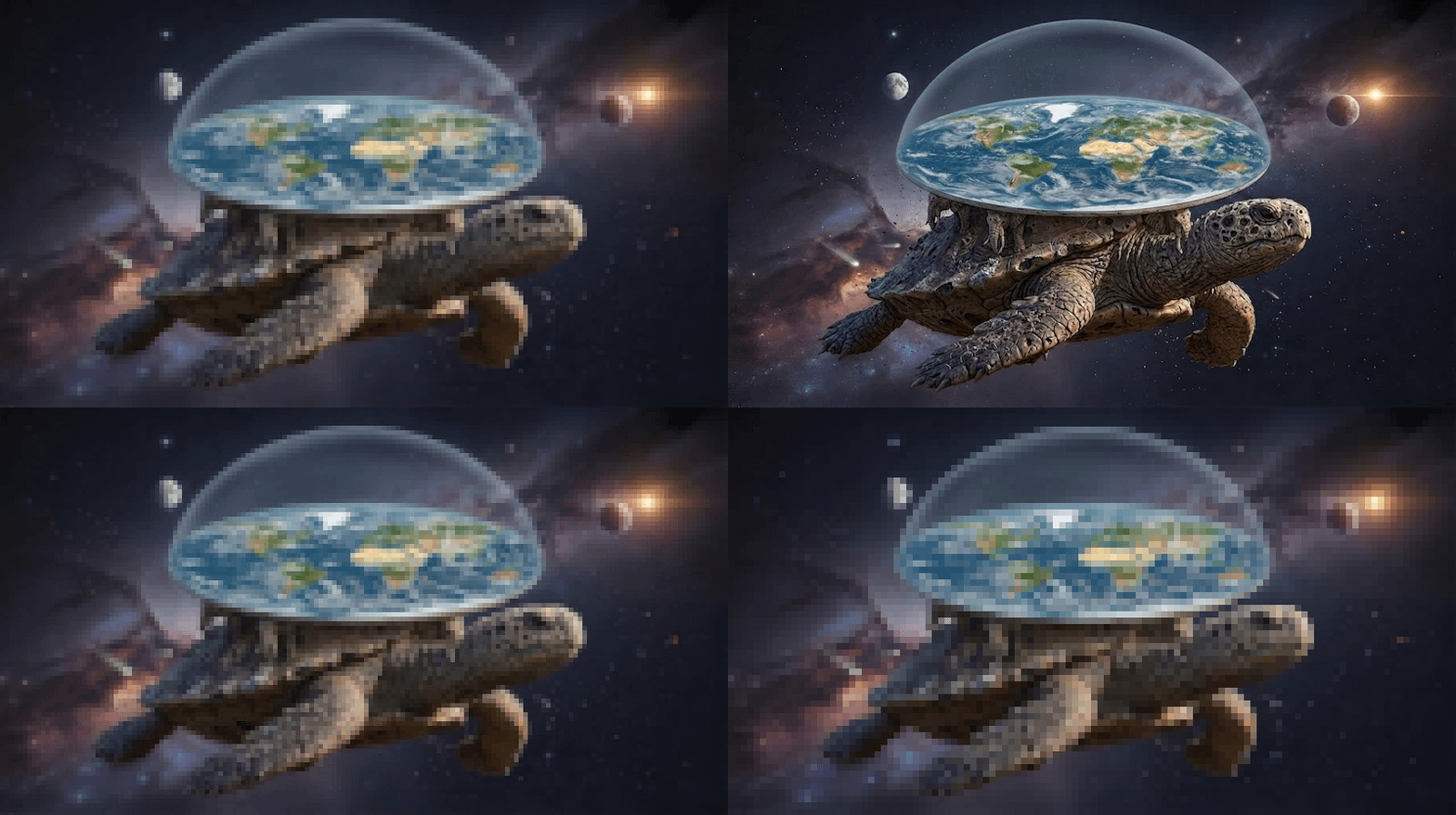
Turtles all the way down
My opponent’s reasoning reminds me of the heathen, who, being asked on what the world stood, replied, “On a tortoise.” But on what does the tortoise stand? “On another tortoise.” With Mr. Barker, too, there are tortoises all the way down — Joseph Barker, 1854.
David Kipping (publishing in the predatory journal Universe) produced a paper called A Bayesian Approach to the Simulation Argument. He seems appropriately uncomfortable with the idea of ‘turtles all the way down’, so he puts some bottom limit on the number of turtles in the layer. That’s a large part of his argument, by the way. He claims to show that:
… the probability that we are sims is in fact less than 50%, tending towards that value in the limit of an infinite number of simulations.
I’m a great fan of Bayes’ theorem, which he depends on here. But as previously discussed, we need to look at two things rather carefully—our priors and our model. For example, we saw how the Bayes Information Criterion is demonstrably inferior to the AIC,⌘ when our list of models doesn’t contain the correct model. If you have a lot of time to waste, read Kipping’s paper and interrogate his model. He doesn’t even mention terms like ‘waste heat’. But others have taken different approaches, for example …
Vopson
If you found Bostrom a bit too rich for your liking, be very careful with Melvin Vopson. In his The second law of infodynamics and its implications for the simulated universe hypothesis, which remarkably snuck into AIP Advances in 2023, he says this sort of thing:
Since the second law of infodynamics[sic] appears to be manifesting universally and is, in fact, a cosmological necessity, we could conclude that this points to the fact that the entire universe appears to be a simulated construct.
Before you drown in nucleotides and whatnot, you may wish to read Lorcan Nicholl’s recent comment on PubPeer. He doesn’t hold back:
The evolutionary example based on the SARS-CoV-2 genome conflates Shannon entropy defined over nucleotide sequence ensembles with thermodynamic entropy of a physical macromolecule, then claims that this biological trend follows strictly from a novel proposed universal law. This is a category error.
We won’t talk about the rest of this utterly bizarre article, or indeed his other blunders.
Faizal et al.
“But as experience shows, even the most determined wet blanket cannot prevent people from appealing to [Gödel’s first] incompleteness theorem in contexts where its relevance is at best a matter of analogy or metaphor” — Torkel Franzén.
And if you thought Vopson was a bit unusual, then check out Mir Faizal and colleagues. Interestingly, on his list of co-authors is Jeffrey Epstein fanboi⌘ and sex pest Lawrence M Krauss.
This one was punted in Futurism, but first appeared as Journal of Holography Applications in Physics 5 (2), 10-21 (2025) under the title Consequences of Undecidability in Physics on the Theory of Everything. You don’t need much expertise to realise that this is a huge pile of tosh, because the authors reveal their busted flush in the abstract.
Yep. As I’ve pointed out before, any invocation of Gödel’s incompleteness theorems outside the orbit of an expert mathematician’s exploration of their consequences is a sure-fire stigma of a crank.⌘ As if these unholy stigmata are insufficient though, they give us the whole crucifixion scenario: singularities, information theory, computational undecidability, and a demand for “non-algorithmic understanding”.
But unlike the above arguments, they decide that the universe can’t be a simulation. This is yet another example of a Gettier problem: they come to a reasonable conclusion through bat-shit crazy logic. They have naturally been criticised; it’s just a bit of a shame that Vopson is one of their major critics. Quite apart from all of the hand-wavey Gödelian stuff though, there’s a huge problem with their assumption that “non-algorithmic” components are necessary for a proper simulation. Can you see it?


Okay, you do better!
Above, I hinted that there is a much more potent refutation of a lot of the speculation about simulation and how we can detect whether we’re living in one. Initially I thought “How would a game creator make an utterly compelling simulation?”8 And then I realised this is the wrong question.
Let’s say we’ve simulated an entire human brain.9 How much detail do we then require in the entire simulated universe we create for this single human brain? A naive answer is “an entire, extremely high resolution universe” but this is obviously silly. Once you have the brain, the rest of the simulation can be quite economical: all you need is human sensory inputs, perhaps around 10 million bits per second. Physicists like Thomas Campbell even believe they can test the hypothesis.
But this all still misses the point. If we are in a simulation, we’re not a gamer playing a game. We are the game. If the game makers accidentally introduce a glitch, then all they need do is remove all knowledge of it from the simulated brain that they control utterly. Unlike The Matrix, there is no escape on swallowing the red pill.
There are just two ways to find out whether we’re living in a simulation: creators who are super-advanced but also worryingly sloppy and unconcerned (Oops! Yeah, you’re in a simulation and the cat proves it, whatever, gimme a beer); or super-malevolent (Yeah! You’re a construct. Erase memory and resume game [Y] or just die [N]?). The latter is Susan Schneider’s Illusory World Skepticism, or Eric Schwitzgebel’s dysphoric scenarios populated by cruel and callous gods.
Do we then need to look up Arthur C Clarke’s third law here? Naah. It’s obvious that if we are in a simulation, the makers are indistinguishable from gods.10 The whole simulation thing is a red herring: what philosophers are really doing here is theology. They are trying to answer the question asked by every prophet and priest and devotee since the dawn of religious ideation:
What came before?
Consider a scientist explaining our modern take on the Big Bang. They appropriately note that the extremely, ridiculously high-energy realm of the first 100 billionth of a second of the start of the universe is unknown territory. We don’t have a reasonable model here.
At this point, the believer says “Aha!” and proceeds to insert their own particular god into that tiny fraction of a second, as an explanation for absolutely everything. The scientist may then reasonably point out that in the next 13.787±0.02 billion years or so, plus 99.999,999,999% of that first second, our models work pretty well. Does their god?
All our Simulation hypothesis chaps are doing is slotting in an ‘advanced civilisation’ in place of a god. Which is a bit less than entirely satisfying. Fortunately there are two ways out of this:
If we’re worried about that fraction of a second, we can try to make better models. Testing these, though, is somewhat constrained by the high-energy realm, unattainable in modern particle accelerators. (We’ve already established that in the similar simulation scenario, we don’t have a chance.11)
We can just invoke Occam’s razor.

Ockham
William of Ockham was a Franciscan friar in the 14th century. Philosophers today tend not to use his razor much, as it’s considered a bit of a blunt instrument, but here it shaves uncomfortably close. When we can’t know, all Occam’s razor suggests we do is accept the simplest explanation. For example, when faced with the options:
A Huge, not-so-benevolent and in fact somewhat nasty, genocidal, irascible and inconsistent God with all the characteristics of a badly-behaved Abrahamic prophet (evidently male, but it’s uncertain whether he has a beard or a tonker) called everything into being as an incarnation of some daft anthropic principle …
One of a multitude of other gods did something similar—and nobody can agree on pretty much any shared characteristic of these competing deities, who all seem to have told their various followers to do different, mutually incompatible things.
We’re living in a simulation because future societies will have near-unlimited resources and peculiar fixations that impel them to preferentially simulate more primitive societies repeatedly in great detail (rather than all the other things they could do with the energy), which will then mature and do the same thing, recursively, all without mucking up any thermodynamic principles whatsoever.
It just happened.12
Which one are you going to choose?
My 2c, Dr Jo.
⌘ This symbol is used to indicate posts where I’ve discussed the flagged topic in more detail.
The picture at the start was created in Ideogram, tweaked in Gemini, and then altered and animated using The Gimp.
Note that Hoha in no way resembles Zhuang Zhou. At all. Whatsoever.
People like Elon with his unfortunate and not entirely involuntary right upper limb hemiballismus, for example.
We must first note that in 2011, Bostrom & Kulczycki produced a ‘patch’ for two errors in the original: they acknowledge that the original formula for the fraction of people living in a simulation is incorrect; but then patch it with another assumption (retaining that original ‘astronomic’ assumption); the second patch is yet another anthropic assumption. In 2017, Robert Dustin Wehr produced a valuable paper that shows quite how shonky even the patches are! He deduces that the patched version contains absurd errors. When these are corrected, the argument becomes banal. Wehr concludes “First, in such posthuman civilizations that are so profoundly advanced that they can build a simulation as realistic as what we perceive as real life, wealthy individuals would simply have too little to gain to put in the expense of fully programming something so complex, and then running it N times.” Even more tellingly, he notes “I believe that in a civilization capable of surviving long enough to run such simulations, most people will believe that running such realistic ancestor simulations is profoundly unethical…”. A note of sense in a dismal body of work. (You will now see the full relevance of including that simulation from The Good Place, unless you haven’t watched the final episode of the first season).
The superficial counter-argument is naturally that the rules might be different in the universe that’s doing the simulation, but this in turn is unsatisfying. If the simulator works differently from our apparent universe, then surely all hope is lost—we can’t begin to understand it. And this is about as satisfying as claiming that we were all sneezed out of the left nostril of the Great Arkleseizure, and must wait in terror for the Coming of the Great White Handkerchief. (Thanks, Douglas Adams).
Let’s not even talk about the anthropic principle⌘ implied in his vague term “human-type experiences”.
In a very recent paper (December 2025) David H Wolpert tries to create some sort of mapping between an entire universe and a digital computer. Specifically, if he starts with the assumption that the base universe is just such a machine, he can then show that it can simulate another universe that can then simulate the primary one … and so on. He has no thermodynamic argument, of course; this is just an exercise in theoretical computer science, employing deterministic Turing machines in Newtonian universes.
We won’t comment on Elon Musk’s blathering on the same topic. It’s too painful, like the Boring Company, or those poor people who put down money in 2017 for the new Tesla Roadster, or indeed Full Self-Driving.
As popularised by people like Rizwan Virk and Eric Steinhart.
We will, of course, reject the notion that some super secret special sauce⌘ is required for consciousness, especially in a simulation.
As David Chalmers has pointed out in a lucid interval in this literature.
Interestingly enough Silas R Beane and colleagues propose that we look at “the high-energy cut off of the cosmic ray spectrum” to determine whether we’re in a simulation. Perhaps they haven’t thought this through carefully enough, as motivated by my preceding text?
Sometimes, shit just happens. The answer “It just happened” is however not favoured by many, because it lacks the narrative punch of gods and simulators. But if we choose these, then we’re either left with turtles/meta-gods/simulators all the way down, or “It just happened” in answer to the ultimate, otherwise unanswerable question “Where did those gods or simulation-fixated, advanced, god-like societies come from?” (The answer “There’s no time or space and thus no causality before the beginning of reality, so no need for an answer”, is of course merely a sophisticated way of saying “It just happened!”)
I have a very simple two-fold response to the simulation hypothesis:
1) It's fundamentally untestable.
2) Whether it's true or not makes zero difference to our lives.
I’ve never believed that we live in a simulation. What I have started to suspect is that we live in a really awful dystopian thriller from 1994. The script is mostly ad-libbed, the director walked off ages ago, and the producers forgot to cast anyone in the lead. Also we’re method actors and can’t even remember how to break character.