Gödel around the world
A dog whistle only mathematicians can’t hear


𝕴 believe that during the three long centuries before Andrew Wiles finally proved Fermat’s last theorem,1 mathematicians of standing used to live in fear of bulky, unsolicited mail that began “I have a remarkable proof of Fermat’s last theorem …”2
It is claimed that mathematician Edmund Landau became so tired of all this that he constructed a form letter to be filled out by one of his hapless graduate students. A letter along the lines of “Thank you for your contribution. The first error in your manuscript is on page ___, line ___.” The student would read the manuscript and then fill in the blanks.3
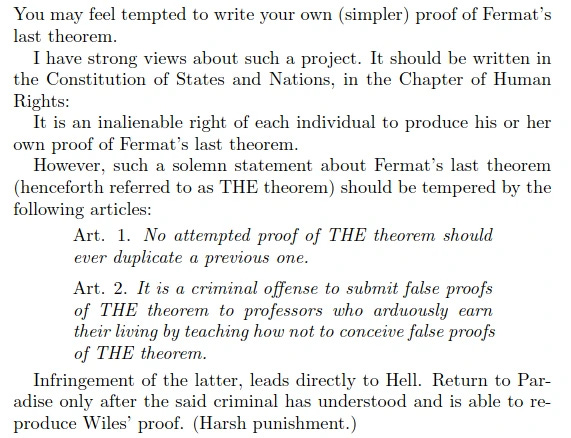
Some mathematicians still have strong views. In Fermat’s Last Theorem for Amateurs, Canadian mathematician Paulo Ribenboim suggests:
Nothing compares to Gödel
With Kurt Gödel’s remarkable theorems though, it’s worse. Far, far worse.
It’s become so bad that mathematician Torkel Franzén—who spent much of his career working on those two theorems—even wrote a book called Gödel’s Theorem: An Incomplete Guide to its Use and Abuse. If you’re really keen (likely a warning sign) you may wish to devour all 182 pages, but there’s a four-page overview on the AMS website for more normal people.
It does a decent job of explaining how everyone who is not a mathematician leaps upon those two ‘incompleteness theorems’, devours them, and then immediately starts spouting incoherent nonsense.
“Thus the [first] incompleteness theorem has been invoked in justification of claims that quantum mechanics, the Bible, the philosophy of Ayn Rand, evolutionary biology, the legal system, and so on, must be incomplete or inconsistent.”
We’ll get to the details below. And, although it may be difficult to see how, things get even worse! First, there’s a host of people who seem desperate to disprove Gödel, and have the rants to prove it. But otherwise seriously smart people have also shown quite convincingly that they just don’t get it: people like physicist Roger Penrose, and of course any number of philosophers.
Glancing through the Web today, I find phrases like “Gödel’s incompleteness theorem … applied to AI”, “Conjoining Jung’s cognitive functions with Gödel’s incompleteness theorem” and “Gödel’s discovery not only applied to mathematics but literally all branches of science, logic and human knowledge”—the author then goes on to rant about God with a capital G. It may be generally unwise to google terms like “Gödel” and “god” together, especially if you have a nut allergy.4
What was Gödel actually on about?
Perhaps we should stick to the opinions of mathematicians in the field? Franzén is keen to help. He phrases the first theorem in English as:
“Every sufficiently strong axiomatic theory is either incomplete or inconsistent”.
As Franzén is at pains to point out, we’re talking about formal mathematical systems. And mathematicians themselves are not ‘floundering in a sea of undecidability’ as a consequence of this theorem.5 For the second theorem, he quotes Ian Stewart:
“Goedel showed that...if anyone finds a proof that arithmetic is consistent, then it isn’t!”
Although this revelation may have messed with Platonic programs like those of Bertrand Russell, it just doesn’t have lots of implications outside of a formal mathematical system. It certainly doesn’t jar with our view of Science,⌘ where all of our ‘truths’ are provisional.
But let’s not stray outside of formal systems, shall we? Or as Franzén puts it:
Many nonmathematicians at once find this fascinating and are ready to apply what they take to be the [first] incompleteness theorem in many different contexts. The task of the expositor becomes, rather, to dampen their spirits by explaining that the theorem doesn’t really apply in these contexts. But as experience shows, even the most determined wet blanket cannot prevent people from appealing to the incompleteness theorem in contexts where its relevance is at best a matter of analogy or metaphor.
Remember that unwise search about “Gödel” and “god” above? Similar cautions apply to his name associated with “biology”, “programming”, “DNA”, “psychology” or (heaven help you) “hypercomputation”.6 Especially if you’re using an AI-driven search engine, which may well lose the plot consummately.
Penrose
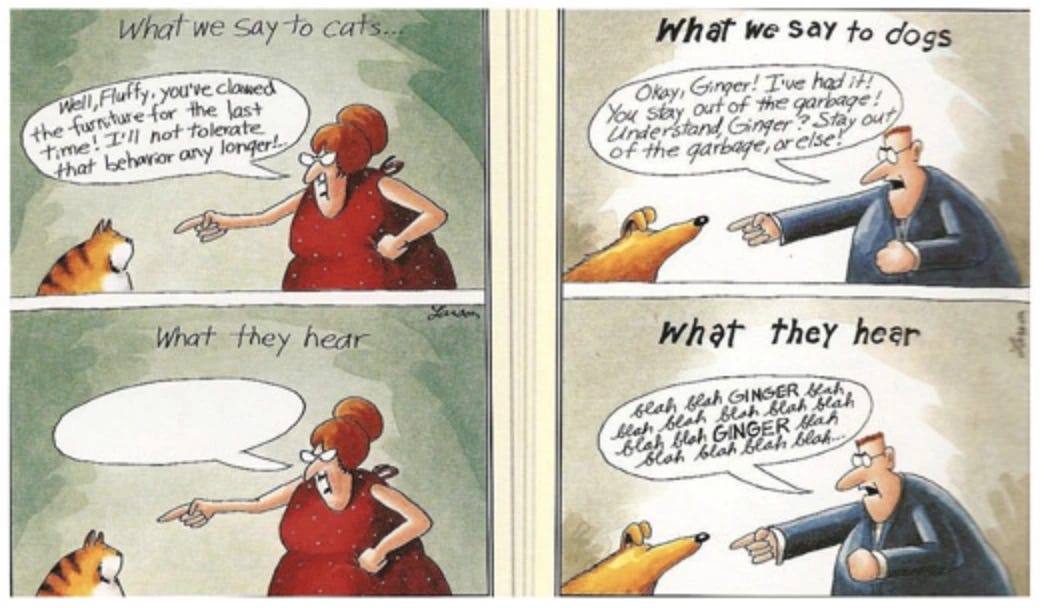
None other than Roger Penrose—top-notch physicist, mathematician—completely loses it. For reasons of ‘Ginger’, it may be unwise to venture near the Wikipedia page on this topic, but here it is anyway.
Yep. Human consciousness with a side order of divine quantum fries ‘cos, well, Gödel. This basic argument seems to reduce to “I’m unreasonable, therefore any conceivable computer can’t think like me, so I’m very special, and full of quantum woo.”
I’ve talked previously about both “I’m special”⌘ arguments and also defective theories of consciousness.⌘ But let’s leave Penrose to the mathematicians. Solomon Feferman spends 10 pages rather graciously picking his maths apart, and then points out that Penrose doesn’t seem to understand how mathematicians do mathematics! Penrose’s starting point is a weird, Platonic view—global notions of ‘truth’ and assumptions about what ‘proof’ means. Drew McDermott from Yale is even more incisive, for example;
[Penrose] very much wants to believe that the existence of artificially intelligent mathematicians would entail the possibility of an all-encompassing axiomatic mathematics (”the very basis of its own unassailable belief system”), but it just wouldn’t.
I found one of McDermott’s 1995 observations particularly relevant to current discussions about AI:
Simple systems can get by with simple simulacra, but the more complex the organism, the broader must its skills be in relating one part of its environment to others, so that at some point it becomes legitimate to talk of the organism’s simulacrum of the world. And at some point the organism must include itself in the model. This is not meant to be a mystical step. A computer taking an inventory of office furniture will include itself in its simulacrum.
The fun idea here is that the very real problems we have with current attempts at ‘AI’ seem to relate to the fact that things like large language models lack this sort of model or ‘simulacrum’. You can’t expect your model to be relevant if your build it wrong.
Here, Penrose is simply attacking a straw man of his own device.

.jpg)
A rule of thumb
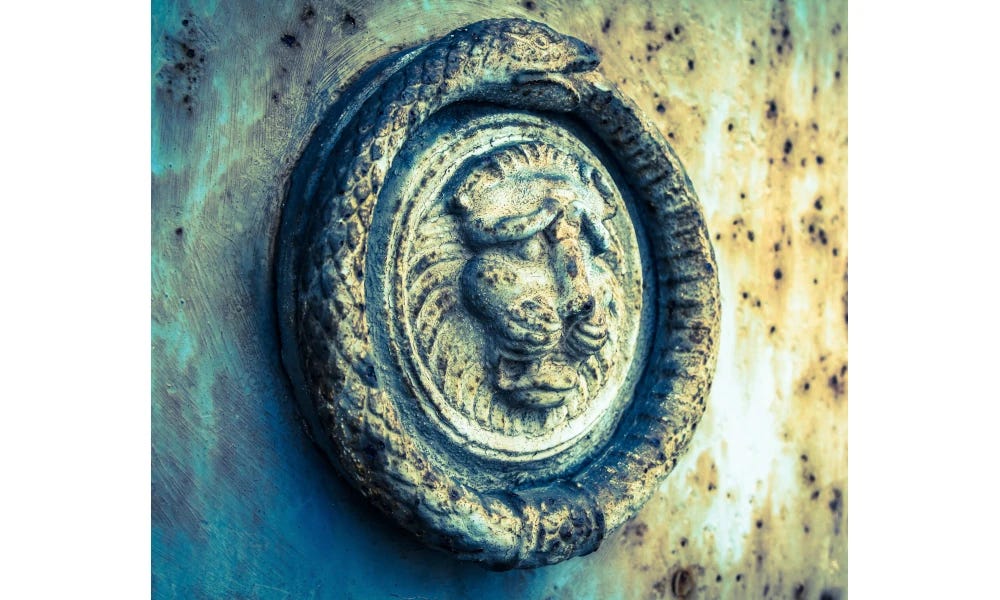
In olden days, there was a belief that the whole World was girdled by a giant serpent, the Ouroboros.7 Blind, autocoprophagic, but in some mystical way, perfect. To this day, some Tarot cards show the last of the major Arcana—the World—as a woman surrounded by a ouroboros. Plato was keen on the ouroboros, whether as a metaphor or maybe even as a real thing.
But we’ve grown up a bit since then. The closest we can come to a reptile swallowing its own tail is the unusual lizard pictured at the start, the Armadillo girdled lizard, which does the ouroboros thing when danger threatens.
We’ve also realised that we don’t need perfection, be it mathematical systems that are entirely consistent, or other tail-swallowing fixations. Which leads us to a useful rule of thumb:
If anybody mentions Gödel’s incompleteness theorem outside of the context of formal mathematical systems, just walk away. You’re allowed to laugh heartily as you do so.
My 2c, Dr Jo.
⌘ This symbol is used to indicate posts where I’ve discussed the flagged topic in more detail.
Note that the above post is a riff on something I wrote on Quora a couple of years ago.
Far better still, Wiles proved the much more important Taniyama-Shimura conjecture (for semistable elliptic curves). Fermat’s theorem is just an interesting aside.
And this package is large enough to contain it.
This is almost certainly an apocryphal story, but the 100,000 mark Wolfskehl Prize did result in an enormous number of submissions. (An amusing aside: When I asked Gemini about this, it persistently hallucinated an entire chapter in Constance Reid’s Hilbert as a source!)
One of Gödel’s odd quirks was trying to prove that God exists using an ontological argument. Always a bit of a conspiracy theorist,* he starved to death in 1978 when his wife fell ill and couldn’t prepare his food, as he suspected everyone else of poisoning it.
*When he moved to the US, Einstein and Oskar Morgenstern sat in on Kurt’s immigration interview, and apparently had their hands full trying to steer him away from ranting about ‘A Defect in the US Constitution’.
If they find a rare something that is undecidable and worth pursuing, they can presumably extend their system appropriately.
The ‘hype’ part is right, at least. Martin Davis has explained in small words why ‘hypercomputation’ is silly.
Jung rather liked it. Jörmungandr, the ‘world serpent’ and middle child of Loki in Norse mythology is a ouroboros too.
I remember trying to read "The Emperor's New Mind" (his first publication on his theory of consciousness being caused by the collapse of quantum wave function ) shortly after it was published. I never finished it because it didn't seem to make sense. I thought it might be because I didn't have enough math to understand it (algebra, analytic geometry, plane geometry, trig, math analysis) but when I looked it at briefly again a few years later, I leaned more towards the idea that it just didn't make any sense. Perhaps I was right!
"Nowadays, one of my favorite pastimes is not interpreting Gödel’s incompleteness theorems. Seriously, I really enjoy it. I could spend hours not interpreting one of the theorems, and on the best days – which, honestly, are most days – I interpret neither the first nor the second."-Alon Amit