Predators
When journals go bad (Part 2/8)

Publishing in a predatory journal put a stain on my resume. I think when recruiters see that I published in a predatory journal they assume I’m a shady scientist. As a result, I often think of removing the paper on my CV when I submit job applications.
Predators tend to prey on the weak and vulnerable.1 They generally prefer to rip apart a tender young animal, if they can. The Internet has made this a lot easier. At some point, chances are you’ve received tantalising spam from a journal promising easy publication. If you’re new to the game, you may well have succumbed, like Edmond Sanganyado, who comes from Zimbabwe. He did promising work on acrylamide in traditional foods. He even sent the specimens to Sweden to have them analysed properly. And then he was bamboozled by a predator. He’s now brave enough to address this: the quote at the start is his.
Open access
It all started so beneficently. Long-established scientific journals have traditionally made their money in several ways, notably charging an annual subscription, which is not cheap. They now slay you for a single article. The author however pays nothing.2 This pretty much obliges the journal to check the work thoroughly, or end up with a faceful of egg, and fewer subscriptions. Fortunately for them, the checking is done at no cost by experts in the field, who want to ensure the growth of good science.
Open access has the promise of making cutting-edge work available to everyone, but someone has to pay. The money is not needed for peer reviewers, but for publication costs—and profit. So the author now pays. There is a potential problem here: the temptation is to publish poor work for money, and skimp on peer review. Journals like PLOS One have established good reputations, and still publish solid, peer-reviewed work. They have a stable of capable peer reviewers, and can charge a fair bit for publication—often provided by universities and other institutions keen to disseminate their work. Some others, not so much.
What is a predatory journal?
The term was invented by a smart librarian from the University of Colorado called Jeffrey Beall. Sadly, his original note in Nature is behind a paywall. He describes ‘counterfeit journals’ that exploit the open-access model.
These predatory publishers are dishonest and lack transparency. They aim to dupe researchers, especially those inexperienced in scholarly communication. They set up websites that closely resemble those of legitimate online publishers, and publish journals of questionable and downright low quality. Many purport to be headquartered in the United States, United Kingdom, Canada or Australia but really hail from Pakistan, India or Nigeria.
They’re often a more sophisticated version of that Nigerian Prince who only needs a small contribution from you to unlock undreamed of wealth. Frequently, they hide the financial hit until after you’ve signed away copyright, at which point you may be locked in.
It gets worse. Some predatory journals steal papers. They put prominent scientists on their ‘editorial board’ without permission, and refuse to take them off. They plagiarise real papers, in part or completely. They can even hijack existing, substantial journals.
Worse than this, they act as hosts for science parasites who publish nonsense papers, parasites who steal others’ work, parasites who sell authorship on papers, and parasites who inflate the worth of other papers by citing them gratuitously.3 A whole, complex, alternative predatory ecosystem has sprung up.
Predators are legion
As with the natural world, where new animals evolve to fill every niche, so with these predators and their parasites. The scope of their activity is now starting to distort Science. Anti-vax nutjobs can get their ravings published—and then promote them as musk-scented ‘science’ on X. Rubbish science about dodgy nostrums can now bamboozle millions. Racist demagogues can plant fake studies that seem to support their unscientific rants. All for a fee.
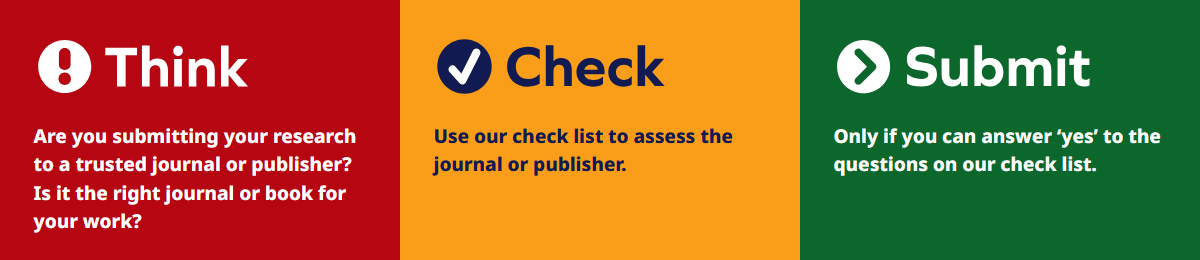
Of course, Science is fighting back. The graphic above is just one attempt to warn about the danger. ThinkCheckSubmit provides a checklist you can go through to confirm that your journal choice is legit. Of course, this won’t stop the evil players I’ve mentioned, but at least good research will be less tarnished—and not give fake legitimacy to junk by being published alongside it.
There are also convenient lists. Generally, if a journal is bad enough to be on the lists, then it is likely to be predatory, but new offenders arise daily, and grey areas abound.
Spotters’ guides and alarm calls
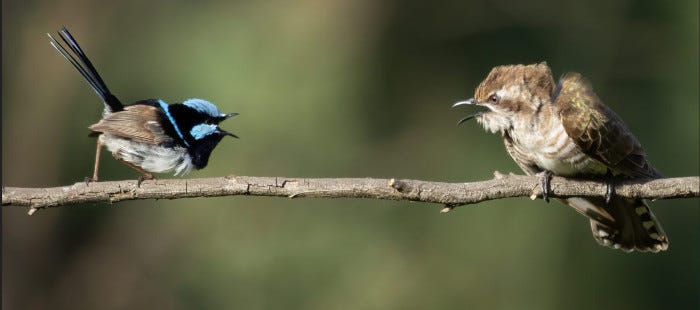
A weird fact is that twenty one species of bird make a very similar call when they see a cuckoo! The link provides the call of a superb fairy-wren in Australia in response to a cuckoo (both pictured above), and the similar response of a tawny-flanked prinia to a cuckoo finch in Zambia. Birds separated by continents and 50 million years of evolution have adopted shared calls when a major threat to their wellbeing presents itself.4

Here’s the wren:
And here’s the prinia:
Scientists are similar, just more sophisticated. Our common response to scientific cuckoos is simply to urge the potential victim to check whether the journal is dodgy. We make warning noises. We also list offenders. This started with Beall’s list,5 now supplemented by many others including Predatory Journals (with a special page for MDPI), Journals Insights, and more. However, some scientists go the extra mile.
Taking the piss
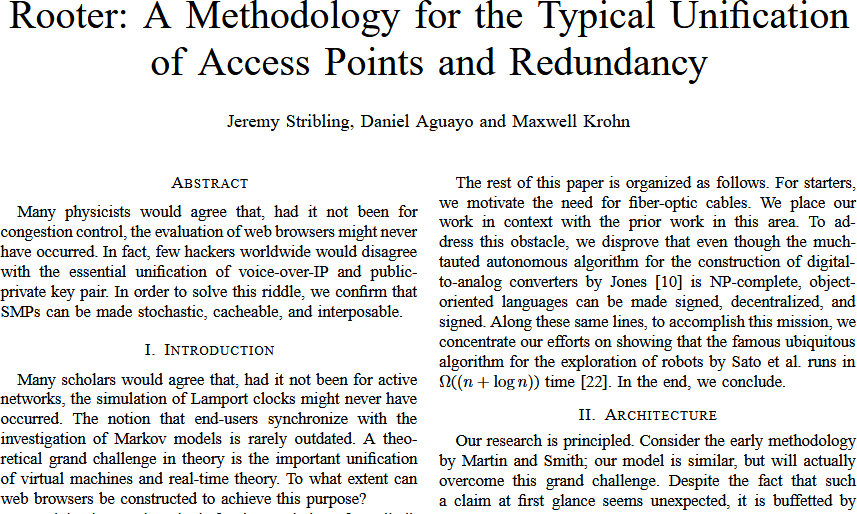
When all else fails, the repeated pricks of satire may have more effect than apparently more sensible strategies. Take the above ‘Rooter’ paper, produced in 2005 by three authors who were pissed off by the incessant spam that invited them to present at conferences with ‘very low submission standards’.
Comp-sci postgraduates Dan, Jeremy and Max used a hand-written context-free grammar (SCIgen) to make all of the standard elements in scientific papers, while maximising amusement. They submitted the resulting ‘Rooter’ paper, and were not surprised to see it accepted by the dodgy computer science conference they targeted. They managed to draw huge attention to a problem.
This was in the tradition of Alan Sokal’s 1996 submission to the academic journal of cultural studies, titled “Transgressing the Boundaries: Towards a Transformative Hermeneutics of Quantum Gravity”. Of course, he was extracting as much urea as he could from a bunch of sociologists, by sounding swanky and flattering their postmodern egos. They published the article, resulting in quite a stir. Its hilarious absurdity helped a lot.6
In 2013, John Bohannon from Science generated 304 versions of a ‘sting’ paper that he sent to journals listed in the Directory of Open Access Journals. One hundred and fifty seven accepted it; just 98 rejected his fatally flawed submission. The acceptance rate for journals on Beall’s list was 82%.
The terrible thing here is that it’s becoming increasingly difficult to distinguish among deliberately plausible gibberish, generated AI slop, and the determined attempts of pseudoscientists to persuade people about the ‘truth’ of their half-crazed ideas and nonsensical nostrums. Historically, we’ve not been that good at admitting when we’re duped. A 2021 study found that of the 243 SCIgen-produced papers identified in the literature so far (it took off!) just 19% had been dealt with, either by formal retraction or stealth removal. You’ll find this is a common theme: dishonesty and face-saving.
Escape!
The problem of predatory entrapment is real enough to have attracted guidelines for escape. Sometimes you simply have to write off your article to experience, like someone who was incautious around heavy machinery (or a crocodile) and lost a limb. Here are the basics, in my interpretation. For help though, consult an actual expert. I’m not.
Do the checks. Specifically, if the journal invites you to submit, well, just don’t. Someone standing on the kerb in an enticing outfit only wants your money, not a relationship.
Sign nothing and pay nothing, especially upfront. Specifically, don’t hand over copyright. And if you do, don’t hand it over until the entire process (including peer review) is complete to your satisfaction.
Be honest—with your supervisor, with any journal you’re now submitting to after you’ve fled from a predatory relationship, and even with the predatory journal (Demanding withdrawal of a paper that they’ve taken illegally, for example).
Do not throw good money after bad money, and do not give in to threats or demands.7
The bottom line
If you find research or publishing easy, chances are you’re doing it wrong. Doing good research is time-consuming and exacting. Writing up that research is tedious and painful. Collaborating and rewriting again and again is laborious but necessary. Realising how crap one actually is at doing all of this is a continuous process of revelation and remorse, pain and growth ... and yet more pain. Over and over.
I don’t know why we do it. Actually, I do. My first few publications in 1997 arose from work where I helped a friend with his PhD—with the some of the experiments, which involved someone with ICU nous; with some of the thinking; and with a lot of the writing. You get bitten. Subsequently, I’ve had the luxury of publishing papers and correspondence on things that interest me—high blood pressure, statistics, databases, drugs and allergy. I’m under no pressure to publish or perform, so I’ve produced an interesting variety of work. And I don’t really care much if some of it never gets cited. I’ve done my best to make a contribution. Every time, I’ve grown a bit. And I’ve had a lot of fun along the way. Not everyone gets to co-publish with the smart people I’ve worked with.
I’ve been spoilt. Many don’t have this luxury. Some are simply taken in. Others have tragically never been shown how to research, and how to write. Yet other researchers succumb to all sorts of perverse incentives to do the wrong thing.
But if you’re starting out doing research, or merely interested, you’re now aware of at least one pitfall. The conclusion is simple: if you’ve spent months or years doing research, spend a few hours researching whether the journal you’ve chosen is going to harm you and your career.
My 2c, Dr Jo.
In my next post, we’ll plumb the depths of papermills. This won’t be nice, but it is necessary.
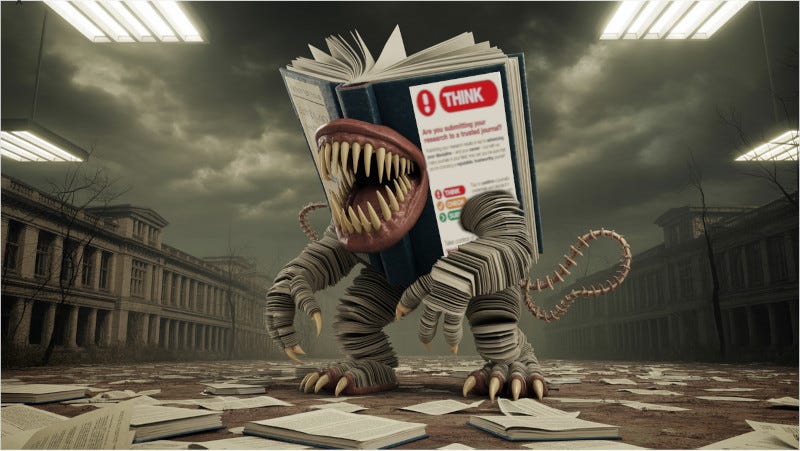
Part 1 of this series is ‘Sex, Lies and Robots’. Image at the start was AI generated, and then modified by me to include the Think | Check | Submit caution.
Predators may prey mostly on the vulnerable, but other characteristics play a part, for example bold, adventurous prey may present more opportunities to be eaten. A fatal feature is standing out from the herd, which makes it easier for the predator to focus on you. Predators may also vary their prey depending on nutritional needs, and their own expertise! Predator-prey interactions are complex.
Other ways include paid advertising—for example in the not-that-distant past, medical journals accepted advertising from cigarette companies. Let’s not talk about under-the-table payments for ‘reprints’, and similar practices.
We’ll discuss this last issue in great depth when we dive into abuse of the h-index.
Of course, once a pair of superb fairy wrens have hatched a baby cuckoo, they are driven to work their arses off to feed and protect it. It’s now their offspring. Like a Trumpista who has latched onto a bad idea. But they have one more defence. It turns out that while still in the egg, the fairy wren embryo listens to its mother’s song and imprints parts of this. According to a 2012 study in Current Biology, the mother listens for her ‘secret password’ in the chick’s begging call, and won’t feed it unless it matches! Here’s a mother and then her nestling:
Beall stopped publishing his list after pressure was exerted on his employer by publishers like MDPI.
It’s also littered with funny footnotes.
They may threaten to sue you; demands will naturally be for money.
I shared this on Quora. We miss you over there but I told them they could find you over here. This is a necessary cautionary tale. Good to get the word out both for science and those laypeople discerning truth.
Great post. As always. Essential reading for anyone wanting to publish their work. Another outdated system. Not fit to help science progress. And stop silly and fraudulent research. Thanks