Papermills and deceit
Modern journals smoulder (Part 3/8)

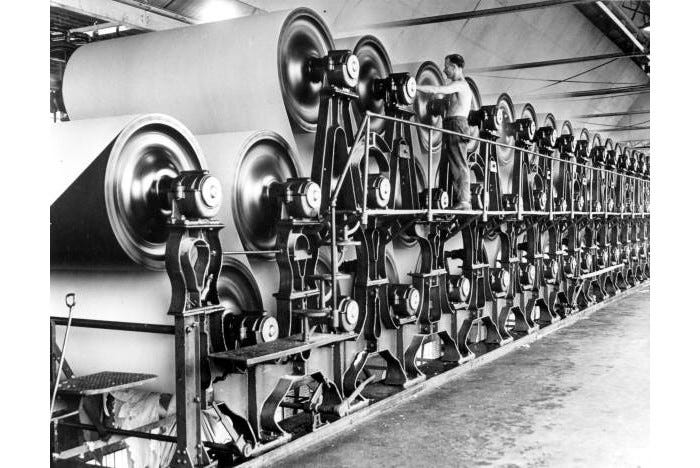

Papermaking filters a dilute suspension of cellulose fibres (wood pulp) through a screen, gets rid of the water, and produces a strong, flat, uniform sheet of paper. Traditionally, papermaking is resource-intensive; a lot of waste is produced. The ‘kraft process’ digests pulpwood to pulp. For every tonne of paper produced, about seven tonnes of black liquor is squeezed out, made up of lignin, soaps, and tall oil, which is in turn made up of rosins (especially abietic acid), fatty acids and other crap. Black liquor used to be dumped, but it is highly alkaline and toxic to wildlife. Almost all of it is now processed in a recovery boiler.
This post is not about papermaking. Papermilling (in our sense) filters a dilute suspension of bullshit, and extracts surprisingly large amounts of money. It may be a billion-dollar industry. The major byproduct is indigestible, toxic literary sludge that pollutes and erodes the scientific literature, ultimately ruining careers.
A growth industry
Papermilling is new, relatively unknown, prevalent and evil. In 2023, the ‘troubled’ open-access publisher Hindawi closed entire journals and retracted over 8000 papers. Wiley, their owner, lost tens of millions of dollars in revenue.
Belatedly, they realised that multiple articles were full of ‘discrepancies’—meaningless and irrelevant content, dubious research and inappropriate citations. Often peer review had been manipulated or otherwise compromised.
Papermills churn out papers: manuscripts for publication in scientific journals. They then make money from the churn, by offering authorship to desperate and would-be academics, most of whom are under pressure to perform. Some effective papermillers get papers placed in high-impact journals, but most go for the soft underbelly. An extra dimension of badness has now come to the fore: citation hacking, a topic I’ll explore in a future post, “Hirsch-hacking”.
Learning from Hindawi
In December 2023, Hindawi produced a whitepaper titled “Tackling Publication Manipulation at Scale: Hindawi’s Journey and Lessons for Academic Publication”. As I write, their ‘Research Integrity Updates’ page is still up, but the whitepaper is lost in the links. Fortunately, copies abound elsewhere.
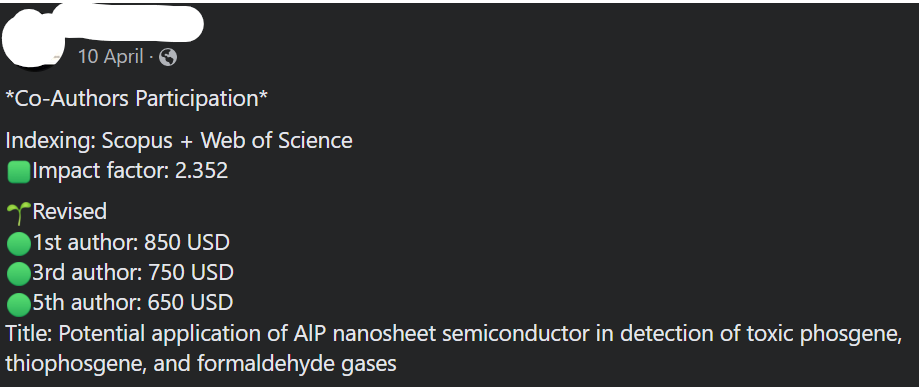
Hindawi relied heavily on Internet sleuths for a lot of the information that led to their radical surgery. Take the Facebook screenshot above. Nick Wise1 shows on PubPeer how flagrant the cheating is—the paper is ‘accepted’ but open for co-authorship, for a price. Data provided by ‘Smut Clyde’, a “self-appointed blackboard monitor of Science”, contributed hugely to Hindawi’s ability to spot the junk science. Actually, there’s a suggestion they weren’t really trying before the kind people at For Better Science pointed out the error of their ways.
The ‘Hindawi experience’ is likely just the tip of the shitberg. The relative opacity of the Hindawi process, their “lessons were learned” phrasing, and the disappearance of the whitepaper from the website does not inspire confidence that ‘learnings’ have been life-changing. Wiley is simply no longer punting the Hindawi brand.
Very Special issues
One thing that should set your spidey senses all-a-tingle is the ‘special issue’. It seems that these are particularly vulnerable to manipulation. In concept, a special issue focuses on a specific topic. For this reason, a ‘guest editor’ is often appointed, someone who has substantial editorial powers. Subvert one of these people, and you almost have carte blanche for the insertion of toxic papers into the issue. As Hindawi notes:
Guest Editors can submit proposals for SIs, help solicit the papers themselves, and oversee and contribute to peer review. Strategies of paper mills include manipulating the identities of Guest Editors, authors, and even reviewers (to appear as genuine researchers) and/or fabricating content...
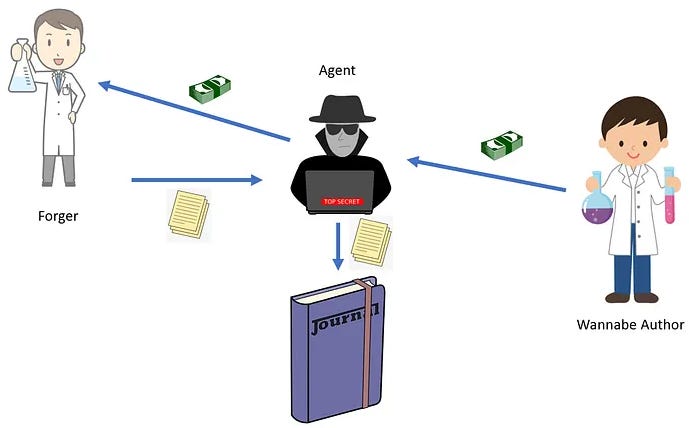
The special issue editor becomes a special friend of the papermill agent (in the above diagram) who sells access to the devious ‘author.’ Genuine research may rub shoulders with and give apparent authenticity to rubbish.
Not all of the milled papers are complete dross either, but the quality is often poor. To mess things up even more, the millers will often use freely available, detailed data like the National Health and Nutrition Examination Survey (NHANES) to put trackers off the scent. The data are valid; the content is vapid.
An important covariate for papermilling seems to be the author’s country of origin, with China, Pakistan, India, Eastern Europe, Russia and several Middle Eastern countries featuring disproportionately. Another feature is sheer volume of published papers from a single author in a given year. A third is the research topic, for example, RNA research seems particularly afflicted.
The Heroes
Some people believe that humans are intrinsically evil. Others cling to the idea that we are born with an enormous capacity for good. I’m inclined to the opinion that humans are basically, well, human. We are social creatures who are shaped, most of the time, by our environment. Then there is a small proportion of psychopathic monsters, and a considerable—but still small—group of altruists and obsessives who will walk over burning coals to do a bit of good.
Included among the last-named are science integrity researchers like Elisabeth Bik, Smut Clyde, Leonid Schneider, Jana Christopher, Jennifer Byrne, and many more. Knowing the stakes, some researchers hide behind pseudonyms like ‘Morty’, ‘Tiger BB8’ and ‘Indigofera Tanganyikensis’, because we are all aware that whistleblowers and critics are never rewarded. People in power may cheer them on if the wind is blowing in the right direction, but a lot of this is just for show. As Jeffrey Beall found in my recent post, honest and justified criticism can threaten your livelihood.2
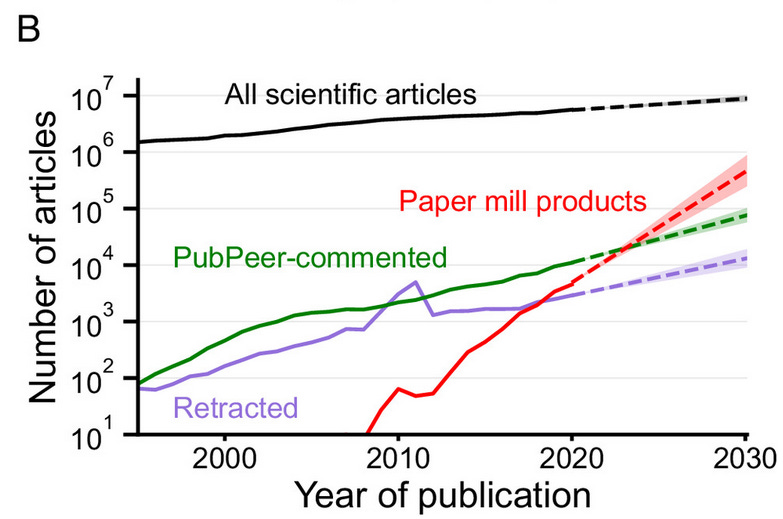
It seems no publisher is immune. Wiley, Elsevier, Taylor & Francis, Springer Nature, PLOS One, Oxford University Press/Karger, the IEEE, the Royal Society of Chemistry and many more are afflicted. The contagion is growing. In 2024, Wiley estimated that 10–13% of submissions to its journals were papermilled. This may not be unusual. Another estimate from the same year suggests 400,000 papermilled articles out there. The graphic at the start of this section is from Fig. 5 of a recent PNAS article, which anticipates papermill products will increase exponentially.3
Some journals and critics have now got together and issued statements like ‘United2Act’, with noble if somewhat milquetoast objectives,4 but I suspect the talented and impassioned hunter will still find lots of papers that slip through the net, especially with the rise of AI. Here’s one …
Top-tier black liquor
Lancet and the New England Journal of Medicine are likely still smarting from the ‘Surgisphere’ scandal, where dodgy COVID-19-related data led to two retractions.5 But on 5 November of this year, it seems the austere British Medical Journal was duped by an Iranian papermill.
The paper is very weird, and difficult to believe. It is alleged that researchers in Iran took Wharton’s jelly from the umbilical cords of newborn babies and injected its stem cells directly into the coronary arteries of 136 patients, with implausible benefits. The BMJ released the article to great fanfare.
As I write, it has numerous comments on PubPeer. This paper looks dodgy as, with patient data that appear to have been synthesised, and defects in basic counting. There are also issues with outcomes, study registration, blinding, provenance of stem cells, and undisclosed financial conflicts of interest. The technique described for the infusion is assessed by an experienced coronary interventionalist as “a recipe for cardiac arrest” (comment #43). Did it even happen?
But most interesting is how the two UK authors were added to the final article (Anthony Mathur and Sheik Dowlut). Yet they are described as participating in every aspect of the trial, including conceptualisation, supervision and patient management. As Leonid Schneider points out, there are other substantial questions about co-authorship. For example the last author on the study (Negar Azarpira) has 30 dodgy papers on PubPeer, with conspicuous image reuse identified by Elisabeth Bik and others. Provenance and proof of work,⌘ chaps. Oops!
Why?
Most of us are cowards. I personally have seen a senior and powerful professor throw a junior doctor under the bus, out of pure cowardice. Avarice is also a potent driver, whether this is greed for influence and power, or greed for money. But many people saunter vaguely downhill because it’s the easier route, favoured by prevailing circumstances.
Journals also try to save face. As I’ve hinted above, some ‘papering over’ may occur. I’m going to watch that BMJ article with interest.
In my next post, I’ll explore why papermilling is so prevalent. It’s all so predictable.
My 2c, Dr Jo.
⌘ This symbol shows a link where I explore the ‘topic of interest’ further.
The previous episode in this series is Predators.
His sleuthing abilities even landed him a job doing what he excels at—hunting evil as a research integrity manager.
There are prolific examples of whistleblowers getting booted in the ribs repeatedly, despite being scrupulously honest and utterly correct. Take Stephen Bolsin, who revealed the unnecessary deaths of children at the Bristol Royal Infirmary, and precipitated reforms that surely saved many lives. He then couldn’t get a job anywhere in the UK, and had to leave for Australia. Exiled to the colonies. As soul-searing is the example of bioethicist Carl Elliott, who concludes “don’t go it alone”. Let’s not even talk about poor Solal Pirelli.
Noting that the Y axis is logarithmic; extrapolation is however always a risky business.
Their 5 principles are (1) education and awareness; (2) To investigate and agree ways to improve communication and corrections; (3) Research; (4) Development of trust markers; and (5) dialogue between stakeholders. They even want to ‘delve deeper’, which suggests AI assistance in writing the document.
Also the origin of the ivermectin nonsense!