Slavery, then & now
Evolving evolution part VI (With spiders)

The vote is in⌘ : slavery it is! We need to do some groundwork first, though.
Let’s start by saying what we mean by eusocial animals. The word is lovely, isn’t it? In Greek, ‘εὖ’ means either good or true, and both seem to fit here. Eusocial: individuals in a society working together for the common good. There is co-operative care of the young, generations overlap and share in some way, and there is division of labour. Gotta be good, right?
Here’s the rub. From our previous investigation, we know two things, and know them damn well. The first is that ‘pure forms’ are a Platonic fallacy;⌘ the second is that game theory is sufficient justification for co-operation⌘ but it also has its pointy bits. We’ll discover that eusocial pretty much inevitably seems to entail a dark side. Every Eu has its Eugh.
But let’s not get ahead of ourselves. This is a fairly chunky post. We’ll talk briefly about social spiders, move on to eusocial insects, and then confront slavery. After revisiting Darwin and his take on how ant slavery started, we’ll get to the nasty bit: modern human slaves. The conclusion may be a mite uncomfortable for almost everyone.
We’ll start gently, with spiders. Spiders that aren’t considered eusocial, merely social. I have some bias here, but for those of you who are arachnophobes, bear with me—things only really start getting nasty when we get to the hymenoptera. And people.
Damn spiders!
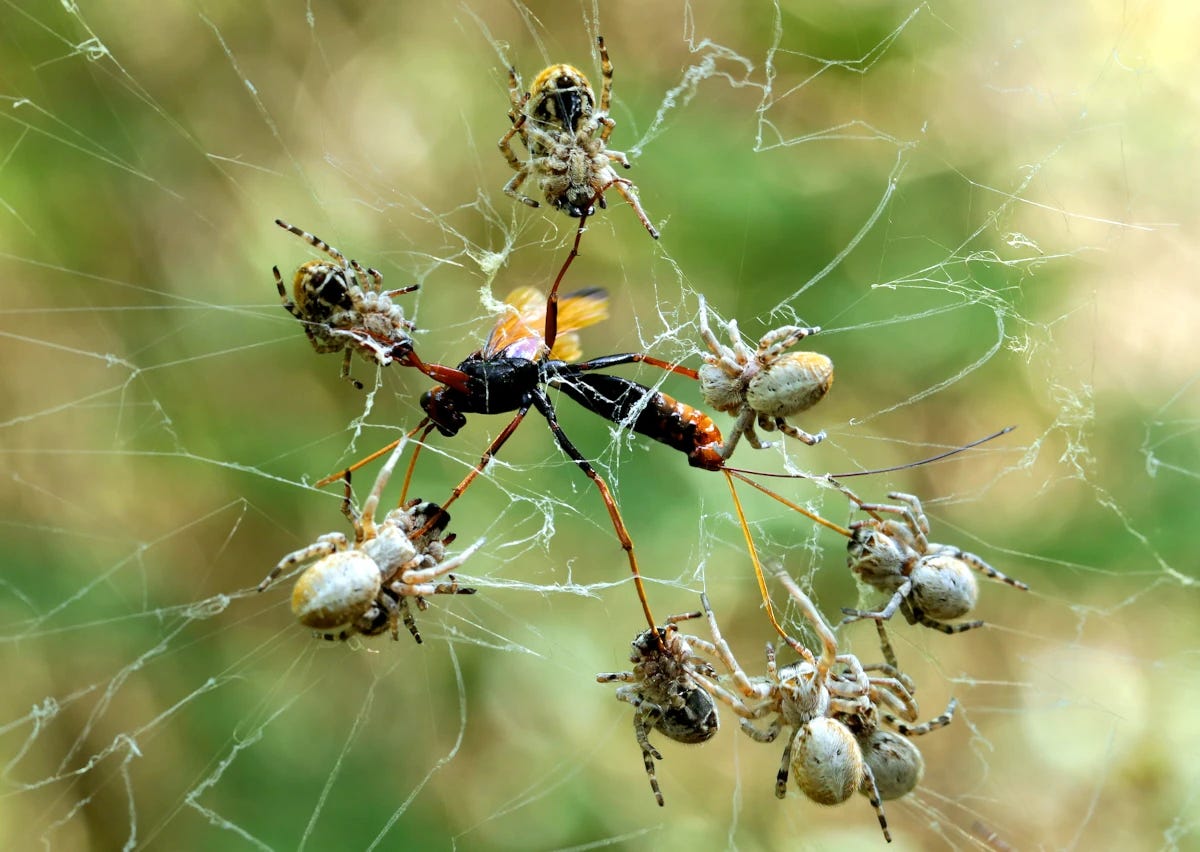
Diligent readers may suspect that I have a slight spider fixation, based on my previous exploration⌘ of the (mostly) vegetarian spider Bagheera kiplingi, as well as that smarter-than-a-lion⌘ hunter, Portia fimbriata, who relentlessly preys on other spiders. Truth be told, as a child I was fascinated by spiders. We had a large garden, and before my parents put their united foot down,1 I perhaps went a bit over the top in infesting populating it with spiders. There were giant orb-webs, but pride of place was given to colonies of Stegodyphus dumicola, the social ‘velvet’ spider. The rose bushes in the rockery had less-than-conventional adornments.
They seemed so counter-intuitive, and therefore so special. The vast majority of spiders are solitary predators, and we’re surely all familiar with the rather fraught stereotype of tiny male spiders courting giant females, and being extremely lucky if they’re not eaten.2 Of over 50,000 spider species, barely more than twenty are social.
Biologists have looked at this in some detail. There are benefits and costs involved in being social, even before we get to the eusocial thing—these spiders don’t have castes or overlapping generations of adults in the colony. Based on research by Marija Majer and her colleagues from Aarhus University, it may all come down to food. If this is abundant, sociality is supported. Remarkably, social behaviour seems to have evolved on about 20 distinct occasions among spiders!
But not without problems. Part of the two-edged sword seems to be genetic diversity: social spiders are often inbred, and with this comes the risks we’d expect: it’s easy for an infection or parasite to wipe out everyone. For the individual spider, there are also fecundity costs. There is neither a benefit of nor a need for prolific production of offspring. Can you see any similarities to people here?3
There seems to be a common opinion among biologists that social spiders are an evolutionary dead end. They point out that notwithstanding the benefits of extended maternal care, social spider species have few sister species, and explain this with the hypothesis that these social spiders evolve often, but also die out often, perhaps due to inbreeding. The genomic consequences of sociality have recently been looked at in some detail by Ma et al (Aarhus, again). Spiders have been around for 300 million years; they find that the social Stegodyphus species only diverged about 1.3 – 1.8 million years ago. Which rather invites a question, doesn’t it?
Eusocial
So why, if spiders are so bad at sociality, have hymenoptera succeeded so well? Not only do they have similar, high female to male ratios (or greater); they also have even fewer females that actually breed. Single queens, in the extreme.
The answer may well lie in two features of ants and bees: haplodiploidy, which we’ve already explored,⌘ and flight: queen bees mate with a variety of drones, on the wing; ants similarly disperse and spread their genes. Molecular clock data tell us that eusociality evolved twice among wasps, both tens of millions of years ago, or more.4
In a recent review, Kocher and Kingwell dig deeply into the genetic basis of this eusociality. They tease out ‘complex’ eusociality, where workers are sterile, there is developmental determination of ‘castes’ that are structurally different, and the entire nest acts as a ‘superorganism’.5
One thing that stands out is how important pheromones are: a host of chemicals that modulate the behaviour of other members of the group. If you’ve been stung by bees, you’ll likely remember the smell of ripe bananas they release—isoamyl acetate, that goads other bees into stinging you too.
Other examples are more subtle. Take gamergates6: worker ants that can reproduce sexually. They compete, form a dominance hierarchy, and those that reach the top alter their pheromone production, become fertile, and mate.7 With all of this in mind, we’re now ready to approach slavery.

Slavery
If you look up Web definitions of ‘slavery’, it is generally defined as “a system in which one person is treated as the property of another.” Additional details are often added: forced work, inability to refuse, legal sanction of slavery. The 1926 Slavery Convention defines it like this:
“Slavery is the status or condition of a person over whom any or all of the powers attaching to the right of ownership are exercised.”
The 1956 supplement adds debt bondage, serfdom, forced marriages, and child exploitation, and more, including details of prohibition of the slave trade, and freeing of slaves. Every nation has signed up. Now let’s try a little thought experiment.
Imagine that you lived in a human society somewhere before the 1800s. Through most of human history, slavery has not only been considered acceptable, but endorsed by the laws of the time. As a member of such a society, what would you …
I’ll leave this poll open forever. The results should be interesting—if we’re all honest.
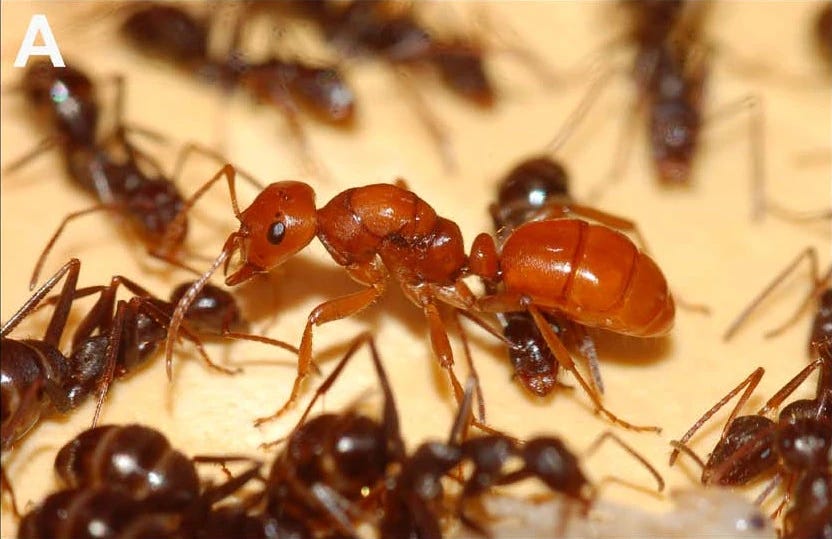
It is clear that none of this touches on the oldest slave-makers of all: ants. I find it sad that modern biologists, seem to eschew the word ‘slavery’. Instead they talk of ‘dulosis’. And what, pray, is ‘dulosis’? The Greek word for slave is δοῦλος, you see. Slavery. It seems to me that we have more common ground with ants than we’d care to admit. Darwin is more honest:
“This ant is absolutely dependent on its slaves ; without their aid, the species would certainly become extinct in a single year. The males and fertile females do no work. The workers or sterile females, though most energetic and courageous in capturing slaves, do no other work. They are incapable of making their own nests, or of feeding their own larvæ.
He’s talking about Polyergus rufescens, an obligatory social parasite. As usual, Darwin’s focus is on trying to refute natural selection: how might such slavery possibly have come about? As usual, his answer is “in small steps”, starting with perhaps a tendency to carry off the young i.e. the ‘brood’, a hypothesis that in hindsight may well be wrong.8
We now know a bit more than Darwin did. It appears that slave-making has evolved independently on at least ten different occasions. The sociobiologists in particular—however we might feel about sociobiology—have made great play of the social nest as a superorganism, and why shouldn’t a superorganism have ‘super parasites’? Social parasites like slaver ants fit the bill rather well.
Patrizia D’Ettorre and Jürgen Heinze explore this capably. We can distinguish certain patterns. For example, the slaver queen will generally invade a mature colony, confuse its occupants with pheromones, kill the queen and take her place; her slaver offspring will be cared for by the slaves, and those same offspring will raid adjacent nests for new slaves, stealing the brood.
But how does this slavery come about? Some ant colonies may invade colonies of their own species, and pillage the brood. Superficially, it seems more likely that slavers branched off from a species with several queens, and several nest sites9; indeed, the genetic evidence shows that slaves and slavers are often closely related. This would also explain why their mutual pheromones may ‘just work’. As we have worker specialisation among ants, why not have superorganism specialisation? But not all of the evidence is consistent.
There are some macabre details. After she has killed the queen, it is common for the invading social parasite queen to hold the body tightly for several minutes, to acquire the right smell. Dufour’s gland also plays a part—the Polyergus queen rubs the corpse with its secretions, dissuading workers from approaching their dead queen. Other species use ‘propaganda pheromones’ to confuse host workers, even inducing them to fight one another. Eventually, the social parasite queen ends up smelling like the slave workers. Have you had enough of this? I have—let’s get back to people.
The present day
All countries of the world have now officially abolished slavery. But effective slavery is widespread, as highlighted by Kevin Bales in Disposable People. Just as biologists prefer to use euphemisms like ‘dulosis’, so we see other labels attached to those around the world who are held against their own will in brothels, on fishing boats, and in prisons. They are often disadvantaged people: poor, poorly educated, migrants, or victims of sophisticated deceit. Many of these slaves live in South Asia and Africa; but others are in countries that regard themselves as ‘more civilised’.
When you ask the right questions, things rapidly become uncomfortable. I’d suggest these:
Is the person being paid adequately? Financial capture is a powerful slavery.
Are they confined, either absolutely, or in a very constrained way?
Are they free to choose basic actions such as whom they consort with, whether they work or not, and simple things like choice of food?
As with eusocial insects, social stratification seems important if we’re to have slavery. Let’s look at prisons. In many European countries, which have a rehabilitative model, prisoners are paid and also have the opportunity to do educational activities. In New Zealand payment is tiered, but the rates haven’t changed for decades, resulting in accusations that this is ‘practically slave labour’. The US is fragmented, but in Texas, Georgia, Alabama, Arkansas and South Carolina, inmates are not paid anything for much or all of the work they do.
Let’s look in more detail at the US then. It has one of the highest per-capita prison populations in the world, and the two million people in prison are paid a pittance or not at all. Black Americans are disproportionately represented. Slavery is alive and well in the United States of America, long after the 13th amendment!
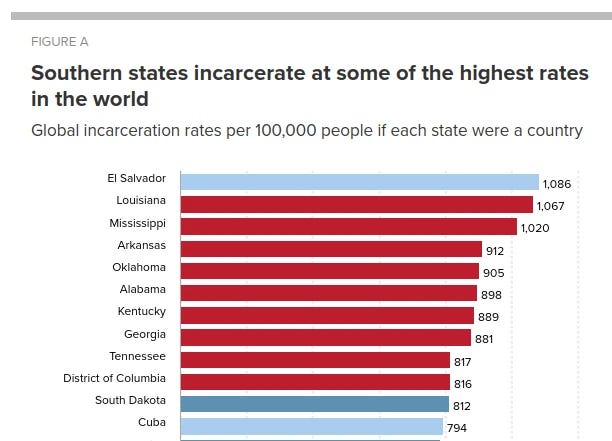
Around the world, there are tens of millions of people who are effectively slaves. Some likely in a gaol near you. This invites another survey. You are a slave—at any time in the course of history. Even now. Do you …
This too is open forever. Again: be realistic and honest here. Nobody is watching you[10 ].
The future
My exploration above invites some challenging questions, doesn’t it? Here are a few more: “Are humans a dead end, like social spiders?” ; “Is our human tendency towards slave taking wired in?” and “Why do we passively allow millions of people to be enslaved—actually and effectively—today?”
I have a few suggestions for answers. Although humans are not that genetically diverse compared to many other species, we’re not like social spiders. We still tend to spread our genes enthusiastically; we also have the future potential for corrective DNA surgery, which might be used for good, ill or both. We don’t have to be a dead end, although we seem to be trying so hard at present.11
Our rapidly changing social mechanisms may also transcend the generally slow march of natural selection. Even if we have a propensity for slavery, we have shown in the past century that we can start to overcome it through international consensus, however frayed this may have recently become.
I cannot answer the question of apathy though. Why we allow stratification to creep in; why we regard other humans as ‘inferior’ based on distinctions that are nonsense—for example, the unsupportable myth of ‘different races’. I believe that we can overcome parochialism and better the quality of our global village; I’m just struggling to see improvements recently.
Looking to the far future, I do sometimes wonder whether our current, ultra-wealthy ‘social parasites’ will isolate themselves from other humans so effectively, that they will eventually speciate into obligate slave-takers. Remember the gamergates from above—workers that start off equal, but out-compete the rest of their nestmates, and then assume dominance, so that their offspring are favoured. What happens when this sort of behaviour is entrenched in a society for ages,12 and enhanced using technology?
Perhaps you have some ideas, and some better questions than mine? ⇶ My next post will deal, as Darwin does, with hybridism.
My 2c, Dr Jo.
⌘ This symbol is used to indicate posts where I’ve discussed the flagged topic in more detail
A friend of theirs blundered into the web of one of my Nephila fenestrata females, and complained bitterly. Thank you, Mr Thorpe. If there’s reincarnation, you are surely back as a moth. Repeatedly.
Putting aside the image of that very briefly lucky drone from the previous post,⌘ who gets to have daughters and ultimately grandsons, but at the slight cost of having his genitals ripped off and left inside the queen, once mating is done. Nature is so kind.
Under half of the females reproduce; all females regurgitate food to feed the spiderlings. There’s also the slight individual cost that the spiderlings ultimately eat their mother and her friends, referred to as “suicidal offspring provisioning”. Nature is so kind.
Eusociality evolved just once among ants, about 100 million years ago, and did so multiple times among bees.
In some ways, our social spiders fit their definition of ‘simple’ eusociality, including co-operative brood care at the sharp end, and non-reproducing females. I must say that, despite Kocher & Kingwell’s detailed exploration of the genetic pathways that seem to change in these eusocial insects—unsurprisingly related to nutrition, hormones and fecundity—I felt that the big picture somehow gets lost.
Nope, we’re not talking about the misogynistic online right-wing harassment campaign that happened in 2014, spreading on 4chan.
A key here may be the production of queen-specific cuticular hydrocarbons, or CHCs. There are other signals too, for example, in the internationally invasive South American red imported fire ant Solenopsis invicta, hunger triggers workers to make a specific vibrational signal (a stridulation) that results in them cannibalising most of the virgin queens. Let them eat brioche!
The “slave raids” of slaver ants are disturbingly similar to those of human slave raiders. There are also facultative slave-makers, that have the ability to fend for themselves, but are not above capturing a few slaves for the housework.
Respectively, ‘polygyny’ and ‘polydomy’.
Apart from Palantir. And if they don’t already know what you’re thinking, they’re entirely happy to impute your pre-crime using an LLM.
Ironically, those who strive most for ‘racial purity’ are often most diverse. To name but one example, Afrikaans speakers from South Africa are some of the most genetically diverse people in the world—yet half of them settled on Apartheid. As my father used to say about our ancestors, there were two Van Schalkwyks who came over on the ship with Van Riebeeck in 1652: one was gay, and the other married a Malay wife. (Malays were brought to the Cape by the Dutch, as slaves. Some of the earliest Afrikaans texts were written in Arabic!)
Is this how slave-taking species actually arise?
I doubt that it is possible for anyone to say how they would respond to either of the poll questions if they had actually been born and raised in a slavery-oriented society. And even if the questions are about how people would respond if parachuted into the body of someone in such a society while retaining their current knowledge and attitudes, then I would expect the answers to depend quite strongly on various detailed aspects of the target societies.
I think evolution has effectively ended for Homo sapiens.
Almost anyone who can survive a few hours after birth can live to breeding age.
This means there is no longer any selection pressure. Except perhaps teen-aged boys with fast cars, although simply having that car with a back seat may accelerate their gene propagation.
I've done some genealogy. Before modern medicine, 20% to 30% of children died before age five.
Not that I want children to die! But what does that say about the future of our species?
Meanwhile, Elon Musk has fourteen children. So he is evolutionarily "successful", while I, who decided there were too many people and got "the v" before having any children, is unsuccessful.