Aluminium Rain
Midweek madness: Musk’s “AI in space”

Soo. When not huffing the ketamine, or perhaps immediately after huffing the ketamine, Elon’s vision for AI and the Earth is over 100 GW of “AI compute per year”, in space.1 One possible motivation for joining up SpaceX and xAI. Let’s break this down. We’ll be generous.
Musk’s hot vision
The big thing here is cooling. The only way you can cool a chip in space is through radiation. The International Space Station (ISS) runs on about 100 kW, the equivalent of about 80 average US houses, or about one current AI data rack. Musk wants about one million times that, or about 1 million satellites each with the radiative capacity of the ISS.
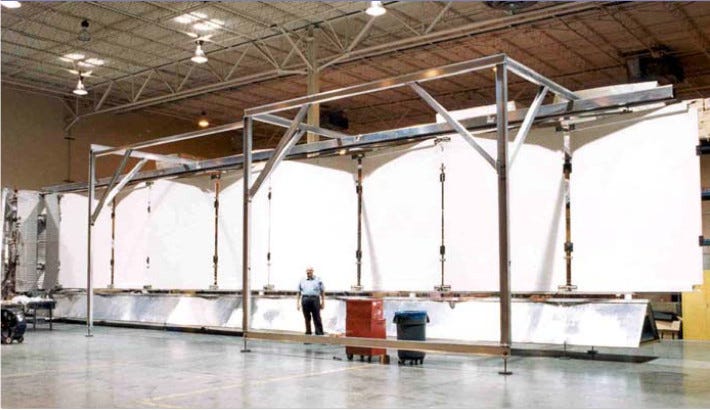
The ISS has a radiative area of about 1200 m2 or a bit more (mainly the External Active Thermal Control System). That’s about 10 m2 per kW. For a million satellites with similar capacity, that’s about half a billion square metres (double sided).
The aluminium-and-ammonia panels on the ISS weigh in at about 10 kg/m2, so just the cooling would require 12 tonnes of satellite.2 Don’t talk about folding a thousand square metres of ‘wing’ into a one tonne satellite that can still squeeze into Starship with a lot of others.
But we’ll be very generous. Say Elon comes up with superb cooling and magnificent origami-like folding. And/or he runs those AI chips really hot to cut down the radiative area. Just maybe. For now, let’s give him the benefit of the doubt.3
SpaceX currently has about 9,600 satellites in orbit. Musk wants to increase this one hundredfold. The v2 Mini (Standard) weighs about 800 kg, and apparently he want each of those million satellites to weigh about a tonne. But how much will this cost?
Some numbers
The current cost per kg of getting something into low-Earth orbit is a bit north of $1000, which gives us an upper limit of a trillion dollars just to get those million radiation-hardened AI satellites launched. Of course, there are economies of scale, and we are told Musk wants to decrease this by a factor of 100. For now, let’s give him the benefit of the doubt—at least, to a reasonable degree. Let’s assume that he manages a factor of 10. That gives us a launch cost of a mere 100 billion for those million satellites.
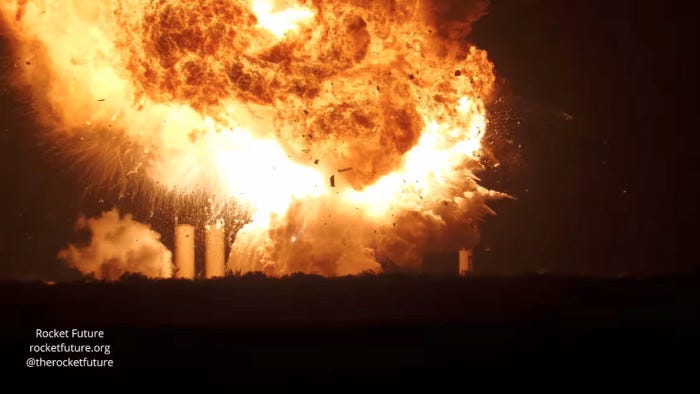
How many Starship launches would this require? The current greatest payload might be 35 metric tonnes.4 That’s about 29,000 launches over the three year window Musk is talking about, or about one launch per hour, every hour for those 3 years! Of course, if he increases the payload to the claimed 100 tonnes, which they seem to be struggling with, that means a launch every 3 hours. Day and night. For now, let’s give him the benefit of the doubt.
The carbon footprint of a single SpaceX Starship with a 35 tonne payload is very conservatively about 3000 metric tonnes of CO2.5 So that’s ~100 tonnes of CO2 per tonne payload, or at least 100 million tonnes of CO2 for those million satellites. About the annual carbon emissions of the Netherlands.
Burning coal, that 100 GW of power over a year would cost about 800 million tonnes of CO2. Using nuclear power, you could obliterate most this cost. In contrast, if you used solar on the ground, the savings aren’t as big.6
What do you get for your buck?
So what do we get? Something that is far worse than nuclear, and similar to ground-based solar. But with a lot of extra risk, and a huge number of unknowns—for example, Musk ironing out the kinks that have made his rockets tend to vibrate and fall to bits with higher payloads, and the potential for the entire lot to be buggered and need replacing if a large solar storm hits. And a lot of superb, new cooling tech. And full reuse of his rockets. But, let’s give him the benefit of the doubt, here.
What do we really get, though? Musk’s AI is fundamentally still just large language models. And there are ten not-so-tiny issues with these LLMs:
LLMs were seen as a general solution to ‘artificial general AI’ (AGI). This has generally failed. Even if you believe that AGI even makes sense.⌘
Because LLMs work by filling in the gaps within known patterns, you can’t blame them for ‘hallucinating’ (confabulating⌘). That’s the only way they know to think. It just so happens that a fair bit of the time, their ‘hallucinations’ match your perception of reality.
Scaling is failing. It’s pretty much failed, actually. LLMs have an exponential need for training data about rare concepts. This is unavailable. All the information on the ‘Net is insufficient, so they’ve hit a wall.⌘
Transformer-based technology can overtrain. And when you do this, two things happen. It learns to regurgitate entire images, and entire texts. And its thought patterns become less flexible.⌘
LLMs are really very bad at flexible reasoning, and generalise poorly. Because they form broad, weighted associations, you’d expect them to be great at this, but the sheer wealth of associations seems to prevent them from seeing the wood for the trees.
LLMs simply have no internal model of the world. Subsequent advances will depend on makers of LLMs quietly introducing ‘model-based thinking’, behind the scenes. This is hard.
LLMs don’t understand causal reasoning.⌘ They can’t.7
LLMs don’t understand counterfactuals⌘ — “What if?” scenarios. They can’t.
They have built in bias, and because they don’t get how good Science works,⌘ they have no way of eliminating it.
Attempted fixes like RAGs, ‘chain of thought’ and so on have inflated the computational time and power costs but can’t do the job.⌘
So all of this eye-watering expense and poorly quantified risk, for really stupid association machines. In space. Devices that are great at autocorrect, stereotyped translations, composition of boilerplate text/code, data regurgitation, and generating summaries that are immensely plausible but also incredibly good at covering over their own internal errors and ‘hallucinations’.
But let’s give Elon the benefit of the doubt here. Let’s assume that we do really come up with ‘Artificial General Intelligence’ in the next few years, just as he gets his ‘AI in space’ going. What are the possible scenarios here?
We’ve already explored this.⌘ Putting aside the killbot nonsense,⌘ one reasonable scenario is that our billionaire tech bro overlords simply consolidate their position,⌘ with mass unemployment. Everyone else loses. The converse—that rich bastards like Musk, Page, Brin, Bezos, Zuckerberg, Ellison, Arnault, Huang, Ballmer and so on get together and usher in a new age of reason, where everyone has a universal basic income and our new-found AI friends dream up new solutions to humanity’s problems—seems a teensy bit fanciful, doesn’t it?
There’s one other little issue.
One more thing
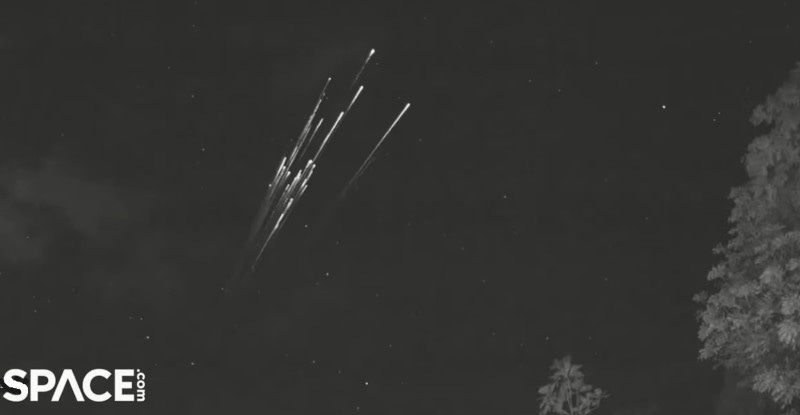
We talked above about ‘retiring’ those satellites. If, as seems reasonable according to current practice, we junk those chips after 3 years, we need to retire and replace 300,000 satellites every year. Thirty-four every hour.
Where do they go? They burn up on re-entry. That’s at least 300,000 annual tonnes of vaporised aluminium, combined with gold, silver, exotic rare earths, and a pinch of silicon.
The natural influx of space dust is about 12,000 tonnes of meteoroids. We’re not entirely sure what cranking that up twenty-fold and converting it to aluminium microparticles will do to the ozone layer, or the atmosphere more generally.
But we can do some numbers. A 2024 article in Geophysical Research Letters points out that a single, typical 250 kg satellite produces about 30 kg of aluminium oxide nanoparticles, that stick around in the atmosphere for decades. With Musk’s vision, we might crank this up to 30,000 tonnes of the stuff per year—accumulating progressively. That paper worries about 360 tonnes causing significant ozone depletion.8
At some point, we need to stop giving our tech bros the benefit of the doubt.
Call me a cynic, but fucking up the atmosphere to make tech bros even more dominant over everyone else seems a bit of a silly move, to me. And that’s perhaps the best case scenario.
Just sayin’.
My 2c, Dr Jo.
⌘ This symbol is used to indicate posts where I’ve discussed the flagged topic in more detail.
In between frequent toilet breaks. Long term ketamine in high doses tends to ulcerate your bladder lining, due to the interstitial cystitis.
Each radiator ORU measures 23.3 meters by 3.4 meters and weighs 1,122.64 kilograms.
Using 370 m2 of roll-out solar arrays, solestial claim 508g/m2 = 188 kg. If he runs his chips hot at 100C, he might cut the radiative area to ~ 200 m2 double sided carbon composite radiators, perhaps as little as 440 kg. There are a few other issues, like micrometeorites, chip life, temperature swings, and radiation damage to chips. A big solar flare can age every single chip by about 3 years in a single day, killing a lot of them. Mitigation may be possible, for example by shielding the chips and re-orienting the satellites before the flare strikes. That shielding adds weight, of course.
Although the greatest demonstrated payload was just 16 tonnes, on flight test 10.
About 3 kg of CO2 per kg of the thousand tonnes of methane used. But some have put the impact of the high-altitude release of the CO2 at twenty times this number. This is not counting the 5 failures of the 11 launches up till October 2025.
The lifetime CO2 emissions from solar alone are about 20 times less than coal, but for continuous operation, you need lots of batteries, that have a carbon cost that works out similar to the ‘solar in space’.
They can mimic it, on occasion.
Other effects appear to be substantial heating of the stratosphere in high latitudes, and a decrease in the polar vortex.
No evidence of ‘genius’ on display in Elon’s fantasy. Plenty of grandiosity, sloppy speculation and attention seeking. The only tangible idea in Elon’s thought vomit is that he wants his stuff outside (above) International Law. If this nonsense was produced by a random teenager it would induce only laughter.
Lowering the expectation to 10 satellites per "rack equivalent" makes it more feasible. The lifetime could be 6 or 9 years, which is often more typical for data centre kit - got to sweat those assets, and the expensive part is getting them up there.
If you think more along the lines of an augmented Starlink that stays up a bit longer makes more sense. The "data centre in space" bit and the use of "million" sounds like marketing hype.
It would give him traffic analysis capability that makes NSA look like amateurs, while lowering the cost of Skynet oops I mean Starlink to a point where traditional Fibre ISPs can't compete.
Even if it's nuts.