Done with Darwin?
Evolution part X—an Entangled Bank

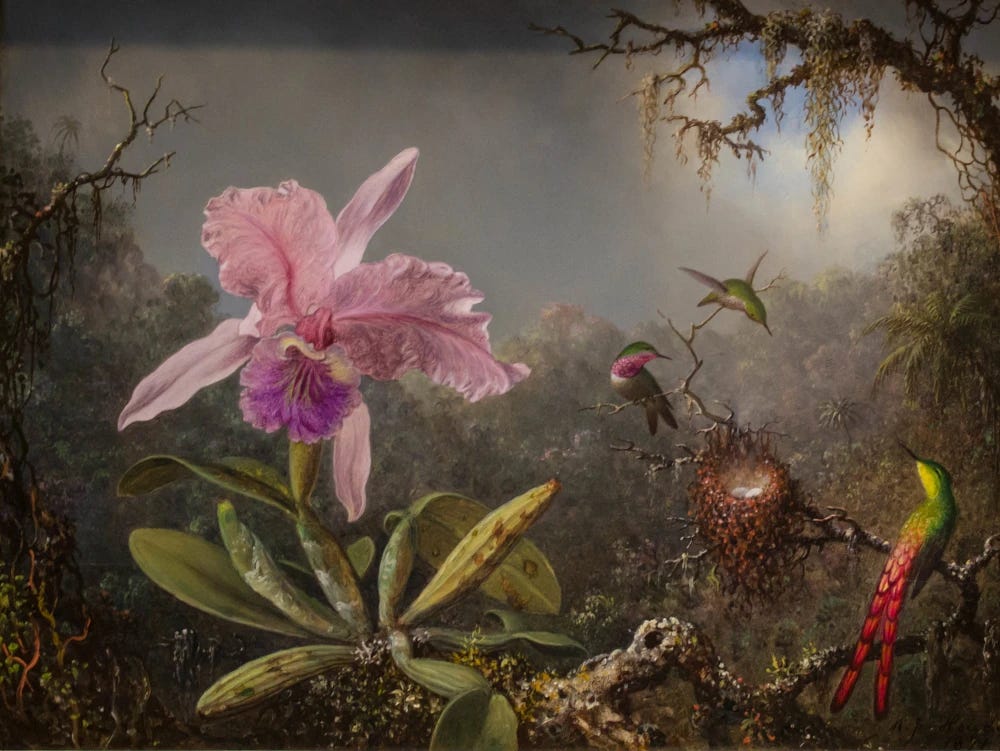
“It is interesting to contemplate an entangled bank, clothed with many plants of many kinds, with birds singing on the bushes, with various insects flitting about, and with worms crawling through the damp earth, and to reflect that these elaborately constructed forms, so different from each other, and dependent on each other in so complex a manner, have all been produced by laws acting around us.” — Charles Darwin, On the Origin of Species by Means of Natural Selection.
A common trope today is “Evolution has moved on since Darwin”, often combined with comments about how religious fundamentalists are still beating up on him. This is wrong in two ways. First, Darwin’s religious opponents seem almost never to have read him; I’ve yet to encounter one who has read through On the Origin of Species cover-to-cover, let alone ‘got’ it. My conviction is that were they to do that, they would toss out both fundamentalism and religion in one stroke. Most attacks on Darwin attack ideas that never existed.
But over the past nine posts, something more subtle and more worrying should be apparent. Obviously we’ve moved on since 1859—we have nucleic acids, chromosomes, the mathematics of heredity, meiosis, Mendel, continental drift, radioactivity, molecular clocks and more—but we still need to be careful, lest we are too superficial and miss some profound insights that Darwin spelled out. In part V, when we looked at scurvy,⌘ we saw how important details are. It’s easy to nod and pretend. Without deep understanding, we are repeatedly led astray.
Let’s take stock
In my first post on evolution, I started by asking questions about the complexity of nature.⌘ We looked at receptors, and found that traditional models of these molecular switches are ‘Lies to Children’.⌘ A more sophisticated approach led us to the patterns we see when we compare receptors across multiple species, and into the concept of natural selection.⌘ Which, we found, is not a theory but a process that predictably occurs where we make imperfect copies of, well, pretty much anything, and then preferentially select those that work a little better in context. I then noted how DNA works, with a practical, visible, measurable example of natural selection. We discovered molecular clocks and convergent evolution⌘ too.
Enter our friend,⌘ Charles Darwin, with ideas about species. We contrasted Darwin’s solid, scientific approach of agonising and self-questioning, with the ebullient pseudoscience of Jared Diamond. We discovered that species are pretty much a convenient fiction.
Next, I introduced the idea that in the formation of new species, it’s not even necessary for them to be spatially separated—although this obviously is a potent agency, as Darwin explores in Chapters XI and XII of his book.1 Nature will find gaps and exploit them—even herbivorous green spiders.⌘
Then, we dug into the details. Bees⌘ introduced us to how powerfully natural selection shapes behaviour. We explored eusociality and the darkness of dulosis,⌘ along the way discovering that one third of our (poll-answering) readers would have kept slaves in a past age, and that slavery is still common around the world, today.
We moved to hybrids,⌘ re-examining ‘species’. For millions of years after they ‘diverge’, species indulge in introgression—swapping DNA prolifically. Then, on to sex in all its biological variety.⌘
We discovered fish (like Nemo and Marlin) that are true hermaphrodites, starting out male and becoming female2 as they ascend the social hierarchy; after a brief review of mitosis and meiosis, we were sequentially astonished by archaea, and then cladistics,⌘ and finally by all the enthusiasm of sex⌘: polychaete sex, the default of isogamy, organisms with thousands of sexes,⌘ and finally, how Nature is like Nanny Ogg, and uhh, tri-sexual⌘—she’ll try anything once, and some things thousands of times. Especially with frogs.⌘
Finally, parasites, where she really lets rip.⌘ Parasites reveal how natural selection is able to explore unimaginably complex variations. And here we are.
Skipping over …
There is however a lot more to On the Origin of Species. I gave several of Darwin’s initial chapters short shrift. At the start, he points out how pervasive variation is. If humans can take tiny variants and selectively breed them over geologically very small intervals, how much more can natural selection do something similar, randomly, over vast periods of time? He also describes the (Malthusian) geometric increase in populations and the consequent winnowing that pulls out even tiny features that confer better survival. His fabulous, single illustration (the tree of life) is in Chapter IV.
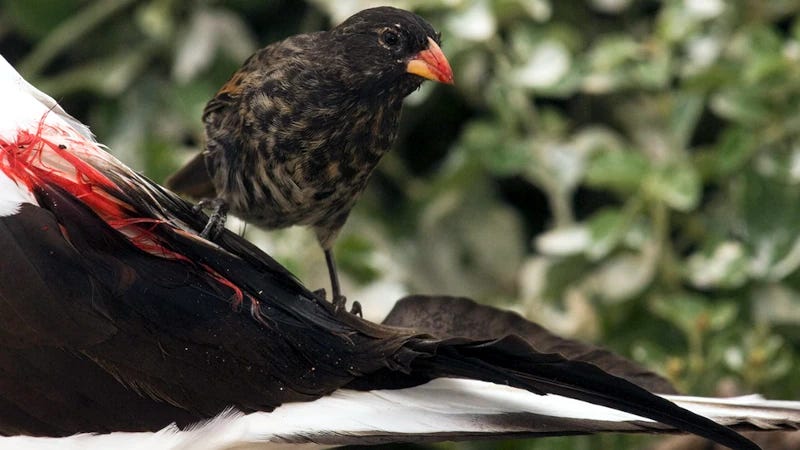
I would imagine that pretty much everyone is aware of Darwin’s finches, which Darwin collected on the second voyage of the Beagle, when he visited the Galápagos Islands. Initially he paid little attention to them; but subsequent, more careful examination may have tipped him into wondering about how stable species are. Particularly impressive is how their beaks have become adapted to different diets; but some have acquired peculiar habits too. Take the vampire finch pictured above.3 On the Origin does mention island habitats and their potential for speciation, but strangely enough doesn’t single out finches.
I also haven’t touched on Chapter IX, On the Imperfection of the Geological Record—which in Darwin’s day was a big thing for several reasons; but we’ve already seen why intermediate forms will be uncommon: they are marginal, and pushed out by a prolific variant that is simply better in that environment. A bigger issue for Darwin in the subsequent decades was the age of the Earth: was there enough time?4 Darwin summarises his chapter neatly as follows:
For my part, following out Lyell’s metaphor, I look at the natural geological record, as a history of the world imperfectly kept, and written in a changing dialect ; of this history we possess the last volume alone, relating only to two or three countries.
Chuffed
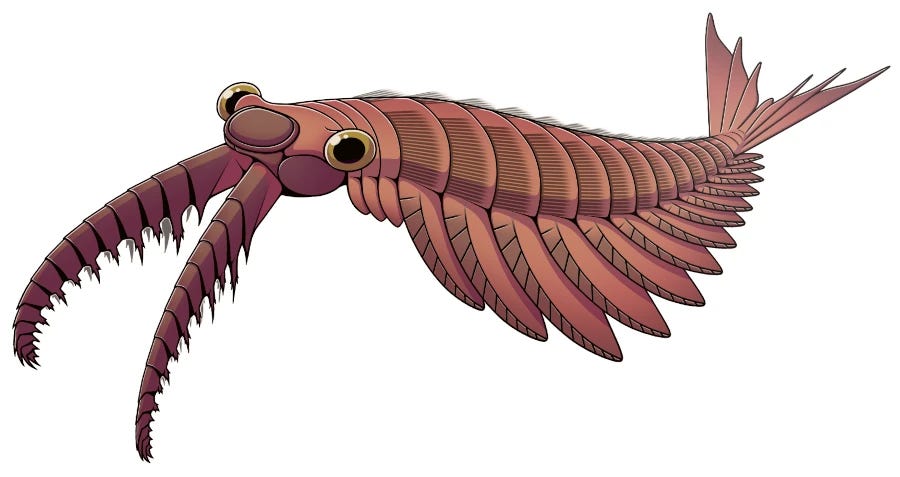
I think Darwin would be ecstatic today. He didn’t know, for example, of the Burgess Shale that has almost perfectly preserved soft parts of strange animals from half a billion years ago. Steven Jay Gould rhapsodises about Cambrian fossils like large predator Anomalocaris in his book Wonderful Life, where he suggests that long-term success of a species is often pretty much random. If we replayed history, would our current fauna still succeed and all of the bizarre forms in the Burgess Shale still fail?5 The shale was only discovered in 1909, and only correctly interpreted in the 1960s.
Stromatolites—layered microbial mats dating back two billion years or more—would also have been a wonderful revelation for Darwin, let alone microbially induced sedimentary structures from 3.48 billion years ago, and isotopic evidence of even earlier life.


Extinction
We also discovered that Darwin was far from perfect. He was almost preternaturally perceptive in working things out before we even understood chromosomes and genes, mutation and meiosis—but to understand dramatic changes like the three whole genome duplication events⌘ we need chromosomes and modern genetics.
In his Chapter X, Darwin talks of extinction; here too, Darwin is a ‘gradualist’—but we must remember that although Georges Cuvier came up with the idea of ‘catastrophism’ in 1796, it was only in the 1960s that modern ideas of massive extinction events started taking off, consolidated by Raup and Sepkoski in 1982. Here, Darwin was just plain wrong.⌘
We can now even estimate the size of major ecological shake-ups, the greatest in the last half a billion years being not extinction but explosive radiation of new life—the Great Ordovician Biodiversification Event (GOBE). The big extinctions are the Permian-Triassic (252 Ma), Cretaceous-Paleogene (66 Ma), Late Devonian (372 Ma), Triassic-Jurassic (201 Ma), and the Late Ordovician mass extinction (445 Ma) as a prelude to GOBE. And, of course, the great extinction event we’re now inflicting on the planet.
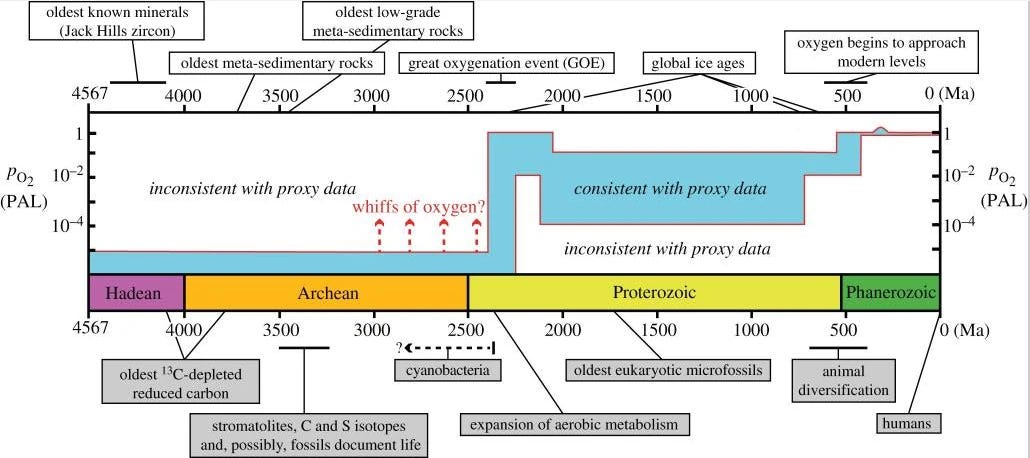
These may all have been far tinier than the Great Oxidation Event that occurred about 2.46 billion years ago, when cyanobacteria ran rampant, churning out oxygen and massacring everything that needed reducing substances like ferrous iron, methane, H2S and pure sulphur. Most life forms just died.
For reasons of space, I’m not going to delve into his Chapter XIII, where he focuses on embryology and morphology, yet talks about ‘propinquity of descent’ in a way reminiscent of modern cladistics. In future posts, we may find that the ‘modern synthesis’ also neglected embryology at its own peril.
Entangled
It seems we’re nearly done with Darwin. In Chapter XIV he recapitulates, as I have just done. There are however a few things left to learn. Important things. Our first lesson from Darwin that many people still don’t seem to ‘get’, is this:
The concept of ‘species’ is a Lie to Children!
Species are little more than convenient bookmarks in the evolutionary tree, which itself is more a sort of web, with frequent introgression.
But there’s an even bigger misapprehension that is prevalent. We mentioned JBS Haldane,⌘ who is prepared to give up his life for “two brothers or eight cousins.” This seems mathematically smart, but is biologically dumb. Haldane is fundamentally concerned with ‘dog eat dog’; Darwin goes to great lengths to emphasise how ecology and indeed natural selection is concerned with a web of interactions.
The organism is not simply competing with other organisms on a gene-by-gene basis; they are locating a space for their entire family, within the vast space of possible options. If you want to think of the maths of how wrong Haldane is, consider whether he will lay down his life for a cousin, knowing that he himself will have no more children; or why human women undergo menopause; or how short sighted it is not to sacrifice yourself for the group if you are among the last remaining humans at some bottleneck in human history. This isn’t an exhaustive list.
There’s a third place Darwin did better. In the 1960s, the Modern Synthesis emphasised that if we are to obtain new species, we pretty much need spatial separation. It seems this is wrong, and Darwin was right once more.⌘
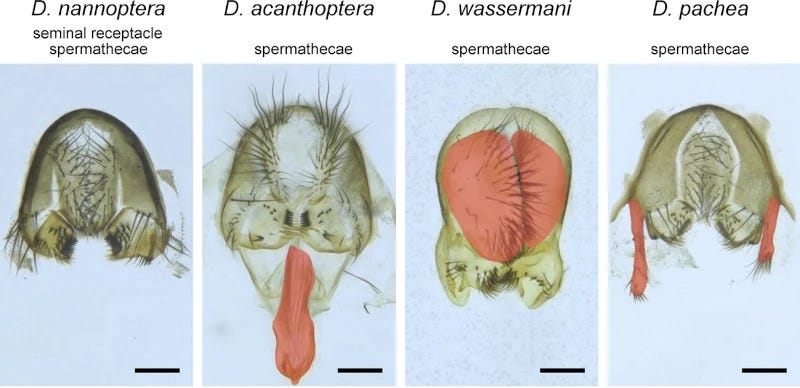
Small changes in habits or form can also be as potent as spatial changes. All it may take is different foraging behaviour, say moving from dusk to daytime: butterflies arose as day-flying moths. If your genitals bend asymmetrically, you may end up starting a new species, as we see with the Drosophila nannoptera species group.6
Ending in context
It seems to me that a lot of ‘modern’ evolutionary biologists became so fixated on building blocks like genes, that they missed the bigger picture! The Entangled Bank. Everyone understands that organisms are “so different from each other” but have we emphasised the second part of that phrase: “and dependent on each other in so complex a manner”?
This concern is underlined by that obnoxious term—absent from Darwin’s first edition. Yep, ‘survival of the fittest’. Never have four words been so misunderstood. To this day, arrogant fools misinterpret this as meaning they or other organisms are somehow inherently superior! They cannot see that from an evolutionary point of view, ‘fitness’ is always contextual. Fitness depends on the entangled bank. Show me a right-wing politician, and I’ll show you someone who doesn’t understand this.
We also still have a lot of questions to answer. How does the mathematics of evolution pan out? There are all those terms still unresolved from Part I: ‘neutrally evolving’, ‘inferred haplotypes’, ‘balancing selection’, ‘Hardy-Weinberg equilibrium’. What questions have modern evolutionary biologists answered well, and what questions are still outstanding? What about Lamarckism versus epigenetics? Where and how did that first, common ancestor of all life arise, and what did it look like? What about LECA, the last eukaryotic common ancestor⌘? And much more. In future posts, I’ll try to explore these sometimes tricky topics. My very next post will take on the ‘Modern’ Synthesis. But for now, let’s leave the last word to Darwin:
There is grandeur in this view of life, with its several powers, having been originally breathed into a few forms or into one ; and that, whilst this planet has gone cycling on according to the fixed law of gravity, from so simple a beginning endless forms most beautiful and most wonderful have been, and are being, evolved.
My 2c, Dr Jo.
⌘ This symbol is used to indicate posts where I’ve discussed the flagged topic in more detail
He was puzzled by many aberrant findings, several of which are now nicely explained by continental drift.
That is, protandrous sequential hermaphrodites.
It seems that this finch initially had a commensal relationship with seabirds, cleaning them of parasites, but has now gone all parasitic, pecking them and drinking their blood, especially in dry conditions.
This was before the discovery of radioactivity, so a lot of smart people got it profoundly wrong.
As difficult a question, I suspect, as “Why did the 1989 Pulitzer jury unanimously recommend the book for the prize, only to be overruled by the Pulitzer board?” We’ve also subsequently worked out that at least some of these strange organisms* did leave descendants that thrived.
*The Cambrian fauna, not the Pulitzer board.
Or perhaps asymmetric mating behaviour came first and the genitals followed?
I'll second and third other respondents in offering thanks for this wonderfully detailed and truly monumental explanation of something we probably thought we understood from our secondary education...as if! So, given your pledge of a follow-up, are you thinking of including something speculative on Cuvier's catastrophism, which seems to be staring us in the face via human-made warming/climate change? I just saw yesterday that temperatures at Argentina’s Esperanza base, situated in Hope Bay at the tip of the Antarctic Peninsula, reached a record 59.7 degrees Fahrenheit (15.4 degrees Celsius) on June 6, in what's the dead of winter there...!!
My dear late friend always suggested that Spencer should have said "survival of the most fitted" because it's less likely to be misunderstood.