This is Not a Hip
(And this post isn't about hips)

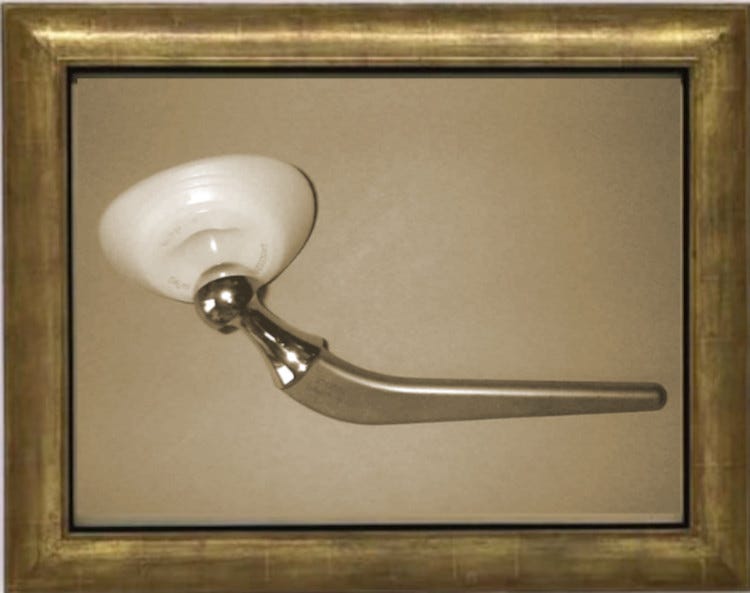
The Charnley hip replacement revolutionised orthopaedic medicine. Bone grating on bone is sore. If the cartilage lining your hip wears away, you’re in trouble—often, you’re in incessant pain.
For years, surgeons tried to mimic the ‘normal anatomy’ of the hip with their prosthetic replacements. After much agonising, Charnley came up with not one but three fixes. Together, they worked.
He cemented the stem of the hip prosthesis (on the right of the picture) within the femur (thigh bone).
He discovered that ultra-high molecular weight polyethylene was just the thing for the socket.1
He made the head of the prosthesis smaller—contrary to ‘Nature’.
This last is the key. Every time the patient rises from sitting, the femoral head applies a frictional torque (like turning a wrench) to the cup in which it sits. The smaller you make the radius of the head, the lower the torque! The width of a normal femoral head is about 44 mm. Charnley cut this down to 22.2 mm.2
Charnley’s “breaking of the rules” was crucial to getting things right. A genius move. Let’s draw from this. We’ll see how Nature finds solutions, their constraints, and how we’ve already found some cheats. Then we’ll lament current AI limitations, explain why AIs get stuck with ‘world models’, and suggest there are simple solutions just waiting to be found. Some ‘natural’, some not. Be prepared for some tricky stuff!

Nature and the panda’s thumb
It’s often extraordinarily difficult to duplicate Nature. She’s sometimes had tens or even hundreds of millions of years to iron out the bugs. But her solutions are locally optimal. There are also one-way streets.
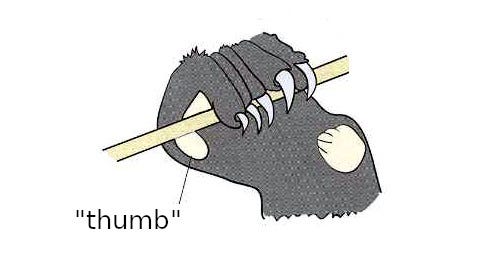
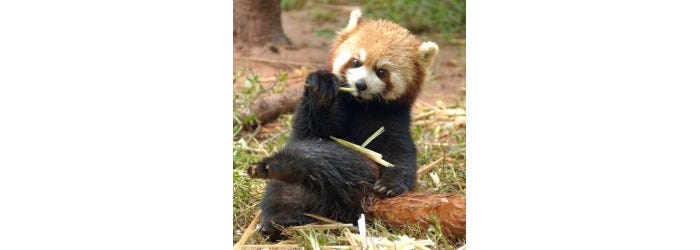
Like other bears, the ancestors of the giant panda had five similar fingers. The panda effectively has a sixth. The extra ‘thumb’ is a modified radial sesamoid bone, which has enlarged so that the panda can manipulate bamboo, its main food. The red panda (‘Firefox’) also has the same ‘thumb’ arrangement, despite being descended from a raccoon-like ancestor.
Why didn’t ‘evolution just de-differentiate a finger back into a thumb’? No go! There are no useful, intermediate back-steps. The radial sesamoid was there, and simply met the need: over time, pandas with a bigger radial sesamoid gained an advantage. Easy.
Constraints
Nature is fickle, and sometimes we need to flout her rules. For example, brains can do Bayesian well⌘ because this has practical value for predicting what to do next when moving. But often, our brains set us up to fail,⌘ due to otherwise useful biases or plain unfamiliarity.
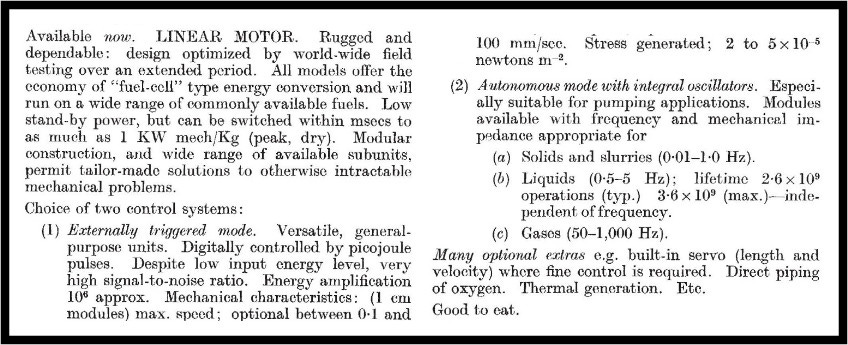
Good to eat
That’s a 1969 advertisement in Nature by Professor DR Wilkie. You’d still be hard-put to engineer it. It’s muscle. Amazingly versatile, but had we not engineered other solutions to some of our needs, we might still be stuck with horses for transport, and buckets for moving fluid. Wheels and engines are ‘unnatural’. In the future though, who knows whether digitally controlled artificial muscle will be the thing for many applications?3 Context and timing is all.
Where is all this going?
Now let’s talk AI. At present we’re hung up on artificial neural nets, specifically ‘transformers’.⌘ Analogous to how neurones work in brains. Have we taken the wrong lesson? Sure, they’re superficially quite flash, but scaling is now failing,⌘ and they’re greedy for computing power, energy, and even water.
Once set up, large language models can’t integrate a single new fact⌘ without expensive re-programming that costs millions. Or even billions. And they continue to make really stupid mistakes because they have no ‘world model’—as Gary Marcus has been pointing out for yonks, and Yann LeCun has belatedly affirmed.
Bots are crippled trying to perceive things in 3D, and navigating the real world. I’m not going to ‘fix’ this in one post. But here are some ideas. Let’s start with the fovea centralis. It’s there at the bottom of the picture below. Within a 5 mm yellow spot (‘macula lutea’) at the back of the eye.
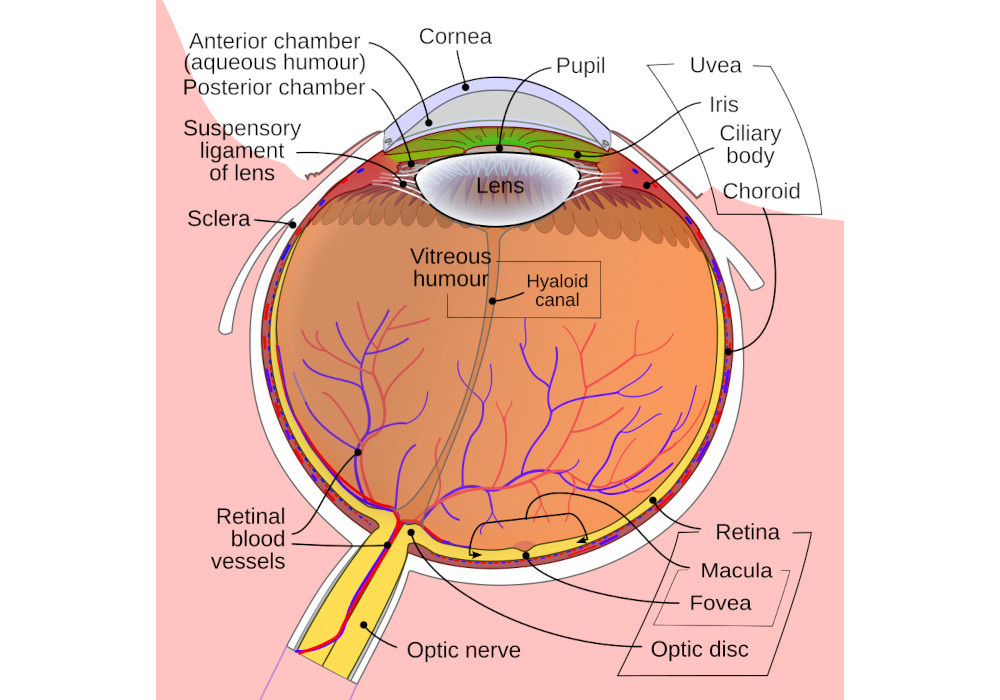
Computer vision—less is more
Modern cameras can now make 400 million pixel images. Technically the eye is said to have a “resolution of 576 megapixels”, but that’s a fib. One of those “lies to children”⌘ we know all too well.
In a single glance you get maybe 10 megapixels. We see in high resolution thanks to that central fovea—our peripheral vision is blurry. We get the extra information by moving our eyes, looking for what’s important.
There’s the trick! Right there. If we wastefully had a gazillion cones everywhere, we’d need far more bandwidth and processing power than we have. And then we’d throw away almost all of the information.
In contrast, all 100 million pixels in a fancy camera have the same ‘validity’. Recognising something then demands vast bandwidth, more discards — and AI vision is still rather sucky. Why?
Underdetermination
In an utterly brilliant article, William H Warren explains why computer vision so often fails. AI researchers may have got the wrong message.
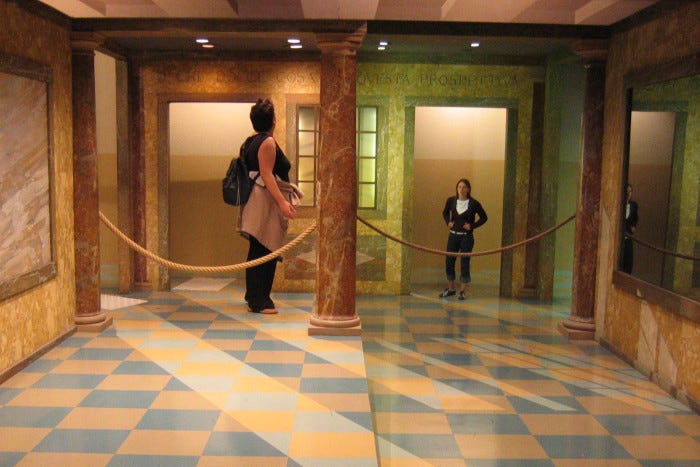
In the above picture of an Ames room, two similar sized adults look grossly different. This distorted but ‘normal-looking’ room nicely illustrates underdetermination: projecting 3D onto a flat image gives a ‘wealth’ of possible arrangements. More a ‘confusion’ actually. You don’t have enough information to choose one model.
Seeing someone walking around the Ames room, you’ll quickly get the trick.4 There are often ways to break the deadlock—and if things seem ‘underdetermined’ in real life but nevertheless work, there’s a reason. We just missed it.
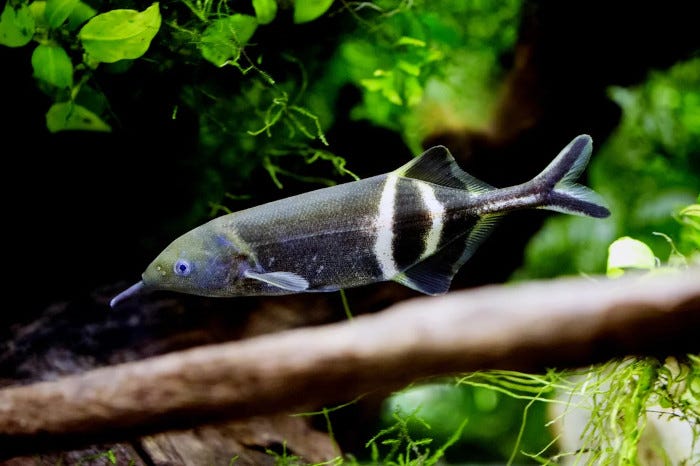
A lovely example is the elephantnose fish Gnathonemus petersii. This huge-brained fish lurks in dank African swamps, where it uses the electric fields it generates to sense its environment. But—like the Ames room—a small object close by will resemble a much larger object further away.
There’s a natural solution: the object being sensed casts an electric field ‘shadow’ on the flank of the fish, and its blurriness (slope of the gradient of the edges of this shadow) breaks the underdetermination. The fish can ‘see’ its normal environment with its skin.5
Teach your bot, then
How does this sort of thing help us with vision? Warren describes pioneering work back in the 1950s by James Gibson on ‘optic flow’, how the pattern of flow of information into the moving eye changes. Take a goshawk flying through woodland at breakneck speed. It conspicuously fails to crash into trees, but how? The moving bird samples the data stream and uses heuristics (‘rules of thumb’) to prevent a crash. Such processes are quick, efficient and don’t even need that much information!
Clearly, a high-resolution camera ‘eye’ may even be part of the problem here. There are ways around ‘intractably underdetermined problems’ if we look for them.
And more generally still
... a fish need not know the laws of hydrodynamics in order to swim, its body and perceptual-motor loops merely need to be tuned to the properties of water. If one persists in calling such tunings “knowledge” and their activation “inference”, one persists in being metaphorical—and so does one’s theory.
An animal body is inseparable from its environment. We have brains precisely because they are needed for movement.⌘ We have been shaped by our context. Which brings me to my main point.
If we want to give our bots efficient 3D world views, we need to get them out there in the 3D world, finding ‘tricks’ that real-world interaction provides.
What have we done instead? We’ve bunged a ton of high-res images into stereotyped, processor intensive algorithms and hoped for the best. And guess what? Yep, our creations have no clue about the shape of the real world, or manoeuvring through it. Their views are underdetermined, robbed of context and unfixable. This seems almost cruel.
Heuristics
Not all solutions are just there for the taking. For example, if you try to brute-force the travelling salesman problem you bump into O(n!) complexity.⌘ Optimal exact algorithms are likely O(2n), but a bunch of heuristic methods rapidly come within 1% of an optimal solution for millions of cities; some are O(n2) or better. Here we’re trading solution quality for tractable computation.
A provocative article is ‘Homo heuristicus’ by Gerd Gigerenzer & Henry Brighton. They point out that sometimes, a heuristic is just better than garnering yet more data and doing yet more computation. A well-known, practical example is catching a ball that’s high in the air: fixate on the ball, run, and adjust your speed so that your gaze angle is constant. It just works. Comparable computation is insanely complex. Here’s another: in buying n shares on the stock market, simply allocate 1/n part of your funds to each share. This routinely out-performs complex weighting.
We’ve also seen how a simple tit-for-tat out-performs other strategies in the iterated prisoner’s dilemma!⌘ Sometimes, depending on the environment, you can obtain better results with far less computation.
So what?
There is a horde of simple heuristics “out there” to be discovered. They will out-perform many fancy computational strategies, in context.⌘ Given they way we’re flinging trillions at the illusion of Artificial General Intelligence,⌘ this is going to hurt. A lot.
Future AIs will look back at how easily they found new heuristics that are orders of magnitude better than our current one-size-fits-all approach, and wonder.
Or am I wrong?
My 2c, Dr Jo.
⌘ This is is a complex post. Follow the flagged links for explanations!
His initial attempts used Teflon. These fell to pieces and the microplastics caused local tissue inflammation. With Charnley in the depths of despair, two things happened. One of his patients reassured him, saying “Don’t worry, Dr Charnley, just the few months of pain relief I had made it all worthwhile”, and his research assistant serendipitously discovered UHMWPE.
This does increase the risk of dislocation a bit, however. There’s always a trade-off. New bearing surfaces that weren’t available to Charnley now allow large heads.
Robot muscles? Sewerage pipes like giant colons?
Consult the Wikipedia page for just such a video. And did you notice the ropes?
It seems as though AI vision is expected to perceive a whole scene in one go and identify the important things in it. I remember when I first saw scanners that could "read" text from an image and copy it into a document that could be edited, and thought "Wow!". And of course ANPR cameras do the same thing with speeding cars. And I thought at the time that, just as our visual cortex has nerve cells that trigger when they see specific things, that actually building a whole series of little systems together would be the most sensible way to build AI. All those logon systems where we are asked to "identify all pictures with bicycles" - OK, but we aren't asked to actually point out the bicycles in the pictures. So how is the AI expected to learn which set of pixels is a representation of a bike? I can imagine some process identifying two circles side-by-side... but ah-ha! they are not circles but ovals! And the one on the left is bigger than the one on the right! This could be a bike, and it may be converging with my route...
I don't think you're wrong (or blind). I love AI's deep learning, but I'm looking forward to Artificial General Intelligence, which I'm guessing, will mimic how the brain infers by "considering" every input it has available. The brain is fascinating, and still not completely understood.